
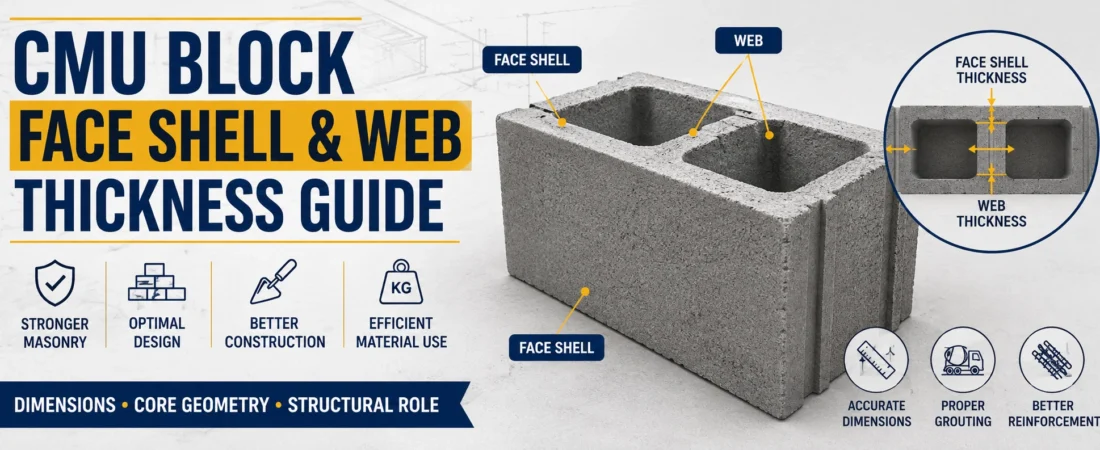
Concrete masonry units (CMU) are manufactured with a specific internal geometry that allows them to provide strength while reducing unnecessary material and weight. If you look inside a typical hollow concrete block, you will find face shells, webs, and hollow cores that work together to form the block.
Understanding CMU face shell and web thickness is important when evaluating block dimensions, structural performance, reinforcement, grouting, anchoring, and overall masonry wall construction.
The face shells form the main outer surfaces of the block, while the webs connect the two sides and separate the hollow cores. Their dimensions and configuration can vary depending on the CMU type, size, weight classification, and intended application.
In this guide, we will explain what CMU face shells and webs are, how their thickness affects the block, the difference between face shell and web thickness, hollow core dimensions, structural considerations, and common mistakes to avoid.
What Is a CMU Face Shell?
The face shell is the outer portion of a hollow concrete masonry unit that forms the visible front and back surfaces of the block.
A typical hollow CMU has two main face shells:
- Front face shell
- Back face shell
These face shells surround the hollow cores and provide a significant portion of the block’s cross-sectional area.
The face shell is important because it:
- Forms the exterior surface
- Provides part of the load-bearing area
- Protects the interior cores
- Provides the surface for mortar joints
- Contributes to wall thickness
- Helps transfer loads through the masonry assembly
The exact face shell dimensions depend on the specific CMU design.
What Is a CMU Web?
A CMU web is the internal concrete section that connects the two face shells.
The web runs across the block between the front and back portions and separates the hollow cores.
The web helps:
- Connect the face shells
- Maintain block geometry
- Transfer loads
- Provide internal stability
- Separate hollow cells
- Support handling and manufacturing
The number and configuration of webs can vary depending on the block design.
CMU Face Shell vs Web
The easiest way to understand the difference is:
Face shell = outer concrete portion
Web = internal concrete connection between the face shells
A simplified hollow CMU cross-section looks like this:
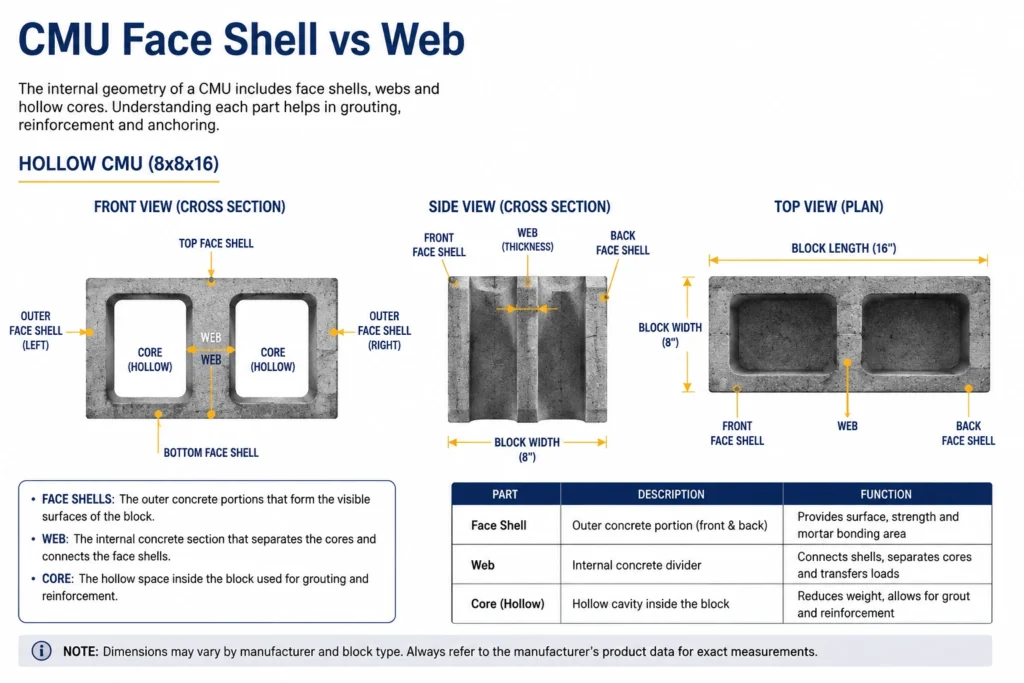
The exact geometry is different for different CMU products, but the basic concept remains the same.
Why Face Shell Thickness Matters
Face shell thickness affects the physical characteristics of the CMU and the wall assembly.
It can influence:
- Load transfer
- Mortar bearing area
- Surface durability
- Core dimensions
- Grouting configuration
- Reinforcement placement
- Anchor installation
- Overall block geometry
A thicker face shell does not automatically mean that every CMU block is stronger. The overall strength depends on the complete block design, concrete properties, density, geometry, manufacturing quality, and masonry assembly.
For more information about overall CMU strength, see our:
The performance of a masonry unit depends on more than its individual dimensions. Learn more about CMU compressive strength, including the factors that influence masonry unit performance.
Why Web Thickness Matters
The web provides an internal connection between the face shells.
Its thickness and configuration can affect:
- Internal block stability
- Load transfer
- Core dimensions
- Grouting
- Reinforcement placement
- Overall unit weight
- Manufacturing performance
A web that is too thin or improperly formed may create manufacturing or structural concerns, while the correct geometry helps maintain the intended performance of the block.
However, web thickness should always be considered as part of the complete CMU design rather than as an isolated measurement.
CMU Hollow Cores
The hollow spaces inside a CMU are commonly referred to as cores or cells.
These spaces reduce the amount of concrete required to manufacture the block and can also provide space for:
- Reinforcement
- Grout
- Utilities
- Vertical structural elements
The size and shape of the cores depend on the particular block design.
For a broader explanation of hollow masonry units, see:
CMU core configuration is closely related to whether a masonry unit is hollow or solid. Our guide explains the differences between hollow and solid concrete blocks and where each type is commonly used.
CMU Face Shell and Web Thickness in 8x8x16 Blocks
The 8 × 8 × 16 inch CMU is one of the most commonly recognized concrete masonry unit sizes in the United States.
The nominal dimensions refer to:
- 8 inches high
- 8 inches wide
- 16 inches long
However, the internal geometry of the block is more complicated than these three outside dimensions.
The block contains:
- Face shells
- Webs
- Hollow cores
The exact internal dimensions can vary according to the manufacturer’s design and the particular CMU product.
For the complete outside dimensions and terminology, see our:
The 8 × 8 × 16 CMU is one of the most commonly used masonry unit sizes. See our 8x8x16 CMU Block Dimensions Guide for a detailed explanation of its dimensions and applications.
Nominal Dimensions vs Actual Face Shell Dimensions
One common mistake is assuming that the nominal size of a CMU describes every part of the block.
For example, an 8 × 8 × 16 CMU does not mean that the face shell, web, and core are each 8 or 16 inches.
The nominal dimensions describe the overall unit size used for construction planning.
The actual manufactured dimensions and internal geometry are different.
This distinction becomes important when:
- Planning reinforcement
- Calculating grout
- Installing anchors
- Designing openings
- Estimating wall thickness
- Coordinating structural details
For more information about this terminology:
When working with masonry dimensions, it is important to understand the difference between nominal and manufactured dimensions. Read our guide to CMU nominal vs actual dimensions before planning a block wall.
Face Shell Thickness and Mortar Joints
Mortar is normally placed on the bearing surfaces of masonry units.
The face shells therefore play an important role in creating the horizontal mortar joint between blocks.
The mortar joint connects adjacent units and helps distribute loads across the masonry assembly.
Poor mortar placement or insufficient bearing can create problems even when the CMU itself meets its intended specifications.
For mortar quantity and masonry construction planning, see:
Proper mortar placement is an important part of CMU construction. Use our Mortar Calculator to estimate mortar requirements for masonry projects.
Face Shell and Web Thickness in Reinforced CMU
Reinforced CMU walls often contain vertical and horizontal reinforcement.
The hollow cores can provide space for vertical reinforcement and grout.
Depending on the wall design, reinforcement may be installed within selected cells rather than throughout every core.
This is why understanding the internal geometry of the block is important when planning reinforced masonry.
For detailed reinforcement information:
When reinforcement is placed inside CMU cells, the block geometry and reinforcement layout need to work together. Learn more about CMU rebar spacing and the factors that affect reinforcement placement.
Face Shell and Web Thickness During Grouting
Grouting changes the way the internal cells of a CMU wall function.
When selected cores are filled with grout, the previously hollow space becomes part of the reinforced masonry system.
Grout can surround:
- Vertical reinforcement
- Embedded components
- Structural connections
- Reinforced cells
The location and configuration of webs can influence how grout moves through the masonry.
For this reason, proper grouting procedures are important when constructing reinforced CMU walls.
See our:
For reinforced masonry, grout needs to properly fill the designated cells and surround reinforcement. Our CMU Grouting Methods Guide explains common grouting approaches and important construction considerations.
Face Shell and Web Thickness for CMU Anchoring
Internal CMU geometry is also important when installing anchors.
An anchor installed into a face shell may behave differently from an anchor installed into a grouted cell.
The anchor location can affect:
- Embedment
- Pull-out resistance
- Edge distance
- Masonry capacity
- Risk of cracking
This is especially important for structural or heavy-duty connections.
For more information:
Anchor performance depends on the masonry substrate and the location of the connection. Learn more about CMU wall anchoring, including anchor placement, embedment, spacing, and load considerations.
Face Shell Thickness and CMU Wall Thickness
The width of the complete CMU determines the nominal wall thickness.
Common CMU wall widths include:
- 4 inches
- 6 inches
- 8 inches
- 10 inches
- 12 inches
The actual wall assembly can be more complicated because finishes, coatings, mortar joints, insulation, furring, and other components may increase the overall wall thickness.
For a complete discussion of masonry wall widths:
The block width is an important factor in determining the basic masonry wall thickness. See our CMU Wall Thickness Guide for common wall thicknesses and construction considerations.
Does a Thicker Face Shell Mean a Stronger CMU?
Not necessarily.
CMU performance depends on multiple factors, including:
- Concrete strength
- Density
- Aggregate
- Block geometry
- Face shell dimensions
- Web configuration
- Manufacturing quality
- Curing
- Grouting
- Reinforcement
- Mortar
- Overall wall design
Therefore, face shell thickness should not be used by itself to determine whether one CMU is stronger than another.
A complete product specification and applicable masonry requirements should be considered.
Face Shell and Web Thickness in Lightweight CMU
Lightweight CMU can have a lower unit weight than normal-weight CMU because lightweight aggregates are used in its production.
The overall block geometry can still include:
- Face shells
- Webs
- Hollow cores
However, the material properties can differ from normal-weight masonry.
This can affect:
- Unit weight
- Handling
- Thermal performance
- Sound performance
- Structural characteristics
For more information about these differences:
Material density can change the weight and performance characteristics of masonry units. Compare lightweight vs normal-weight CMU to understand the main differences between these two types of concrete masonry.
CMU Face Shell and Web Thickness Standards
CMU face shell and web dimensions are not determined by one universal thickness that applies to every concrete masonry unit.
The actual geometry depends on factors such as:
- CMU size
- Block configuration
- Weight classification
- Manufacturer
- Intended application
- Manufacturing process
- Applicable product requirements
For this reason, the manufacturer’s product data should be checked when exact face shell or web dimensions are required.
The overall block dimensions also need to be distinguished from the internal dimensions. A block may have a nominal size used for construction planning while its actual face shell, web, and core dimensions are different.
Minimum Face Shell Thickness Considerations
Face shell thickness is an important part of CMU geometry because the face shell provides a bearing surface and contributes to the overall unit structure.
However, the required thickness should not be selected simply by choosing a larger number.
The appropriate dimensions depend on the complete CMU design and applicable requirements.
When evaluating a block, consider:
- Overall block dimensions
- Face shell geometry
- Web configuration
- Core dimensions
- Unit density
- Compressive strength
- Manufacturing quality
- Intended wall application
For specification work, use the actual manufacturer’s product information rather than assuming that all blocks of the same nominal size have identical internal dimensions.
CMU Web Configuration
The internal webs of a CMU can have different configurations depending on the block design.
Webs may be arranged to create:
- Two-core blocks
- Multi-core configurations
- Specialized structural units
- Lintel blocks
- Bond beam units
- Corner units
- Jamb units
The web arrangement affects how the internal space is divided and can influence reinforcement and grouting.
This is particularly important when a masonry wall contains reinforced cells.
Face Shell Area vs Net Area
When evaluating hollow CMU, it is useful to distinguish between the gross area of the unit and the net area of the concrete.
Gross area considers the overall cross-sectional dimensions of the block.
Net area considers the actual concrete area after the hollow cores are excluded.
The relationship between these areas helps explain why a hollow block can be much lighter than a solid unit with the same outside dimensions.
This distinction can also be important when discussing masonry strength and structural design.
Hollow CMU vs Solid CMU
The presence of hollow cores is one of the main differences between hollow and solid concrete masonry units.
Hollow CMU
Hollow units contain substantial voids within the block.
These voids can:
- Reduce weight
- Reduce material usage
- Provide space for reinforcement
- Provide space for grout
- Make handling easier
Solid CMU
Solid units contain substantially more concrete through the cross-section.
They may be selected for applications where greater mass or a particular structural or architectural configuration is required.
The choice depends on the wall design and intended application.
For a broader comparison, see our Hollow vs Solid Concrete Blocks Guide.
Face Shell and Web Thickness in Structural CMU
In structural masonry, the face shells and webs form part of the overall load-bearing system.
However, the performance of a CMU wall cannot be determined from face shell thickness alone.
The wall’s performance can depend on:
- CMU strength
- Mortar
- Grout
- Reinforcement
- Wall thickness
- Bond pattern
- Vertical loads
- Lateral loads
- Connections
- Foundation support
A properly designed structural wall therefore considers the complete masonry assembly.
For more information about structural applications, see our:
Face shells and webs are only part of the overall structural system. Learn more about the design and behavior of CMU structural walls and the factors that influence their performance.
Face Shell and Web Thickness in Nonstructural CMU
Not every CMU wall carries major structural loads.
Nonstructural or partition walls may be used for:
- Interior partitions
- Utility spaces
- Separation walls
- Architectural features
- Enclosures
Even in these applications, proper block geometry is important for durability, handling, mortar placement, and construction quality.
The appropriate CMU should therefore be selected according to the actual project requirements rather than assuming that all blocks are interchangeable.
Measuring CMU Face Shell Thickness
If you need to determine the actual face shell thickness of an existing CMU, measure the concrete portion between the exterior surface and the hollow core.
A basic measurement process is:
- Identify the CMU type.
- Locate the hollow core.
- Measure from the exterior face to the inside edge of the core.
- Repeat the measurement at several locations.
- Compare the measurements.
- Record any significant variation.
Measurements should be taken carefully because manufacturing tolerances and surface irregularities can affect individual readings.
If exact dimensions are required for engineering or specification purposes, manufacturer documentation is preferable to estimating from a single field measurement.
Measuring CMU Web Thickness
Web thickness can be measured at the internal concrete sections connecting the face shells.
The process is similar:
- Identify the web.
- Locate both sides of the web.
- Measure the concrete section between the adjacent cores.
- Take multiple measurements.
- Record the results.
If the block is already installed in a wall, accessing the web may require destructive inspection. Do not remove or damage masonry in a structural wall simply to obtain a measurement without appropriate approval.
Why CMU Geometry Matters During Grouting
The internal geometry of the block affects how grout moves through the masonry.
When a cell is designated for grouting, the grout needs a clear path through the appropriate spaces.
Webs can influence:
- Grout flow
- Reinforcement location
- Cell dimensions
- Vertical continuity
- Access for placement
This is one reason why specialized units and properly coordinated reinforcement are important in reinforced masonry construction.
Face Shell and Web Damage
Damage to the face shell or webs can occur during:
- Manufacturing
- Demolding
- Transportation
- Storage
- Handling
- Installation
Minor cosmetic damage may have a different significance from structural damage.
Significant damage can include:
- Broken face shells
- Cracked webs
- Large chips
- Broken corners
- Deep cracks
- Severely damaged cores
Damaged units should be evaluated before being incorporated into important structural masonry.
Common Manufacturing Problems Affecting Face Shells and Webs
Several manufacturing issues can affect the geometry and quality of CMU.
Poor Compaction
Insufficient compaction can create weak or poorly formed areas.
Improper Vibration
Incorrect vibration can contribute to:
- Voids
- Uneven surfaces
- Poor mold filling
- Inconsistent density
Incorrect Moisture Content
The concrete mixture needs appropriate moisture for consistent production.
Damaged Molds
Worn or damaged molds can produce:
- Irregular dimensions
- Poor edges
- Inconsistent faces
- Deformed cores
Improper Handling
Freshly produced blocks can be damaged if they are moved before developing sufficient strength.
For more information about production-related problems, see our Common CMU Manufacturing Defects guide.
Face Shell Thickness and CMU Block Weight
The amount of concrete in the face shells and webs contributes to the overall weight of the block.
Other factors include:
- Block dimensions
- Core size
- Aggregate density
- Concrete density
- Moisture condition
- Overall geometry
A block with larger hollow cores generally contains less concrete than a similar-sized solid unit.
For estimating the weight of different masonry units, see our CMU Block Weight Guide.
Face Shell and Web Thickness for CMU Anchors
When attaching components to CMU, the internal geometry should be considered before drilling.
An anchor placed into a thin face shell may have different behavior from an anchor installed into a grouted cell.
Important factors include:
- Anchor type
- Embedment
- Face shell thickness
- Web location
- Core location
- Grouting
- Edge distance
- Applied load
This is particularly important for heavy equipment, handrails, structural brackets, and other safety-critical connections.
For detailed guidance, see our CMU Wall Anchoring Guide.
Face Shell and Web Thickness Around Openings
Special CMU units are often used around doors and windows.
These may include:
- Jamb blocks
- Lintel blocks
- Bond beam units
- Corner units
The geometry of these specialized blocks can differ from standard hollow CMU.
Therefore, standard face shell and web assumptions should not automatically be applied to every masonry unit.
For door and window masonry construction, see our CMU Jamb Block Guide.
Face Shell and Web Thickness in Bond Beam Blocks
Bond beam blocks are designed differently from ordinary hollow CMU because they provide a horizontal channel that can accommodate reinforcement and grout.
Their internal geometry is therefore specialized.
Bond beam units may be used for:
- Horizontal reinforcement
- Structural connections
- Wall reinforcement
- Lintel-type applications
- Continuous reinforced masonry elements
The unique configuration means that their face shells and internal webs should be evaluated according to the specific product design.
Common Mistakes When Evaluating CMU Face Shells and Webs
Avoid these common mistakes:
- Assuming every 8 × 8 × 16 CMU has identical internal dimensions
- Confusing nominal dimensions with actual dimensions
- Assuming thicker face shells always mean stronger blocks
- Ignoring the difference between hollow and solid units
- Measuring only one block and treating it as representative of an entire batch
- Drilling into a web without considering reinforcement
- Ignoring grout locations
- Using standard CMU dimensions for specialized units
- Assuming manufacturer’s dimensions are identical between brands
- Evaluating wall strength from block geometry alone
CMU Face Shell and Web Thickness Inspection Checklist
When evaluating CMU geometry, check:
✔ Overall block dimensions
✔ Face shell dimensions
✔ Web dimensions
✔ Core dimensions
✔ Number of cores
✔ Block weight classification
✔ Surface condition
✔ Cracks and broken webs
✔ Damaged face shells
✔ Manufacturing consistency
✔ Manufacturer specifications
✔ Intended wall application
Frequently Asked Questions
What is the face shell of a CMU block?
The face shell is the outer concrete portion of a hollow CMU that forms the front and back surfaces of the block.
What is the web of a CMU block?
The web is the internal concrete section connecting the face shells and separating the hollow cores.
Are all 8 × 8 × 16 CMU blocks the same internally?
No. The nominal outside dimensions can be the same while the internal geometry, face shell dimensions, web configuration, and core sizes vary between products and manufacturers.
Does thicker CMU face shell mean greater strength?
Not necessarily. Overall CMU performance depends on the complete unit design, concrete properties, geometry, manufacturing quality, and the masonry assembly.
Can you drill into a CMU face shell?
Anchors can be installed into suitable CMU locations, but the anchor type, load, embedment, face shell thickness, edge distance, and block configuration must be considered.
Why do CMU blocks have hollow cores?
Hollow cores reduce material and weight while providing space that can be used for reinforcement and grout in appropriate masonry designs.
Can CMU webs affect grouting?
Yes. Web configuration influences the size and continuity of the internal cells and can therefore affect how grout and reinforcement are accommodated.
How can I find the exact face shell thickness of a CMU?
The most reliable method is to check the manufacturer’s product documentation for the specific CMU. Field measurements can also be used when appropriate.
Final Thoughts
The face shells, webs, and hollow cores are fundamental parts of CMU geometry.
The face shells form the outer surfaces, while the webs connect the shells and separate the internal cores. Together, these components create the basic geometry that allows hollow concrete masonry units to provide structural and architectural performance while reducing unnecessary material.
Understanding this geometry is particularly useful when working with:
- CMU dimensions
- Reinforcement
- Grouting
- Anchoring
- Mortar
- Structural walls
- Specialized masonry units
- Block manufacturing
- Quality control
However, face shell or web thickness should never be used alone to judge the strength or suitability of a CMU. The complete block specification and wall assembly must be considered.
When exact dimensions are required, always use the manufacturer’s product information for the specific CMU being installed.
Related Calculators
- CMU Block Calculator
- CMU Grout Calculator
- Mortar Calculator
- Concrete Calculator
- Rebar Calculator
- CMU Material Cost Calculator