What Is a CMU Block?
A:
CMU block
stands for:
Concrete Masonry Unit
These concrete blocks are commonly used because they are:
- Durable
- Fire-resistant
- Strong
- Cost-effective
CMU blocks are widely used in:
- Residential construction
- Commercial buildings
- Foundations
- Retaining walls
- Structural masonry walls
You can also read:
What Is a CMU Block?Standard CMU Block Sizes Chart
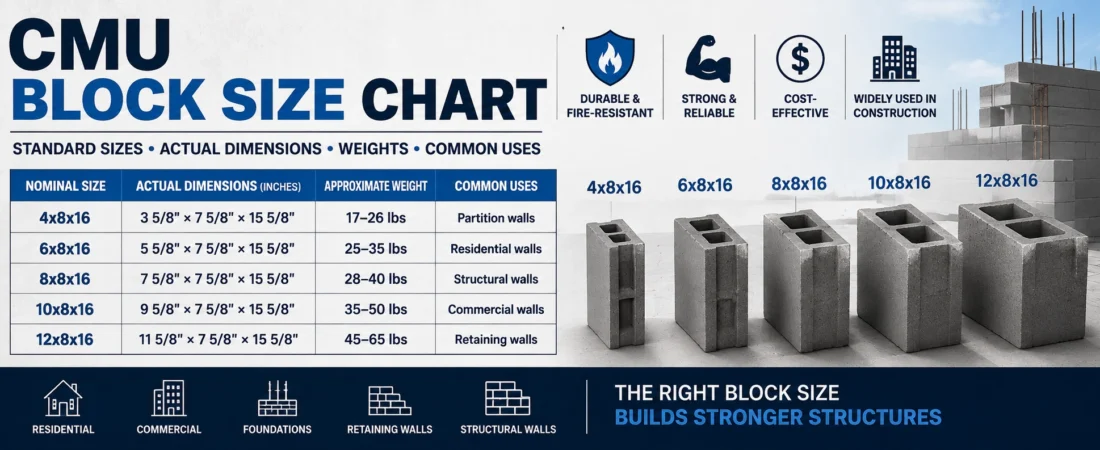
Below is a standard CMU block size chart showing:
- Nominal dimensions
- Actual dimensions
- Approximate weights
- Common uses
| Nominal Size | Actual Dimensions (Inches) | Approximate Weight | Common Uses |
|---|---|---|---|
| 4x8x16 | 3 5/8″ × 7 5/8″ × 15 5/8″ | 17–26 lbs | Partition walls |
| 6x8x16 | 5 5/8″ × 7 5/8″ × 15 5/8″ | 25–35 lbs | Residential walls |
| 8x8x16 | 7 5/8″ × 7 5/8″ × 15 5/8″ | 28–40 lbs | Structural walls |
| 10x8x16 | 9 5/8″ × 7 5/8″ × 15 5/8″ | 35–50 lbs | Commercial walls |
| 12x8x16 | 11 5/8″ × 7 5/8″ × 15 5/8″ | 45–65 lbs | Retaining walls |
Actual weights vary depending on:
- Manufacturer specifications
- Block density
- Hollow or solid design
Nominal vs Actual CMU Block Sizes
The:
nominal size
includes the mortar joint thickness used during masonry construction.
The:
actual size
is slightly smaller to allow space for:
- Mortar joints
- Alignment adjustments
- Construction tolerances
Most masonry walls use:
3/8-inch mortar joints
which create uniform wall dimensions after installation.
You can also read:
CMU Nominal vs Actual Dimensions4x8x16 CMU Blocks
The:
4x8x16 block
is commonly used for:
- Interior partition walls
- Lightweight masonry projects
- Non-load-bearing walls
Advantages:
- Lightweight
- Easier handling
- Lower material costs
6x8x16 CMU Blocks
The:
6x8x16 block
is commonly used for:
- Residential walls
- Garage walls
- Small structural applications
These blocks provide a good balance between:
- Strength
- Weight
- Cost efficiency
8x8x16 CMU Blocks
The:
8x8x16 CMU block
is the most common concrete block size used in modern construction.
Applications:
- Structural walls
- Foundations
- Basement walls
- Commercial buildings
- Retaining walls
Because of its durability and versatility, it is widely used in:
- Residential masonry
- Commercial construction
- Reinforced wall systems
You can also read:
8x8x16 CMU Block Dimensions10x8x16 CMU Blocks
The:
10x8x16 block
is commonly used for:
- Commercial walls
- Reinforced masonry systems
- Heavy structural projects
These blocks provide:
- Increased wall thickness
- Higher load-bearing capacity
- Improved durability
12x8x16 CMU Blocks
The:
12x8x16 block
is commonly used for:
- Retaining walls
- Heavy-load walls
- Large structural applications
These larger blocks provide:
- Greater durability
- Improved stability
- Better structural performance
Most Common CMU Wall Thicknesses
Different wall thicknesses are used depending on:
- Structural loads
- Building type
- Foundation requirements
| CMU Thickness | Common Uses |
|---|---|
| 4 inch | Partition walls |
| 6 inch | Residential walls |
| 8 inch | Structural walls |
| 10 inch | Commercial walls |
| 12 inch | Heavy-load structures |
The:
8-inch CMU wall
is one of the most widely used concrete masonry wall systems in the United States.
You can also read:
CMU Wall Thickness GuideHollow vs Solid CMU Blocks
Hollow CMU Blocks
Hollow blocks contain internal openings that:
- Reduce weight
- Improve insulation
- Lower transportation costs
- Allow reinforcement installation
These are the most commonly used masonry blocks in residential construction.
Solid CMU Blocks
Solid concrete blocks are:
- Heavier
- Denser
- Stronger
They are commonly used for:
- Retaining walls
- Structural foundations
- Heavy-load applications
You can also read:
Hollow vs Solid Concrete BlocksLightweight vs Normal Weight CMU
CMU blocks are available in:
- Lightweight versions
- Normal-weight versions
Lightweight blocks:
- Reduce wall weight
- Improve thermal insulation
- Simplify handling
Normal-weight blocks:
- Provide higher density
- Increase structural strength
- Improve sound resistance
You can also read:
Lightweight vs Normal Weight CMUCMU Block Weight Guide
Concrete block weight depends on:
- Block size
- Density
- Hollow or solid design
- Aggregate material
Approximate weights:
| CMU Block Size | Approximate Weight |
|---|---|
| 4x8x16 | 17–26 lbs |
| 6x8x16 | 25–35 lbs |
| 8x8x16 | 28–40 lbs |
| 10x8x16 | 35–50 lbs |
| 12x8x16 | 45–65 lbs |
Larger blocks generally weigh more because they contain additional concrete material.
You can also read:
CMU Block Weight Guide8x8x16 vs 12x8x16 CMU Blocks
| Feature | 8x8x16 CMU | 12x8x16 CMU |
|---|---|---|
| Weight | Lower | Higher |
| Structural Strength | High | Very High |
| Common Use | Residential & commercial walls | Heavy structural walls |
| Material Cost | Lower | Higher |
| Installation | Easier | More labor-intensive |
Larger blocks generally provide:
- Higher load-bearing capacity
- Better structural durability
- Improved wall stability
How Many CMU Blocks Per Pallet?
The number of CMU blocks per pallet depends on:
- Block size
- Manufacturer
- Block density
- Shipping requirements
Approximate pallet quantities:
| Block Size | Blocks Per Pallet |
|---|---|
| 4x8x16 | 144 |
| 6x8x16 | 96 |
| 8x8x16 | 72 |
| 12x8x16 | 48 |
You can also read:
How Many CMU Blocks Per Pallet?Choosing the Right CMU Block Size
Choosing the correct block size depends on:
- Wall type
- Structural requirements
- Building codes
- Insulation needs
- Load-bearing capacity
Smaller blocks are commonly used for:
- Non-structural walls
- Partition systems
Larger blocks are commonly used for:
- Structural masonry
- Foundations
- Retaining walls
Common Uses of CMU Blocks
Concrete masonry units are widely used for:
- Foundation walls
- Retaining walls
- Garage walls
- Basement walls
- Commercial buildings
- Residential masonry projects
Their strength and durability make them one of the most popular construction materials worldwide.
Frequently Asked Questions
What is the most common CMU block size?
The:
8x8x16 CMU block
is the most commonly used concrete masonry unit in residential and commercial construction.
Why are actual CMU dimensions smaller?
Actual dimensions are smaller to allow room for:
- Mortar joints
- Proper wall alignment
- Construction tolerances
Which CMU size is best for structural walls?
The:
8-inch CMU block
is commonly used for:
- Structural walls
- Foundations
- Reinforced masonry systems
- Commercial construction
Are larger CMU blocks stronger?
Yes.
Larger concrete blocks generally provide:
- Greater load-bearing capacity
- Improved structural durability
- Better wall stability
Use a CMU Block Calculator
Before starting masonry construction, it is important to estimate:
- Block quantity
- Mortar bags
- Material costs
- Wall dimensions
Our:
CMU Block Calculatorhelps estimate:
- Concrete block quantities
- Mortar requirements
- Wall area coverage
- Material costs
You can also use:
- Foundation Calculator
- Concrete Volume Calculator
- Rebar Calculator
- Mortar Calculator
- Gravel Calculator
for additional construction estimation.
Related Articles
- Standard Cinder Block Sizes
- 8x8x16 CMU Block Dimensions
- CMU Block Weight Guide
- How Many CMU Blocks Per Pallet?
- Cinder Block vs Concrete Block
- CMU Wall Thickness Guide
- CMU Nominal vs Actual Dimensions
Final Thoughts
CMU blocks are available in multiple standard sizes for different masonry construction applications. Understanding:
- Nominal dimensions
- Actual sizes
- Block weights
- Wall thickness
helps contractors and homeowners select the correct concrete block for:
- Foundations
- Retaining walls
- Garages
- Structural masonry projects
The:
8x8x16 CMU block
remains the most commonly used concrete masonry unit because of its:
- Strength
- Durability
- Versatility
- Structural performance 👍