
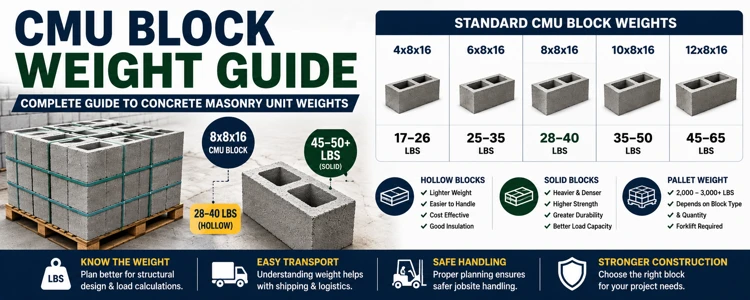
How much does a CMU block weigh? A common hollow 8 × 8 × 16 concrete block often weighs about 35–40 lb. Published product examples include a standard concrete line block at about 38 lb and a lightweight aggregate version at about 28 lb. The exact weight depends on the block’s density, shape, cores, moisture, and manufacturer, so use these figures for planning and confirm the weight of the product you will buy. Use this CMU block weight guide to compare examples by size and estimate block-only package loads.
| Nominal CMU size | Concrete line-block example | Lightweight line-block example |
|---|---|---|
| 4 × 8 × 16 in. | About 26 lb | About 19 lb |
| 6 × 8 × 16 in. | About 32 lb | About 24 lb |
| 8 × 8 × 16 in. | About 38 lb | About 28 lb |
| 10 × 8 × 16 in. | About 49 lb | Not listed in this schedule |
| 12 × 8 × 16 in. | About 55 lb | Not listed in this schedule |
How to use this chart: these are approximate weights from one U.S. manufacturer’s product schedule, not universal values. Its 6- and 8-inch line-block cubes include some window-corner or jamb units, so a cube may contain more than one shape. Ask your local supplier for the current unit weight and package count. See our CMU block sizes chart for the nominal and typical actual dimensions.
Why CMU block weights vary
Two concrete masonry units with the same nominal dimensions can have different weights. The main variables are the concrete’s density, the amount of material in the webs and face shells, the size and number of cores, and whether the unit is a standard line block or a specialty shape. Surface texture, production details, and moisture can also affect the measured weight.
Concrete masonry units are commonly described by concrete density class: lightweight is less than 105 lb per cubic foot, medium weight is 105 to less than 125 lb per cubic foot, and normal weight is 125 lb per cubic foot or more. These are density classes for the concrete, not a direct weight for a finished hollow block. A hollow unit’s cores mean you cannot find its weight by multiplying the block’s full outside volume by the concrete density.
For an estimate, identify the exact nominal size and product type first. Then use the product sheet for its listed unit weight. A standard 8 × 8 × 16 CMU is a useful reference size, but it does not have one fixed weight across every manufacturer or mix.
8 × 8 × 16 concrete block weight by type
For the same nominal size, the shape and core layout still matter. One manufacturer’s approximate schedule lists these examples:
| 8 × 8 × 16 product type | Approximate listed weight | What to notice |
|---|---|---|
| Concrete line block | 38 lb | Standard wall-unit example |
| Lightweight Haydite line block | 28 lb | Lightweight aggregate example |
| Solid-top block | 51 lb | Solid top does not mean the entire unit is solid |
| Open-bottom bond-beam block | 40 lb | Specialty shape; verify the design use |
| Double-end corner block | 44 lb | End configuration changes the product |
| Split-face block | 44 lb | Texture and unit design affect weight |
A fully solid block is different from a solid-top unit. For example, published manufacturer schedules show a 4 × 8 × 16 solid block at about 32 lb and a 6 × 8 × 16 solid block at about 51 lb; one product catalog lists a fully solid 8 × 8 × 16 unit at about 74 lb. These are product-specific examples. Do not use the weight of a solid-top, bond-beam, corner, or split-face unit as the weight of a standard hollow block.
How much does a pallet of CMU blocks weigh?
First calculate the block load, then add the pallet and packaging if you need gross shipping weight:
Block load = number of units × listed unit weight
Gross package weight = block load + pallet and packaging
| Product example | Units in example cube | Block-only load |
|---|---|---|
| Concrete line block at 38 lb each | 90 | 3,420 lb |
| Lightweight line block at 28 lb each | 90 | 2,520 lb |
| Solid-top block at 51 lb each | 60 | 3,060 lb |
The package counts above match those product examples; they are not a standard pallet size. Suppliers can stack the same nominal block in different quantities. Confirm both the units per package and gross shipping weight on the quote before arranging delivery or lifting. Our concrete blocks per pallet guide compares package-count examples by size.
Estimate block weight per square foot of wall
A standard 8 × 8 × 16 CMU covers about 0.89 square feet of nominal wall face, or roughly 1.125 blocks per square foot before cuts and waste. If the selected unit weighs 38 lb, the block-only estimate is 1.125 × 38 = about 42.8 lb per square foot of wall face.
This quick estimate includes only the units. It excludes mortar, grout, reinforcing steel, finishes, and other wall layers, and it is not a structural design load. For footing or framing calculations, use the complete wall assembly and the project’s specified materials. Use our CMU Block Calculator for a wall quantity estimate, and check the design documents for structural loads.
Cinder block, concrete block, and CMU
“Cinder block” is commonly used in everyday searches for a concrete masonry unit. The phrase alone does not tell you the block’s aggregate, density class, core shape, or weight. Check the product description rather than assuming that every cinder block is lightweight. Read our cinder block vs. concrete block comparison for the terminology.
Check the load before lifting or transporting blocks
- Ask the supplier for the current unit weight, units per cube, and gross package weight.
- Include the pallet, wrapping, occupants, tools, and other cargo when checking vehicle payload.
- Verify that the forklift, loader, trailer, or lifting equipment is rated for the confirmed load and lift conditions.
- Keep pallets on a firm, level surface and follow the supplier’s unloading and stacking instructions.
- For a structural load or wall design, use the project documents and a qualified professional rather than a general online estimate.
Frequently asked questions
How much does an 8 × 8 × 16 concrete block weigh?
A standard concrete line-block example weighs about 38 lb, while a lightweight aggregate example is about 28 lb. Other published standard products are close to 33–40 lb. Check the exact product because unit design and density change the weight.
How much does a 4 × 8 × 16 solid concrete block weigh?
One manufacturer’s product schedule lists a 4 × 8 × 16 solid concrete block at about 32 lb. A concrete line-block example of the same nominal size is about 26 lb. Treat these as product examples and confirm the unit you plan to order.
How much does a 12 × 8 × 16 concrete block weigh?
One manufacturer’s approximate concrete line-block example is 55 lb. A solid-top or bond-beam unit of the same nominal size may weigh more, and a lightweight unit may weigh less. Use the specification for the exact product.
How much does a 90-block pallet of 8-inch CMU weigh?
At 38 lb per unit, 90 blocks have a block-only load of 3,420 lb. Add the skid and packaging for gross weight. Confirm the supplier’s actual package count and listed unit weight before transport.
Do solid blocks weigh more than hollow blocks?
A fully solid block usually contains more material than a comparable hollow unit, so its weight is generally higher. “Solid-top” describes a different shape and should not be treated as fully solid. Compare the product names and weight on the supplier’s current schedule.
For an accurate takeoff, record the nominal size, unit type, listed weight, and package count separately. This keeps unit weight, block-only pallet load, and gross shipping weight from being confused.