
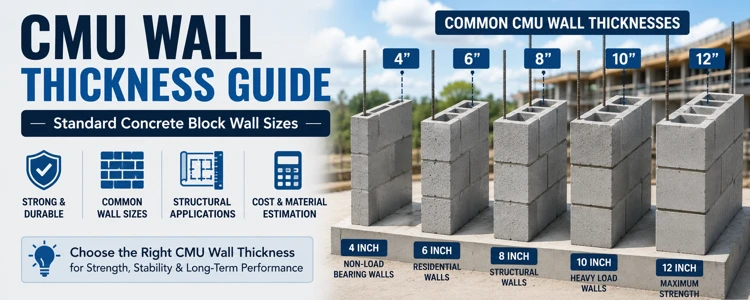
How thick is a cinder block? A common 8-inch nominal CMU is typically 7 5/8 inches wide as a unit. Other common nominal CMU widths are 4, 6, 10, and 12 inches; each standard block is typically 3/8 inch narrower than nominal to allow for the mortar joint. The total finished wall depth may be greater after finishes, furring, insulation, or a cavity are added. Check the product data for the unit you are buying because dimensions and tolerances can vary by manufacturer.
CMU Wall Thickness Chart
Use this chart to compare common nominal CMU widths with typical specified unit widths. The metric values are rounded conversions.
| Nominal CMU width | Typical specified block width | Approx. specified width (mm) |
|---|---|---|
| 4 in. | 3 5/8 in. | 92 mm |
| 6 in. | 5 5/8 in. | 143 mm |
| 8 in. | 7 5/8 in. | 194 mm |
| 10 in. | 9 5/8 in. | 244 mm |
| 12 in. | 11 5/8 in. | 295 mm |
The nominal width is the planning size used for a modular wall layout. The specified width is the listed physical unit size. Nominal CMU face dimensions are commonly 8 inches high by 16 inches long, while widths are available in several sizes. Specialty widths, including 14 and 16 inches, may also be available in some markets.
Why Is an 8-Inch CMU Usually 7 5/8 Inches Wide?
A nominal size accounts for the unit plus a standard mortar joint in a modular layout. A typical 3/8-inch joint added to a 7 5/8-inch unit equals an 8-inch planning module. This convention helps courses and openings line up on a consistent layout; it does not mean every installed joint will measure exactly 3/8 inch.
The same relationship explains common widths: nominal 4-inch CMU is typically 3 5/8 inches wide, nominal 6-inch is 5 5/8 inches, and nominal 12-inch is 11 5/8 inches. Product dimensions can have permitted manufacturing tolerances, so use the current submittal or product label when a precise measurement matters. See our CMU nominal vs. actual dimensions guide for the difference between the terms.
Block Width vs. Finished Wall Thickness
The chart measures the masonry unit across its width. It does not automatically include drywall, plaster, furring, insulation, an air space, or a separate veneer. A finished assembly can therefore be thicker than the nominal CMU size.
Simple estimate: finished wall depth = specified CMU width + finish layers + any cavity or additional wall layer. For example, a nominal 8-inch block is typically 7 5/8 inches wide. If a project adds a 1/2-inch finish on both sides, the illustrative overall depth is 8 5/8 inches. Actual finishes and installation details differ, so measure or check the assembly drawings.
When comparing wall plans, confirm whether dimensions are given to the masonry face, the finished face, or the centerline. For a full length-height-depth overview of common units, use the CMU block sizes chart.
What Does “Cinder Block Thickness” Mean?
People often say “cinder block” when they mean a concrete masonry unit (CMU). The phrase is informal and does not identify one exact thickness or concrete mix. Ask for the nominal width, specified dimensions, weight class, and product type when ordering. For a common 8 × 8 × 16 nominal unit, the typical specified dimensions are about 7 5/8 × 7 5/8 × 15 5/8 inches.
The unit width is the side-to-side dimension that contributes to a single-wythe wall depth. Hollow cores do not make the outside unit narrower. Learn more about this common unit in our 8×8×16 CMU dimensions guide and compare related terms in standard cinder block sizes.
Does a Thicker CMU Automatically Make a Stronger Wall?
No single nominal width determines whether a wall is safe or suitable for a particular building. Wall performance depends on the complete design, including unit properties, wall height and length, support conditions, loads, mortar, reinforcement, grout, openings, and applicable local code. A thicker unit can change the wall section and available core space, but it is not a substitute for a design check.
Do not choose a load-bearing, foundation, retaining, or exterior wall solely from a general size chart. Follow the project drawings and have the wall designed or reviewed by a qualified local professional. Insulation and fire or sound performance also depend on the full wall assembly and its tested or calculated properties, not thickness alone.
How to Confirm the Right CMU Thickness
- Read the plan note or wall schedule and identify the nominal width and finished wall depth separately.
- Check the manufacturer’s product sheet for specified dimensions, tolerance, unit weight, and intended application.
- Include finishes, furring, cavities, insulation, and veneers when checking clearances or total depth.
- For structural work, verify the complete wall design, reinforcement, grout, support, and local code requirements with the responsible professional.
Frequently Asked Questions
How thick is a standard cinder block?
A common 8-inch nominal concrete block is typically 7 5/8 inches wide as a unit. “Cinder block” is an informal name; blocks are sold in multiple nominal widths, so check the specified size of the product you mean.
How thick is a cinder block wall?
A single-wythe wall made with nominal 8-inch CMU has a typical unit width of 7 5/8 inches before finishes. The finished wall depth can be larger after adding finishes, furring, a cavity, or other layers. Other nominal unit widths are available, so use the wall plan and product data for the specific assembly.
How thick is an 8-inch concrete block?
An 8-inch nominal CMU is typically 7 5/8 inches wide as a unit. The 8-inch figure is the nominal planning module, which accounts for a typical mortar joint.
How thick is a 4-inch CMU?
A 4-inch nominal CMU is typically 3 5/8 inches wide as a unit. Check the product specification for the exact unit and its tolerance.
Are all CMU wall widths exactly 3/8 inch less than nominal?
That is the typical specified dimension for standard modular units, but product dimensions and tolerances can vary. Confirm the specific manufacturer’s data instead of assuming every block is identical.
Is CMU thickness the same as finished wall thickness?
No. CMU thickness describes the masonry unit or wythe. Finishes, framing, insulation, cavities, or additional layers add to the total assembly depth.
Are 14-inch and 16-inch CMUs available?
They may be available as specialty widths from some producers or regions. Ask local suppliers about stock, lead time, and product specifications.
Related CMU Guides
- CMU Block Sizes Chart
- CMU Nominal vs. Actual Dimensions
- 8×8×16 CMU Block Dimensions
- Standard Cinder Block Sizes
Use nominal dimensions for early layout, then verify the exact unit and complete assembly before ordering materials or setting clearances.