
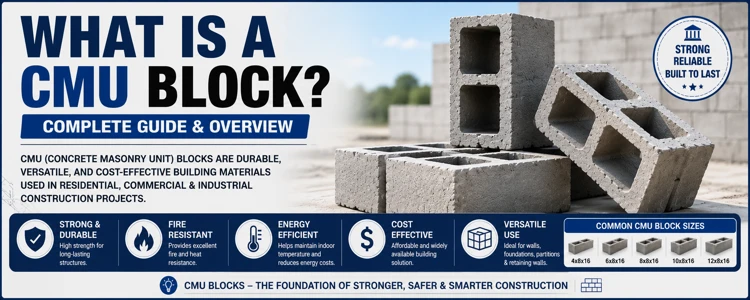
A CMU block, or Concrete Masonry Unit, is a manufactured concrete unit used to build masonry walls and other structures. CMUs are widely used in residential, commercial, institutional, and industrial construction for applications such as foundation walls, exterior walls, interior partitions, retaining-wall systems, and reinforced structural masonry.
In simple terms, when contractors, architects, or engineers refer to a CMU wall, they mean a wall constructed from concrete masonry units joined with mortar and, where required by the design, reinforced with steel and grout.
CMUs are manufactured in many sizes, shapes, densities, colors, and surface finishes. Standard units can be combined with specialty units such as bond beam, lintel, corner, sash, and architectural blocks to meet different construction requirements.
If you are estimating a masonry project, use our CMU Block Calculator to estimate block quantities, wall area, waste, mortar, and material costs.
What Does CMU Mean in Construction?
CMU stands for Concrete Masonry Unit.
The phrase CMU construction refers to construction that uses concrete masonry units as part of a wall or masonry system. Therefore, if you are searching for the CMU construction meaning, it simply means construction using manufactured concrete masonry units.
Common construction terms include:
- CMU block – an individual concrete masonry unit
- CMU wall – a wall constructed from concrete masonry units
- CMU construction – masonry construction using concrete masonry units
- Reinforced CMU – concrete masonry containing reinforcing steel and grout where required by the structural design
- Concrete block – a common everyday term often used for a concrete masonry unit
On drawings and specifications, the abbreviation CMU is commonly used instead of repeatedly writing “concrete masonry unit.”
What Is a CMU Block Made Of?
Concrete masonry units are generally manufactured using hydraulic cement, water, and mineral aggregates. Depending on the required properties and manufacturing process, other permitted materials or admixtures may also be included.
Aggregate selection can affect characteristics such as:
- Unit density and weight
- Thermal performance
- Fire-resistance characteristics of the wall assembly
- Sound-control properties
- Appearance and texture
CMUs are commonly produced using relatively dry, low-slump concrete that is compacted into molds. The units are then cured under controlled conditions before shipment.
This manufacturing process allows producers to create standard blocks as well as specialty masonry shapes for particular construction applications.
Common Uses of CMU Blocks
Concrete masonry is versatile, so CMUs can be incorporated into many types of buildings and site structures. The exact unit, reinforcement, grout, wall thickness, and detailing depend on the project design.
Residential Construction
CMUs may be used in residential projects for:
- Foundation walls
- Basement walls
- Garage walls
- Exterior masonry walls
- Interior partitions
- Site and landscape walls
Commercial and Institutional Construction
Concrete masonry is also commonly found in:
- Schools
- Warehouses
- Retail buildings
- Office and service buildings
- Utility structures
- Industrial facilities
CMU can serve structural, enclosure, partition, architectural, or fire-resistance functions depending on the wall assembly and design.
Retaining and Site Walls
Concrete masonry can also be used in engineered retaining and site-wall applications. Retaining walls require proper consideration of soil pressure, drainage, footing design, reinforcement, and other project-specific conditions.
Standard CMU Block Sizes
Concrete masonry units are manufactured in many dimensions, but a common modular CMU face size in the United States is nominally 8 inches high × 16 inches long. Units are available in different nominal widths to create different wall thicknesses.
| Nominal CMU Size | Typical Specified Dimensions | Nominal Wall Width |
|---|---|---|
| 4 × 8 × 16 in. | 3 5/8 × 7 5/8 × 15 5/8 in. | 4 in. |
| 6 × 8 × 16 in. | 5 5/8 × 7 5/8 × 15 5/8 in. | 6 in. |
| 8 × 8 × 16 in. | 7 5/8 × 7 5/8 × 15 5/8 in. | 8 in. |
| 10 × 8 × 16 in. | 9 5/8 × 7 5/8 × 15 5/8 in. | 10 in. |
| 12 × 8 × 16 in. | 11 5/8 × 7 5/8 × 15 5/8 in. | 12 in. |
These dimensions represent common modular sizes. Manufacturers may offer other sizes and configurations, so product data should be checked for the units being specified.
For the complete dimensional tables, see our CMU Block Sizes Chart.
Nominal vs Specified CMU Dimensions
One of the most important concepts for anyone new to concrete masonry is the difference between nominal and specified dimensions.
Nominal dimensions describe the masonry module, including the space intended for a mortar joint. Specified unit dimensions are typically 3/8 inch smaller than the corresponding nominal dimensions.
For example, a nominal:
8 × 8 × 16-inch CMU
commonly has specified dimensions of approximately:
7 5/8 × 7 5/8 × 15 5/8 inches
With a typical 3/8-inch mortar joint, the installed masonry coordinates with the 8 × 8 × 16-inch nominal module.
See our CMU Nominal vs Actual Dimensions Guide for a more detailed explanation.
Types of CMU Blocks
“CMU block” does not describe only one unit shape. Concrete masonry units are available in numerous configurations for structural, architectural, reinforcement, and construction purposes.
Hollow CMU
Hollow concrete masonry units contain cores or cells. These openings reduce the amount of concrete in the unit and can provide space for reinforcement, grout, or other materials where required.
Hollow CMUs are widely used in conventional concrete masonry construction.
Solid CMU
Solid masonry units contain a greater proportion of solid material than hollow units under the applicable unit classification.
A solid unit should not automatically be assumed to be structurally stronger than every hollow CMU. Structural performance depends on unit properties and the complete masonry assembly, including mortar, grout, reinforcement, wall geometry, and loading.
See Hollow vs Solid Concrete Blocks for a detailed comparison.
Lightweight, Medium-Weight and Normal-Weight CMU
CMUs can also be classified according to concrete density. Different aggregate combinations allow manufacturers to produce lightweight, medium-weight, and normal-weight units.
Density can influence unit weight, handling, thermal characteristics, acoustical performance, and other properties. Lower or higher density does not by itself determine whether a wall is suitable for a particular structural application.
Read our Lightweight vs Normal Weight CMU guide for more information.
Architectural CMU
Architectural concrete masonry units can be manufactured with different colors, textures, shapes, and finishes. Examples may include split-face, ground-face, scored, or other decorative units.
These units can allow the masonry itself to contribute to the finished appearance of a building.
Bond Beam and Other Specialty CMUs
Special CMU shapes are manufactured for specific wall locations and construction details. A bond beam unit, for example, is configured to accommodate horizontal reinforcement and grout.
Learn how these units work in our What Is a Bond Beam Block? guide.
CMU Block vs Concrete Block
In everyday U.S. construction terminology, concrete block is often used to refer to a concrete masonry unit. CMU is the more specific construction abbreviation for Concrete Masonry Unit.
For many ordinary conversations, “CMU block” and “concrete block” therefore refer to the same general building product. However, project specifications should use the correct product classification and applicable standard rather than relying only on informal terminology.
CMU Block vs Cinder Block
The terms CMU, concrete block, and cinder block are frequently mixed together in everyday conversation, but they do not always describe the same material.
Historically, the term cinder block was associated with units containing coal cinders or similar lightweight material. Modern concrete masonry units are manufactured from hydraulic cement, water, and aggregates selected to meet the required unit properties.
Today, people sometimes use “cinder block” informally when they actually mean a modern concrete block or CMU. For that reason, the name alone should not be used to determine a block’s composition, density, strength, or structural suitability.
For a complete explanation, read Cinder Block vs Concrete Block.
Advantages of CMU Construction
Concrete masonry can provide several useful characteristics, but actual performance depends on the selected units and complete wall assembly.
Durability
Properly designed and constructed concrete masonry can provide long-term service in a wide variety of interior and exterior environments.
Fire Resistance
Concrete masonry is commonly used in fire-resistance-rated construction. However, a CMU should not be assigned a fire rating simply because it is made of concrete.
The fire-resistance rating of a concrete masonry assembly can depend on factors such as unit configuration, aggregate type, equivalent thickness, cell fill, wall finishes, and the tested or calculated assembly.
See our CMU Fire Rating Guide for more information.
Thermal Performance
CMU walls provide thermal mass, while overall thermal resistance depends on the unit configuration, density, insulation strategy, grout, finishes, and complete wall assembly.
Where energy performance is important, the entire wall system should be evaluated rather than assuming that every CMU has the same insulation value.
Read our CMU Thermal Insulation Guide.
Design Flexibility
CMUs are available in many:
- Widths
- Shapes
- Textures
- Colors
- Density classifications
- Special configurations
This allows concrete masonry to serve structural, architectural, partition, enclosure, and other building functions.
Resistance to Rot and Termites
The concrete portion of a CMU does not rot like wood and is not a food source for termites. Other components incorporated into a complete wall assembly may still require appropriate protection and detailing.
CMU Wall Thickness
CMU walls can be constructed in several nominal thicknesses. Common nominal unit widths include 4, 6, 8, 10, and 12 inches, with additional widths available from some manufacturers.
The correct wall thickness depends on factors such as:
- Structural loads
- Wall height
- Wall type
- Reinforcement
- Fire-resistance requirements
- Energy requirements
- Architectural design
- Applicable building requirements
A thicker CMU should not automatically be treated as the correct structural solution without considering the complete design.
See our CMU Wall Thickness Guide for more information.
Are CMU Blocks Load-Bearing?
CMUs can be used in load-bearing construction, but the structural capacity of a wall cannot be determined from the words “CMU block” alone.
Structural masonry design may need to consider:
- Unit properties
- Masonry compressive strength
- Wall thickness and height
- Mortar
- Grout
- Vertical reinforcement
- Horizontal reinforcement
- Connections
- Applied loads
- Openings and wall geometry
For structural work, follow the approved plans, specifications, and applicable building requirements.
Reinforced vs Unreinforced CMU Walls
Some CMU walls are designed as unreinforced masonry, while others contain reinforcing steel and grout.
In reinforced masonry, vertical reinforcing bars can be placed in selected CMU cells and surrounded by grout. Horizontal reinforcement may also be incorporated through bond beams or other approved details.
The amount and spacing of reinforcement are engineering decisions and should not be selected from a generic rule that is applied to every wall.
For more information, read How to Reinforce a CMU Wall.
How Much Does a CMU Block Weigh?
There is no single weight for a CMU block. Weight varies with:
- Unit size
- Concrete density
- Web and core configuration
- Aggregate type
- Moisture condition
- Manufacturer
For this reason, supplier data should be used when exact unit weight is important for shipping, handling, structural calculations, or estimating.
See our CMU Block Weight Guide for additional information.
How to Calculate the Number of CMU Blocks Needed
For a basic wall estimate, determine the wall area and divide it by the nominal face area of the selected masonry unit. Openings, special units, cuts, waste, and the actual wall layout should then be considered.
Example Using an 8 × 8 × 16 CMU
Assume a wall is:
- 20 ft long
- 10 ft high
The gross wall area is:
20 × 10 = 200 square feet
An 8 × 16-inch nominal modular face represents approximately:
0.889 square feet per block
Therefore:
200 ÷ 0.889 ≈ 225 blocks
This is a preliminary gross-wall estimate. Door and window openings, corners, bond beams, special units, cuts, breakage, and the selected waste allowance can change the final order quantity.
Instead of calculating everything manually, use our CMU Block Calculator for faster material estimation.
How Much Mortar Is Needed for CMU Blocks?
Mortar quantity varies with the number and size of masonry units, joint dimensions, bedding method, workmanship, waste, and wall configuration.
For this reason, a statement such as “one bag always lays a fixed number of blocks” is not reliable for every project.
Estimate mortar using the actual wall and unit information with our Mortar Calculator.
Are CMU Blocks Good for Foundations?
Concrete masonry can be used for foundation and basement walls when the system is properly designed and constructed for the applicable loads and site conditions.
A foundation CMU wall may require consideration of:
- Footing size and bearing conditions
- Vertical reinforcement
- Grouted cells
- Horizontal reinforcement
- Soil pressure
- Drainage
- Dampproofing or waterproofing
- Backfill conditions
- Local building requirements
Below-grade CMU should not be assumed to be inherently waterproof. Water-management details are an important part of foundation-wall construction.
You can use our Foundation Calculator for related preliminary material calculations.
Are CMU Blocks Waterproof?
No. A standard CMU wall should not automatically be considered waterproof.
Water penetration performance depends on the complete wall system and details such as mortar joints, flashing, drainage, sealants, coatings, integral water repellents, wall configuration, and workmanship.
Below-grade masonry may require dampproofing or waterproofing depending on soil, drainage, groundwater, and project conditions.
How Long Do CMU Blocks Last?
There is no single lifespan that applies to every CMU wall. Properly designed, detailed, constructed, and maintained concrete masonry can remain in service for many decades.
Long-term performance is influenced by:
- Exposure conditions
- Moisture management
- Structural movement
- Freeze-thaw exposure where applicable
- Material quality
- Workmanship
- Maintenance
Rather than relying on a fixed “50-year” or similar number, evaluate the actual wall system and exposure conditions.
Tips for Building With CMU Blocks
Good concrete masonry construction begins with proper planning and continues through material selection, layout, installation, reinforcement, grouting, and moisture management.
- Use the specified CMU size and type.
- Maintain the required masonry layout and joint dimensions.
- Use mortar appropriate for the project specification.
- Keep walls level, plumb, and properly aligned.
- Install reinforcement and grout according to the design.
- Coordinate bond beams, openings, corners, and vertical reinforcement.
- Provide appropriate flashing, drainage, sealants, and waterproofing details.
- Protect masonry materials during storage and construction.
- Follow the approved construction documents and applicable codes.
Frequently Asked Questions
What does CMU stand for?
CMU stands for Concrete Masonry Unit. It is the common construction abbreviation for manufactured concrete masonry units used to build walls and other masonry assemblies.
What does CMU mean in construction?
In construction, CMU means Concrete Masonry Unit. CMU construction refers to masonry construction using concrete masonry units. A “CMU wall” is therefore a wall built using these units.
What is a CMU block?
A CMU block is a manufactured concrete masonry unit used in wall construction. CMUs are available in various sizes, densities, shapes, and finishes and can be used in structural or nonstructural masonry depending on the design and product specification.
What is the standard size of a CMU block?
A common modular CMU has nominal face dimensions of 8 inches high × 16 inches long. Nominal widths include several sizes, such as 4, 6, 8, 10, and 12 inches. Other sizes are also manufactured.
What are the actual dimensions of an 8 × 8 × 16 CMU?
A nominal 8 × 8 × 16-inch CMU commonly has specified dimensions of approximately 7 5/8 × 7 5/8 × 15 5/8 inches. The difference accommodates the typical mortar joint in the modular wall layout.
Is CMU the same as concrete block?
In ordinary construction language, “concrete block” commonly refers to a CMU. CMU is the abbreviation for Concrete Masonry Unit and is the more specific industry term.
Is a CMU the same as a cinder block?
Not necessarily. Traditional cinder blocks were associated with cinder-containing aggregates, while modern CMUs are manufactured concrete masonry products. However, “cinder block” is still commonly used informally to describe modern concrete blocks.
Are CMU blocks hollow?
Many common CMUs are hollow, but concrete masonry units can be hollow or solid depending on their configuration and applicable classification.
Can CMU walls contain rebar?
Yes. Reinforced CMU construction can contain vertical and horizontal reinforcing steel together with grout. The required reinforcement depends on the structural design.
Are CMU blocks fire resistant?
Concrete masonry can be used in fire-resistance-rated assemblies, but the rating applies to the specific wall assembly rather than automatically to every CMU. Aggregate type, equivalent thickness, configuration, grout or fill, and other assembly details can affect the rating.
Are CMU blocks waterproof?
No. CMU walls require appropriate water-management design where moisture exposure is expected. Flashing, drainage, coatings, sealants, water repellents, and waterproofing may be part of the required wall system.
How many 8 × 8 × 16 CMU blocks are needed per square foot?
An 8 × 16-inch nominal modular face covers approximately 0.889 square feet, which corresponds to about 1.125 blocks per square foot before adjustments for openings, special units, cuts, and waste.
How do I estimate CMU blocks for a wall?
Calculate the wall area, account for openings and the selected block size, and then include project-specific waste and special units. Our CMU Block Calculator can perform the basic quantity calculation automatically.
Related Articles
- CMU Block Sizes Chart
- CMU Nominal vs Actual Dimensions
- CMU Wall Thickness Guide
- CMU Block Weight Guide
- Hollow vs Solid Concrete Blocks
- Lightweight vs Normal Weight CMU
- Cinder Block vs Concrete Block
- What Is a Bond Beam Block?
- How to Reinforce a CMU Wall
- CMU Fire Rating Guide
- CMU Thermal Insulation Guide
Final Thoughts
A CMU block is a Concrete Masonry Unit used to construct masonry walls and related building systems. In construction terminology, CMU means Concrete Masonry Unit, while CMU construction simply refers to construction using these manufactured concrete units.
CMUs are available in many sizes, densities, configurations, and finishes. A common modular unit has nominal face dimensions of 8 × 16 inches, but the correct unit width, reinforcement, grout, fire-resistance requirements, moisture protection, and structural details depend on the individual project.
Understanding the difference between nominal and specified dimensions, hollow and solid units, density classifications, reinforced and unreinforced masonry, and specialty CMUs makes material selection and estimating much easier.
When you are ready to estimate a wall, use our CMU Block Calculator to calculate the required concrete masonry units, wall area, waste allowance, mortar, and estimated material quantities.