
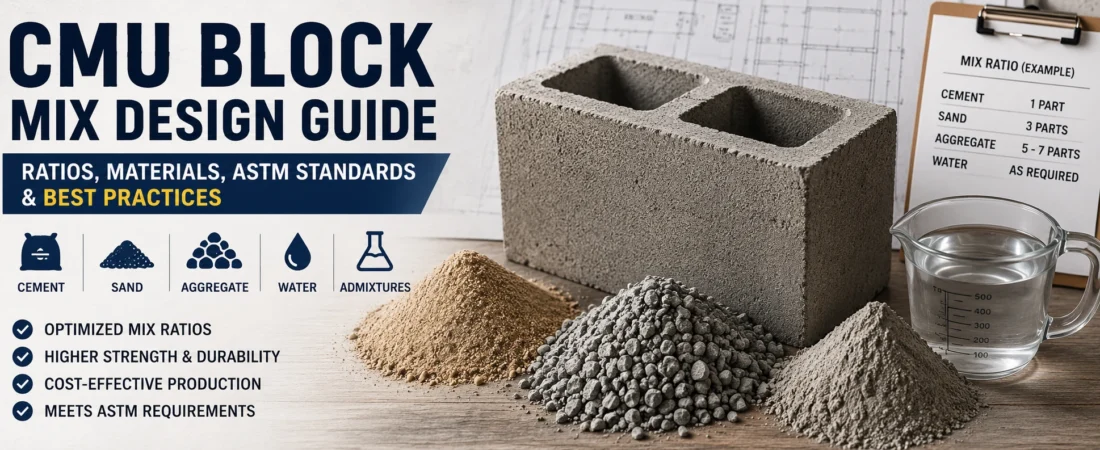
CMU (Concrete Masonry Unit) block mix design is one of the most important factors determining the strength, durability, density, appearance, and overall quality of concrete masonry units. Whether you manufacture concrete blocks commercially, operate a block production plant, or simply want to understand how concrete blocks are made, selecting the correct mix design is essential for producing high-quality CMU blocks that meet ASTM requirements.
A properly engineered mix design not only improves compressive strength but also minimizes cracks, reduces water absorption, increases durability, and lowers production costs by optimizing material usage.
This comprehensive guide explains everything about CMU block mix design, including material selection, standard mix ratios, water-cement ratio, aggregate grading, ASTM requirements, production techniques, common mistakes, and quality control practices.
What Is CMU Block Mix Design?
CMU block mix design is the process of selecting and proportioning raw materials to produce concrete masonry units with the desired engineering properties.
A mix design determines:
- Cement content
- Fine aggregate quantity
- Coarse aggregate quantity
- Water content
- Moisture percentage
- Optional admixtures
- Expected compressive strength
- Density
- Workability
The primary goal is to produce blocks that satisfy structural requirements while maintaining cost efficiency during manufacturing.
Why Proper Mix Design Is Important
Many manufacturers focus only on reducing material costs, but an improper mix design often results in defective blocks that eventually increase production expenses.
A well-designed CMU mix provides several benefits.
- Higher compressive strength
- Better dimensional accuracy
- Reduced cracking
- Lower water absorption
- Improved durability
- Better curing performance
- Longer service life
- Compliance with ASTM standards
- Lower production waste
- Consistent block quality
Proper mix design also improves machine productivity because uniform mixes compact more efficiently during vibration and compression.
Main Ingredients Used in CMU Block Mix Design
Concrete masonry units are manufactured using carefully selected raw materials.
| Material | Purpose |
|---|---|
| Portland Cement | Primary binding material |
| Sand | Fills voids and improves surface finish |
| Coarse Aggregate | Provides strength and dimensional stability |
| Water | Activates cement hydration |
| Admixtures (Optional) | Improve workability, curing, or durability |
| Pigments (Optional) | Produce colored CMU blocks |
Each ingredient directly influences the final performance of the block.
Portland Cement
Portland cement is the primary binding agent responsible for developing strength.
Most manufacturers use:
- ASTM C150 Type I Cement
- ASTM C595 Blended Cement (where applicable)
Increasing cement content generally increases strength, but excessive cement can significantly raise manufacturing costs without proportional benefits.
Proper cement dosage should balance both performance and economics.
Fine Aggregate (Sand)
Sand fills small voids between coarse aggregate particles.
Good quality sand should be:
- Clean
- Well graded
- Free from clay
- Free from organic matter
- Low in silt content
Poor quality sand often causes weak bonding and inconsistent block strength.
Coarse Aggregate
Coarse aggregates provide the structural framework of CMU blocks.
Common materials include:
- Crushed stone
- Gravel
- Limestone
- Manufactured aggregate
Aggregate size is carefully controlled to ensure proper compaction during block production.
Oversized aggregates may create honeycombing and surface defects.
Water
Water initiates cement hydration.
Unlike conventional concrete, CMU production uses a relatively low water content because blocks are compacted using mechanical vibration and compression rather than poured into forms.
Too much water may cause:
- Weak blocks
- Poor shape retention
- Slow production
- Surface defects
Too little water can result in:
- Poor compaction
- Low strength
- Incomplete hydration
Maintaining the correct moisture content is one of the most critical aspects of successful block manufacturing.
Optional Admixtures
Modern CMU manufacturers may incorporate admixtures to improve production efficiency.
Common admixtures include:
- Water reducers
- Plasticizers
- Air entraining agents
- Accelerators
- Integral waterproofing admixtures
- Efflorescence control chemicals
These materials are generally used in small quantities but can significantly enhance block performance when properly selected.
Typical CMU Block Mix Ratio
There is no single universal mix ratio suitable for every concrete block because the design depends on:
- Required compressive strength
- Block density
- Block type
- Aggregate characteristics
- Local material availability
- Manufacturing equipment
However, a commonly used reference mix for normal-weight CMU blocks is shown below.
| Material | Typical Proportion |
|---|---|
| Cement | 1 Part |
| Sand | 3 Parts |
| Coarse Aggregate | 5–7 Parts |
| Water | As required for zero-slump concrete |
This ratio serves only as a starting point. Commercial manufacturers usually adjust proportions after laboratory testing to achieve the desired strength and durability.
Understanding Zero-Slump Concrete
Unlike ready-mix concrete used for slabs or foundations, CMU manufacturing uses zero-slump concrete.
Zero-slump concrete contains very little water, allowing freshly molded blocks to maintain their shape immediately after leaving the machine.
Benefits include:
- Faster production
- Better dimensional accuracy
- Improved edge quality
- Reduced deformation
- Higher production efficiency
The mix should appear damp rather than wet.
When squeezed by hand, it should hold its shape without releasing excess water.
Water-Cement Ratio
One of the most important parameters in concrete technology is the water-cement ratio (w/c ratio).
Lower water-cement ratios generally increase compressive strength because they reduce pore formation inside hardened concrete.
Typical CMU production uses significantly less water than cast-in-place concrete.
Maintaining a consistent water-cement ratio helps manufacturers achieve:
- Uniform density
- Higher strength
- Reduced shrinkage
- Better curing performance
- Improved durability
Instead of adding extra water to improve workability, manufacturers usually optimize aggregate grading and moisture control.
Aggregate Gradation
Aggregate gradation refers to the particle size distribution of sand and coarse aggregate.
Proper grading improves:
- Packing density
- Strength
- Surface finish
- Machine efficiency
- Cement utilization
Poor grading creates excessive voids that require additional cement, increasing manufacturing costs without improving quality.
Professional manufacturers regularly perform sieve analysis to maintain consistent aggregate gradation throughout production.
Moisture Control During Block Manufacturing
Moisture control is one of the most overlooked aspects of CMU block production. Even when the mix ratio is correct, inconsistent moisture can lead to weak blocks, dimensional variations, surface defects, and unnecessary production downtime.
Manufacturers should regularly check the moisture content of aggregates because rain, humidity, and storage conditions can significantly affect the amount of water already present in the materials.
Signs of excessive moisture include:
- Blocks sticking to molds
- Rounded corners
- Surface cracks after demolding
- Poor dimensional accuracy
- Longer curing time
Signs of insufficient moisture include:
- Rough block surfaces
- Honeycombing
- Low compressive strength
- Poor edge formation
- Excessive material wastage
Maintaining consistent moisture throughout production helps produce blocks with uniform density and predictable strength.
Normal Weight vs Lightweight CMU Mix Design
Concrete masonry units are manufactured in different density classifications depending on their intended application.
| Property | Normal Weight CMU | Lightweight CMU |
|---|---|---|
| Aggregate Type | Crushed stone or gravel | Expanded shale, clay, slate, pumice |
| Density | Higher | Lower |
| Weight | Heavy | Light |
| Thermal Insulation | Moderate | Better |
| Sound Insulation | Good | Very Good |
| Structural Strength | High | Moderate to High |
Lightweight blocks reduce dead loads while improving thermal efficiency, making them popular in many commercial and residential projects.
Hollow Block Mix Design
Most structural CMU blocks manufactured in North America are hollow units.
A typical hollow block mix is designed to provide:
- High compressive strength
- Reduced weight
- Lower material consumption
- Better grout placement
- Easier reinforcement installation
Because hollow blocks contain internal voids, maintaining proper compaction during manufacturing is essential.
Poor vibration often produces weak webs and face shells.
Solid Block Mix Design
Solid concrete blocks require slightly different material proportions because they contain more concrete volume than hollow blocks.
Compared to hollow blocks, solid units generally require:
- Higher material consumption
- Better compaction
- Increased curing attention
- Greater cement efficiency
Solid blocks are commonly used where higher load-bearing capacity or enhanced durability is required.
Machine-Made CMU Mix Design
Modern automatic block machines produce concrete masonry units using vibration and hydraulic compression.
Machine production requires:
- Uniform aggregate grading
- Consistent moisture content
- Zero-slump concrete
- Accurate batching
- Continuous quality monitoring
Benefits include:
- Faster production
- Better dimensional accuracy
- Consistent strength
- Lower labor costs
- Improved production efficiency
Large manufacturing plants typically use computerized batching systems to maintain consistent mix proportions throughout the production cycle.
Manual CMU Block Production
Small manufacturers often produce blocks using manually operated or semi-automatic machines.
Although the production method differs, the principles of good mix design remain the same.
Manufacturers should pay special attention to:
- Uniform batching
- Accurate water measurement
- Proper hand mixing or mechanical mixing
- Adequate vibration
- Correct curing practices
Consistency is often more important than simply increasing cement content.
Recommended Batching Practices
Accurate batching ensures that every block produced has similar engineering properties.
Professional manufacturers generally follow these best practices:
- Measure materials using calibrated equipment.
- Keep aggregate moisture consistent.
- Avoid estimating water by visual inspection alone.
- Store cement in dry conditions.
- Protect aggregates from contamination.
- Mix materials thoroughly before production.
Poor batching is one of the leading causes of inconsistent compressive strength.
Mixing Procedure
A proper mixing sequence improves material distribution and reduces production defects.
A typical mixing process includes:
- Add coarse aggregate.
- Add fine aggregate.
- Add cement.
- Dry mix until materials are evenly distributed.
- Add water gradually.
- Continue mixing until the desired consistency is achieved.
- Transfer the mix immediately to the block machine.
Avoid adding excessive water after the mixing process has been completed.
How Mix Design Affects Compressive Strength
Compressive strength is one of the most important quality indicators of concrete masonry units.
Several factors influence the final strength of a CMU block:
- Cement quality
- Aggregate quality
- Water-cement ratio
- Compaction
- Curing conditions
- Moisture control
- Aggregate grading
- Manufacturing equipment
Improving only one factor while neglecting the others rarely produces consistent results.
A balanced mix design supported by proper manufacturing practices is the most effective way to achieve reliable strength.
ASTM Requirements Related to Mix Design
While ASTM standards specify performance requirements rather than prescribing a fixed mix ratio, manufacturers must ensure that their mix design consistently produces blocks meeting the required properties.
Important considerations include:
- Required compressive strength
- Density classification
- Dimensional tolerances
- Water absorption limits
- Material quality
Manufacturers typically verify compliance through laboratory testing rather than relying solely on theoretical mix proportions.
For a detailed explanation of ASTM requirements, read our CMU Block ASTM Standards Explained guide.
Common CMU Mix Design Mistakes
Many production problems can be traced back to improper mix design rather than machine defects.
Some of the most common mistakes include:
- Adding excessive water to improve workability.
- Using poorly graded aggregates.
- Inconsistent batching methods.
- Low cement content.
- Inadequate mixing time.
- Ignoring aggregate moisture variations.
- Using contaminated raw materials.
- Poor curing practices.
- Lack of routine quality testing.
Correcting these issues can significantly improve product consistency without major investments in new equipment.
Troubleshooting Common Mix Design Problems
| Problem | Possible Cause | Recommended Solution |
|---|---|---|
| Low compressive strength | High water content, poor compaction | Reduce water, improve vibration, verify batching |
| Surface cracks | Rapid drying or excess water | Improve curing and moisture control |
| Honeycombing | Poor aggregate grading or inadequate vibration | Adjust aggregate blend and machine settings |
| Rounded corners | Excessive moisture | Reduce water content |
| Rough surface finish | Dry mix or poor sand quality | Improve moisture balance and use well-graded sand |
| Block deformation | Wet mix | Maintain proper zero-slump consistency |
Best Practices for CMU Block Mix Design
Manufacturers seeking consistent, high-quality concrete masonry units should follow these proven practices:
- Use clean, high-quality raw materials.
- Maintain accurate batching procedures.
- Monitor aggregate moisture daily.
- Keep the water-cement ratio consistent.
- Perform regular sieve analysis on aggregates.
- Use zero-slump concrete for machine production.
- Cure blocks under controlled conditions.
- Conduct routine compressive strength testing.
- Calibrate batching equipment regularly.
- Continuously monitor product quality and adjust the mix only when supported by testing data.
Following these practices helps reduce waste, improve production efficiency, and produce concrete masonry units that consistently meet project specifications and customer expectations.
Frequently Asked Questions (FAQs)
What is the best mix ratio for CMU blocks?
There is no universal mix ratio suitable for every concrete masonry unit because the required proportions depend on block type, compressive strength, aggregate quality, and manufacturing equipment.
Many manufacturers begin with a reference ratio of 1 part cement, 3 parts sand, and 5–7 parts coarse aggregate, then adjust the proportions after laboratory testing to meet performance requirements.
Which cement is commonly used for CMU blocks?
Most manufacturers use ASTM C150 Type I Portland Cement or other approved cement types suitable for concrete masonry production.
The cement should be fresh, properly stored, and free from moisture contamination.
Why does water content matter?
Water directly affects:
- Compressive strength
- Density
- Durability
- Block shape
- Surface quality
Too much water produces weak and deformed blocks, while too little water prevents proper compaction and hydration.
Professional manufacturers carefully control the water content during every production batch.
Can recycled aggregates be used in CMU blocks?
Yes. Recycled concrete aggregates may be used when they satisfy project specifications and produce blocks meeting the required engineering performance.
Before large-scale production, manufacturers should perform laboratory testing to verify strength, density, absorption, and durability.
Does increasing cement always make stronger blocks?
Not necessarily.
While increasing cement content may improve strength, excessive cement can increase production costs and sometimes lead to higher shrinkage if the overall mix is not properly balanced.
The most economical mix design is one that achieves the required performance using optimized material proportions.
What is the ideal moisture level for machine-made blocks?
Machine-produced CMU blocks generally require a zero-slump concrete mix with controlled moisture.
The mix should hold its shape when compressed but should not release excess water.
Maintaining consistent moisture is more important than simply adding extra water during production.
How often should the mix design be reviewed?
Manufacturers should review and verify their mix design whenever there are significant changes in:
- Cement supplier
- Aggregate source
- Material grading
- Production equipment
- Product specifications
- Strength requirements
Regular quality testing helps ensure the mix continues to produce blocks meeting design expectations.
Related Calculators
- CMU Block Calculator
- CMU Material Cost Calculator
- CMU Grout Calculator
- CMU Labor Cost Calculator
- Concrete Calculator
- Mortar Calculator
- Foundation Calculator
Related Guides
- Complete CMU Block Production Guide
- CMU Block Quality Control Guide
- CMU Block ASTM Standards Explained
- CMU Construction Cost Per Square Foot
- CMU Wall Thickness Guide
- Standard Cinder Block Sizes
- How Many CMU Blocks Per Pallet
- CMU Block Business Profit Margin
- How to Price CMU Wall Jobs
- How to Start a CMU Block Business
Final Thoughts
A well-engineered CMU block mix design is the foundation of producing durable, high-quality concrete masonry units. The correct combination of cement, aggregates, water, and optional admixtures not only determines compressive strength but also influences density, durability, water absorption, appearance, and long-term performance.
Successful manufacturers understand that there is no single mix suitable for every project. Instead, the most effective approach is to develop a balanced mix based on material quality, production equipment, environmental conditions, and required performance standards. Consistent batching, proper moisture control, accurate aggregate grading, controlled curing, and routine quality testing are equally important in achieving reliable results.
Whether you operate a small block-making facility or a fully automated manufacturing plant, investing time in optimizing your mix design can reduce production costs, minimize defects, improve customer satisfaction, and ensure compliance with industry standards.
By combining proper mix proportions with proven manufacturing practices and regular quality control, you can consistently produce concrete masonry units that meet structural requirements while maintaining efficiency and profitability.