
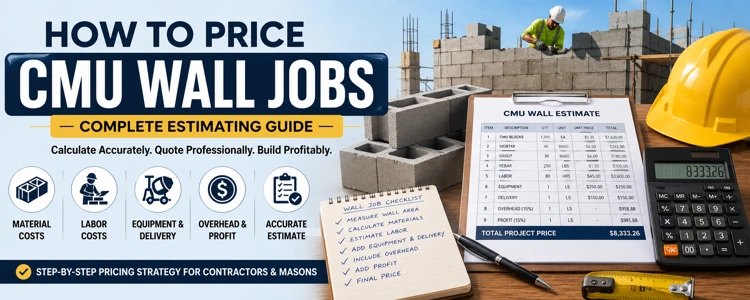
Pricing a CMU (Concrete Masonry Unit) wall job is one of the most important parts of running a successful masonry business. Setting prices too low can reduce profits, while pricing too high may cause you to lose potential customers.
Whether you are a masonry contractor, construction estimator, or starting a CMU block business, understanding how to calculate the true cost of a wall project helps you prepare accurate estimates and remain competitive.
This guide explains the key factors that influence CMU wall pricing, common estimating methods, labor considerations, material costs, and best practices for creating professional project estimates.
Accurate pricing starts with understanding the total project cost. If you want to estimate overall construction expenses before preparing a contractor quote, read our CMU Construction Cost Per Square Foot Guide.
Why Accurate Pricing Matters
Every CMU wall project has different requirements.
Accurate pricing helps you:
- Protect profit margins
- Win more projects
- Reduce unexpected expenses
- Improve customer confidence
- Prepare professional quotations
- Plan labor and materials efficiently
Poor estimating can lead to material shortages, project delays, or financial losses.
What Is Included in a CMU Wall Estimate?
A complete estimate should include more than just the cost of concrete blocks.
Typical project costs include:
- CMU blocks
- Mortar
- Grout
- Reinforcing steel
- Labor
- Equipment
- Material delivery
- Waste allowance
- Contractor overhead
- Profit margin
Considering every cost produces a more realistic project price.
Measure the Wall Area First
Before estimating costs, calculate the total wall area.
Measure:
- Wall length
- Wall height
Formula:
Wall Area = Length × Height
Accurate measurements are the foundation of every professional estimate.
You can also use:
CMU Wall Area CalculatorCalculate the Number of CMU Blocks
Once the wall area is known, estimate how many blocks will be required.
The quantity depends on:
- Block size
- Wall dimensions
- Openings for doors and windows
- Waste percentage
Helpful tool:
CMU Block CalculatorEstimate Material Costs
Material costs usually represent a significant portion of the total project budget.
Typical materials include:
Concrete Masonry Units
The number of blocks depends on wall dimensions and block size.
Mortar
Mortar is required to bond blocks together.
Use:
Mortar CalculatorGrout
Reinforced walls often require grout.
Estimate grout requirements before finalizing your quote.
CMU Grout CalculatorReinforcing Steel
Structural walls may require:
- Vertical rebar
- Horizontal reinforcement
- Bond beams
These materials should always be included when applicable.
Calculate Labor Costs
Labor is often the largest expense in masonry construction.
Labor costs depend on:
- Crew size
- Experience
- Productivity
- Wall complexity
- Project location
- Weather conditions
Estimate labor separately instead of combining it with material costs.
Helpful tool:
CMU Labor Cost CalculatorInclude Equipment Costs
Some projects require specialized equipment such as:
- Scaffolding
- Forklifts
- Concrete mixers
- Material lifts
- Safety equipment
These costs should be included in your estimate when necessary.
Consider Delivery Charges
Material transportation can significantly affect project pricing.
Delivery costs vary depending on:
- Distance
- Fuel prices
- Truck size
- Number of deliveries
Ignoring transportation costs may reduce profitability.
Add Waste Allowance
Construction projects rarely use exactly the calculated material quantities.
Waste may occur because of:
- Broken blocks
- Cutting
- Handling damage
- Design changes
Many contractors include a small waste allowance when estimating materials.
Include Business Overhead
Every masonry business has operating expenses beyond the construction site.
Examples include:
- Insurance
- Office expenses
- Vehicle maintenance
- Fuel
- Employee wages
- Advertising
- Software
- Taxes
Ignoring overhead can reduce long-term profitability.
Add Your Profit Margin
Profit should be calculated after all project costs have been estimated.
Profit margins vary depending on:
- Competition
- Project complexity
- Risk level
- Market conditions
Avoid reducing prices simply to win projects if it affects profitability.
Factors That Affect CMU Wall Pricing
Several variables influence the final project price.
These include:
Wall Thickness
Thicker walls require additional materials and labor.
Related article:
CMU Wall Thickness GuideWall Height
Higher walls may require scaffolding and additional labor.
Reinforcement Requirements
Structural walls usually require more steel and grout.
Architectural Features
Curved walls, corners, decorative finishes, and complex layouts generally increase labor time.
Project Accessibility
Limited site access can increase installation costs.
Common Pricing Mistakes
New contractors often make estimating mistakes.
Avoid:
- Underestimating labor
- Ignoring waste
- Forgetting delivery costs
- Excluding overhead
- Using outdated material prices
- Not accounting for reinforcement
Review every estimate carefully before submitting it to a client.
Tips for Creating Professional Quotes
Professional estimates should be:
- Easy to understand
- Itemized
- Accurate
- Transparent
Include:
- Material costs
- Labor costs
- Equipment
- Taxes (if applicable)
- Total project cost
Clear quotations help build customer trust.
Recommended Estimating Tools
Use these calculators to improve estimate accuracy:
- CMU Block Calculator
- CMU Wall Area Calculator
- CMU Material Cost Calculator
- CMU Labor Cost Calculator
- CMU Grout Calculator
- Mortar Calculator
Related Articles
- CMU Construction Cost Per Square Foot
- CMU Mortar Mix Ratio Guide
- How to Start a CMU Block Business in USA
- What Is a CMU Block?
- CMU Wall Thickness Guide
Frequently Asked Questions
How do contractors price CMU wall jobs?
Most contractors calculate material costs, labor, equipment, delivery, overhead, and profit before preparing a final estimate.
What is the biggest cost in a CMU wall project?
Labor and materials are usually the largest components of a CMU wall estimate.
Should waste be included in the estimate?
Yes. Including a reasonable waste allowance helps improve estimate accuracy.
Can online calculators improve estimates?
Yes. Estimating calculators help contractors calculate material quantities, labor costs, and overall project budgets more efficiently.
Final Thoughts
Learning how to price CMU wall jobs is essential for contractors, estimators, and masonry business owners. A complete estimate should include materials, labor, equipment, overhead, and profit rather than focusing only on the cost of concrete blocks.
Using professional estimating methods and reliable calculation tools can improve pricing accuracy, strengthen customer confidence, and support long-term business growth.