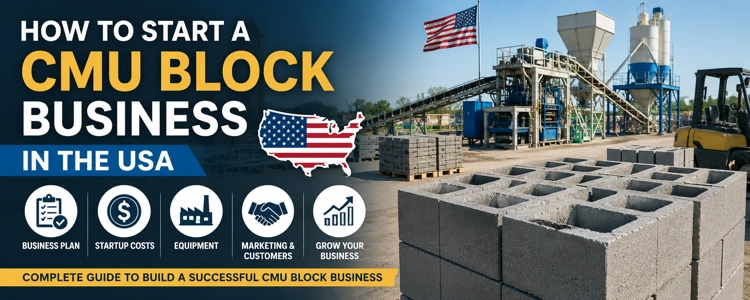
Concrete Masonry Units (CMU), commonly known as concrete blocks, are widely used in residential, commercial, industrial, and infrastructure construction projects throughout the United States. As construction activity continues across many states, the demand for quality CMU blocks remains steady, creating opportunities for entrepreneurs interested in the masonry industry.
Starting a CMU block business can involve much more than manufacturing blocks. Depending on your budget and experience, you may become a manufacturer, distributor, supplier, retailer, or masonry contractor specializing in CMU construction.
This guide explains how to start a CMU block business in USA, what equipment and planning are required, startup considerations, and practical strategies for building a successful business.
What Is a CMU Block Business?
A CMU block business is a company involved in manufacturing, supplying, selling, or installing concrete masonry units for construction projects.
Depending on your goals, your business may focus on one or more of the following services:
- Manufacturing concrete masonry blocks
- Wholesale CMU distribution
- Retail block sales
- Masonry wall installation
- Commercial masonry contracting
- Foundation construction
- Retaining wall construction
- Material supply for contractors
Many successful companies gradually expand into multiple services as the business grows.
Why Start a CMU Block Business in the USA?
The United States construction industry uses millions of concrete masonry blocks every year for residential, commercial, and industrial projects.
CMU blocks remain popular because they offer:
- Excellent durability
- Fire resistance
- Structural strength
- Cost-effective construction
- Long service life
- Low maintenance requirements
As cities continue to expand and infrastructure projects increase, the demand for masonry materials continues in many regions.
Different Types of CMU Businesses
Before investing, decide which business model best matches your experience and budget.
1. CMU Block Manufacturing
Manufacturers produce concrete masonry blocks using specialized block-making machines.
This model generally requires:
- Larger investment
- Manufacturing equipment
- Production facility
- Employees
- Quality control systems
Although startup costs are higher, manufacturing offers greater production capacity and long-term growth potential.
2. CMU Block Supplier
Instead of manufacturing blocks, suppliers purchase blocks from manufacturers and sell them to contractors and builders.
Advantages include:
- Lower startup investment
- Reduced equipment costs
- Faster business launch
- Easier inventory management
Many small businesses begin as suppliers before opening their own production facilities.
3. Masonry Contractor
Some entrepreneurs specialize in installing CMU walls rather than selling blocks.
Typical services include:
- Foundation walls
- Retaining walls
- Basement walls
- Commercial masonry
- Residential block walls
This model focuses more on labor, project management, and installation quality.
4. Construction Material Dealer
Material dealers sell multiple construction products alongside CMU blocks.
These products may include:
- Cement
- Sand
- Gravel
- Mortar
- Rebar
- Concrete blocks
Offering multiple products allows businesses to serve contractors from one location.
Research Your Local Market
One of the biggest mistakes new business owners make is purchasing equipment before understanding local demand.
Before investing, research:
- Local construction activity
- New housing developments
- Commercial projects
- Government infrastructure work
- Existing competitors
- Material pricing
Understanding the market helps reduce business risk.
Choose Your Target Customers
Not every customer has the same requirements.
Your target audience may include:
Residential Builders
Small housing projects.
Commercial Contractors
Warehouses, offices, and shopping centers.
Government Projects
Schools, roads, public buildings, and infrastructure.
Masonry Contractors
Contractors often purchase blocks in large quantities.
Construction Companies
Large construction firms require consistent material supply throughout the project.
Knowing your ideal customer helps shape your pricing, inventory, and marketing strategy.
Create a Business Plan
Every successful business begins with a clear business plan.
Your plan should include:
- Business goals
- Startup budget
- Equipment requirements
- Target customers
- Marketing strategy
- Revenue projections
- Operating expenses
- Growth plans
A well-prepared business plan also improves your chances of securing financing.
Decide Whether to Manufacture or Resell
Many entrepreneurs assume manufacturing is always the better option.
In reality, each model has advantages.
Manufacturing
Advantages:
- Higher profit potential
- Greater production control
- Brand recognition
Challenges:
- Higher investment
- More employees
- Larger facility
Reselling
Advantages:
- Lower startup costs
- Faster launch
- Reduced operational complexity
Challenges:
- Lower profit margins
- Dependence on suppliers
Choose the model that aligns with your available capital and long-term goals.
Find Reliable CMU Suppliers
If you plan to distribute blocks rather than manufacture them, selecting reliable suppliers becomes one of your most important decisions.
Look for suppliers that provide:
- Consistent quality
- Competitive pricing
- Reliable delivery
- Product availability
- Good customer service
Long-term supplier relationships help ensure stable inventory and satisfied customers.
Understand Product Specifications
Before selling or installing CMU blocks, become familiar with common product specifications.
These include:
- Standard block sizes
- Block weights
- Hollow vs solid blocks
- Load-bearing blocks
- Architectural blocks
- Specialty masonry units
Customers often expect guidance when selecting the right product for their project.
You can also read:
What Is a CMU Block?Learn Material Estimation
Customers frequently ask questions such as:
- How many CMU blocks are needed?
- How much grout is required?
- What will the project cost?
- How much labor is needed?
Providing accurate estimates builds trust and improves customer service.
Helpful tools include:
- CMU Block Calculator
- CMU Material Cost Calculator
- CMU Labor Cost Calculator
- CMU Grout Calculator
- CMU Wall Area Calculator
Build Relationships with Contractors
Many successful CMU businesses grow through long-term relationships rather than one-time sales.
Contractors value suppliers who provide:
- Consistent quality
- On-time delivery
- Competitive pricing
- Accurate estimates
- Professional support
Building trust often leads to repeat business and referrals.
How Much Does It Cost to Start a CMU Block Business?
The amount of money required depends on the type of business you plan to start.
For example:
Small CMU Supplier
Usually requires:
- Inventory
- Storage space
- Delivery arrangements
- Basic office setup
Startup investment is generally lower because manufacturing equipment is not required.
Medium-Scale Manufacturing Business
Typically requires:
- Block-making machines
- Mixers
- Pallets
- Forklifts
- Storage yard
- Delivery trucks
- Employees
Manufacturing businesses usually require significantly more capital but also provide greater long-term growth opportunities.
Large Commercial Operation
Large manufacturers often invest in:
- Automated production lines
- Multiple curing areas
- Quality control laboratories
- Fleet management
- Distribution centers
The exact investment depends on production capacity and business goals.
Equipment Needed for a CMU Block Business
If you plan to manufacture CMU blocks, you will typically need:
- Concrete block making machine
- Concrete mixer
- Aggregate storage bins
- Cement storage
- Water supply system
- Material conveyors
- Pallets
- Forklift
- Delivery truck
- Curing area
Additional equipment may be required depending on production volume.
Licenses and Business Registration
Every state has different business requirements.
Before starting operations, research local regulations regarding:
- Business registration
- Sales tax requirements
- Contractor licensing (if applicable)
- Environmental regulations
- Zoning requirements
- Employee regulations
Consult your local authorities or a qualified business advisor to understand the requirements that apply to your location.
Choose the Right Business Location
Location can have a major impact on operating costs and customer convenience.
A good location should provide:
- Easy truck access
- Adequate storage space
- Room for future expansion
- Good road connectivity
- Proximity to construction activity
Reducing transportation time can improve customer satisfaction and lower operating costs.
Build Relationships with Contractors
Successful CMU businesses rarely depend on walk-in customers alone.
Most long-term sales come from:
- General contractors
- Masonry contractors
- Home builders
- Commercial developers
- Government contractors
Building strong business relationships often leads to repeat orders throughout the year.
Offer Accurate Material Estimates
Many contractors appreciate suppliers who can quickly estimate project materials.
Helpful estimates include:
- Number of blocks
- Mortar quantity
- Grout quantity
- Labor estimate
- Material cost
Providing estimates saves customers time and increases confidence.
Helpful tools:
- CMU Block Calculator
- CMU Material Cost Calculator
- CMU Labor Cost Calculator
- CMU Grout Calculator
- CMU Wall Area Calculator
Create a Professional Website
Today, many contractors search online before contacting suppliers.
A professional website should include:
- Company information
- Products
- Services
- Contact details
- Calculator tools
- Educational guides
Publishing useful resources helps establish credibility and attract organic traffic.
Invest in Digital Marketing
Online marketing can help generate qualified leads.
Popular channels include:
- Google Search
- Google Business Profile
- Email marketing
Educational content can also help attract builders and contractors looking for reliable information.
Provide Excellent Customer Service
Customers often return to businesses that provide:
- Honest pricing
- Reliable delivery
- Professional communication
- Accurate estimates
- Consistent product quality
Good customer service is one of the strongest long-term competitive advantages.
Common Mistakes to Avoid
Many new business owners make avoidable mistakes.
Examples include:
- Buying expensive equipment too early
- Ignoring market demand
- Underpricing products
- Poor inventory management
- Weak supplier relationships
- Inconsistent quality control
- Limited marketing efforts
Avoiding these issues can improve business stability.
Can a CMU Block Business Be Profitable?
Profitability depends on several factors, including:
- Local demand
- Operating costs
- Product quality
- Customer relationships
- Efficient operations
- Pricing strategy
Businesses that consistently deliver quality products and dependable service are generally better positioned for long-term success.
Tips for Growing Your Business
As your business expands, consider:
- Adding new product lines
- Offering delivery services
- Selling related construction materials
- Building contractor partnerships
- Improving online visibility
- Investing in modern equipment
Steady growth is often more sustainable than rapid expansion.
Related Calculators
- CMU Block Calculator
- CMU Material Cost Calculator
- CMU Labor Cost Calculator
- CMU Grout Calculator
- CMU Wall Area Calculator
- CMU Wall Weight Calculator
Related Articles
- What Is a CMU Block?
- CMU Construction Cost Per Square Foot
- CMU Mortar Mix Ratio Guide
- CMU Wall Thickness Guide
- CMU Wall Waterproofing Guide
- How Many CMU Blocks Per Pallet?
Frequently Asked Questions
Is starting a CMU block business profitable?
Profitability depends on demand, operating costs, pricing strategy, and efficient business management.
Do I need to manufacture CMU blocks to start a business?
No. Many successful businesses begin as distributors, suppliers, or masonry contractors before investing in manufacturing.
What equipment is required for manufacturing?
Typical equipment includes a block-making machine, concrete mixer, curing area, pallets, forklifts, and delivery vehicles.
How do I find customers?
Potential customers include contractors, builders, developers, government projects, and construction companies. Building relationships and maintaining a professional online presence can help attract new business.
Is a website important for a CMU business?
Yes. A professional website showcasing products, services, educational content, and estimation tools can help build credibility and generate inquiries.
Final Thoughts
Starting a CMU block business in the USA requires careful planning, market research, reliable suppliers, and a clear understanding of customer needs. Whether you choose manufacturing, supplying, or masonry contracting, success depends on consistent product quality, professional service, and smart business management.
As your business grows, investing in educational resources, accurate estimation tools, and strong contractor relationships can help you stand out in a competitive market and build long-term success.