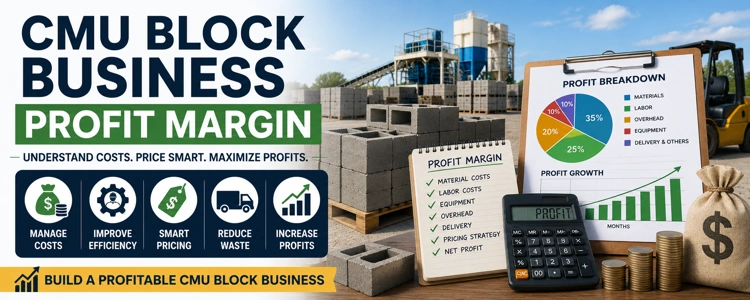
Starting a CMU (Concrete Masonry Unit) block business can be a profitable opportunity when it is managed efficiently. However, one of the first questions most entrepreneurs ask is:
“How much profit can a CMU block business make?”
The answer depends on several factors, including production costs, labor efficiency, material pricing, equipment investment, customer demand, and business management.
Rather than focusing only on sales, successful CMU businesses concentrate on improving profit margins through better estimating, efficient production, waste reduction, and long-term customer relationships.
In this guide, you’ll learn what affects CMU block business profit margins, common operating expenses, pricing strategies, and practical ways to improve profitability.
What Is Profit Margin?
Profit margin is the percentage of money a business keeps after covering its expenses.
For a CMU block business, profit is not simply the difference between the selling price and the cost of a block.
A complete profit calculation considers every business expense, including:
- Raw materials
- Employee wages
- Equipment
- Fuel
- Delivery
- Maintenance
- Insurance
- Rent
- Marketing
- Administrative expenses
Understanding total operating costs helps business owners make informed pricing decisions.
Why Profit Margin Matters
A business with high sales is not always profitable.
Monitoring profit margins helps you:
- Improve cash flow
- Make better pricing decisions
- Plan future investments
- Reduce unnecessary expenses
- Expand operations sustainably
- Measure business performance
Many successful companies focus on improving efficiency instead of simply increasing sales volume.
Factors That Affect CMU Block Business Profit Margin
Several variables influence profitability.
Understanding these factors helps identify opportunities to increase earnings.
Material Costs
Raw materials are one of the largest operating expenses.
Typical materials include:
- Cement
- Sand
- Gravel
- Water
- Chemical additives
Material prices can change because of market conditions, transportation costs, and supplier pricing.
Monitoring material costs regularly helps maintain healthy profit margins.
Labor Costs
Labor is another major expense.
Costs depend on:
- Employee wages
- Crew size
- Productivity
- Training
- Overtime
Improving worker efficiency often increases profitability without increasing product prices.
You can also estimate labor costs using:
CMU Labor Cost CalculatorEquipment Investment
Manufacturing businesses usually require equipment such as:
- Block making machines
- Concrete mixers
- Forklifts
- Conveyors
- Delivery trucks
Although equipment increases startup costs, efficient machinery can reduce long-term production expenses.
Regular maintenance also helps avoid costly breakdowns.
Production Efficiency
The more efficiently your production process operates, the better your profit potential.
Improving efficiency may include:
- Reducing downtime
- Improving workflow
- Training employees
- Scheduling production effectively
- Maintaining equipment
Small efficiency improvements often create significant long-term savings.
Waste Reduction
Material waste directly affects profitability.
Common causes include:
- Broken blocks
- Poor storage
- Incorrect mixing
- Handling damage
- Overproduction
Reducing waste improves overall operating efficiency.
Pricing Strategy
Setting the right selling price is essential.
Prices should cover:
- Material costs
- Labor
- Equipment
- Overhead
- Desired profit
Pricing products too low may increase sales but reduce overall profitability.
Related article:
How to Price CMU Wall JobsDelivery and Transportation Costs
Transportation can become a significant expense, especially for heavy concrete blocks.
Costs may include:
- Fuel
- Vehicle maintenance
- Driver wages
- Insurance
Planning delivery routes efficiently can help reduce operating expenses.
Overhead Expenses
Many new business owners underestimate overhead costs.
Examples include:
- Office expenses
- Utilities
- Internet
- Accounting
- Business licenses
- Insurance
- Marketing
- Software subscriptions
Including overhead in your pricing strategy helps protect profitability.
Customer Relationships
Long-term customers often generate more consistent revenue than one-time buyers.
Providing reliable service can increase repeat business through:
- On-time delivery
- Consistent product quality
- Competitive pricing
- Professional communication
Satisfied customers may also generate referrals.
Ways to Increase CMU Block Business Profit Margin
Improving profitability does not always require increasing prices.
Business owners often improve margins by:
Buying Materials in Bulk
Larger purchases may reduce unit costs.
Reducing Waste
Better inventory management reduces unnecessary expenses.
Improving Productivity
Efficient production helps lower labor costs.
Expanding Product Lines
Selling additional construction materials can increase revenue.
Examples include:
- Mortar
- Sand
- Cement
- Grout
- Reinforcement products
Investing in Marketing
Generating consistent customer inquiries helps maintain production levels.
A professional website, educational content, and local marketing can all support business growth.
Common Mistakes That Reduce Profit
Many businesses reduce profitability because of avoidable mistakes.
Common examples include:
- Underpricing products
- Ignoring overhead
- Poor inventory management
- Low production efficiency
- Weak marketing
- Delayed equipment maintenance
- Inaccurate project estimates
Identifying these problems early helps improve long-term performance.
Should You Focus on Sales or Profit?
Many business owners focus only on increasing sales.
However, profitability often depends more on:
- Better estimating
- Efficient operations
- Cost control
- Customer retention
Growing revenue without controlling expenses may not improve overall business performance.
Recommended Business Tools
Helpful calculators include:
- CMU Material Cost Calculator
- CMU Labor Cost Calculator
- CMU Block Calculator
- CMU Construction Cost Per Square Foot
- How to Price CMU Wall Jobs
Related Articles
- How to Start a CMU Block Business in USA
- How to Price CMU Wall Jobs
- CMU Construction Cost Per Square Foot
- CMU Mortar Mix Ratio Guide
- What Is a CMU Block?
Frequently Asked Questions
Is a CMU block business profitable?
Profitability depends on operating efficiency, pricing strategy, production costs, and customer demand rather than sales volume alone.
What expenses affect profit margins the most?
Material costs, labor, equipment, transportation, and overhead are among the largest operating expenses.
Can improving productivity increase profit?
Yes. Higher efficiency can reduce operating costs and improve overall profitability without increasing prices.
Should transportation costs be included when pricing products?
Yes. Delivery expenses are part of the total cost of doing business and should be considered when setting prices.
Final Thoughts
Building a profitable CMU block business requires more than increasing sales. Successful businesses focus on controlling costs, improving production efficiency, reducing waste, pricing products correctly, and building long-term customer relationships.
By understanding the factors that influence profit margins and using accurate estimating tools, business owners can make better financial decisions and create a stronger foundation for long-term growth.