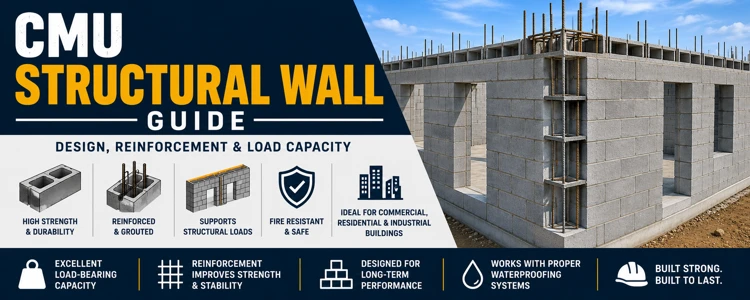
CMU structural walls are designed to support and transfer building loads safely to the foundation. Unlike non-load-bearing walls, structural walls play a critical role in maintaining the strength, stability, and durability of a building.
Concrete masonry unit (CMU) structural walls are commonly used in residential, commercial, industrial, and institutional construction because of their strength, fire resistance, and long service life.
What Is a CMU Structural Wall?
A CMU structural wall is a concrete block wall that supports loads from:
- Roof systems
- Floors
- Beams
- Structural framing
- Building components
Structural walls transfer these loads to the building foundation.
You can also read:
What Is a CMU Block?Structural vs Non-Structural CMU Walls
Not all masonry walls are designed to carry structural loads.
Structural walls:
- Support building loads
- Require reinforcement
- Often use grout-filled cells
- Transfer loads to foundations
Non-structural walls:
- Act as partitions
- Do not carry significant building loads
- Usually require less reinforcement
Understanding this difference is important when selecting wall types for a construction project.
Common Uses of CMU Structural Walls
CMU structural walls are commonly used in:
- Commercial buildings
- Warehouses
- Schools
- Apartment buildings
- Industrial facilities
- Foundation systems
These walls provide excellent long-term structural performance and durability.
Structural Wall Thickness
Wall thickness is one of the most important design factors for structural masonry.
The required thickness depends on:
- Building height
- Structural loads
- Wind loads
- Seismic requirements
- Local building codes
Common wall thicknesses include:
- 8-inch CMU walls
- 10-inch CMU walls
- 12-inch CMU walls
You can also read:
CMU Wall Thickness Guideand
CMU Block Sizes ChartReinforcement Requirements
Most structural masonry walls require reinforcement to improve strength and stability.
Common reinforcement includes:
- Vertical rebar
- Horizontal rebar
- Bond beam systems
- Grouted cells
Proper reinforcement improves:
- Structural capacity
- Crack resistance
- Load transfer
- Seismic performance
You can also read:
CMU Rebar Spacing Guideand
How to Reinforce a CMU WallGrouting Structural Walls
Structural walls commonly require grout-filled cells.
Grouting provides:
- Better load transfer
- Improved rebar bonding
- Increased wall strength
- Greater durability
Both fully grouted and partially grouted systems are used depending on engineering requirements.
You can also read:
CMU Grouting Methods Guideand use:
CMU Grout CalculatorLoad-Bearing Capacity
Structural walls are designed to resist:
- Vertical loads
- Wind loads
- Lateral forces
- Seismic forces
The load-bearing capacity of a wall depends on:
- Wall thickness
- Reinforcement
- Grouting
- Block strength
- Structural design
You can also read:
CMU Load Bearing Wall GuideStructural Foundation Walls
Many structural walls also function as foundation walls.
Foundation walls resist:
- Soil pressure
- Building loads
- Ground movement
- Moisture-related forces
Proper design and reinforcement help maintain long-term structural performance.
You can also read:
CMU Foundation Wall Guideand
CMU Basement Wall GuideStructural Walls in Seismic Zones
Buildings located in earthquake-prone regions often require additional reinforcement.
Seismic masonry systems may include:
- Closer rebar spacing
- Additional bond beams
- Fully grouted walls
- Enhanced connections
These measures improve resistance to seismic forces.
You can also read:
CMU Seismic Design GuideWaterproofing Structural Walls
Structural walls often require waterproofing to protect against moisture intrusion.
Common waterproofing methods include:
- Waterproof membranes
- Foundation coatings
- Drainage systems
- Exterior sealers
Waterproofing helps improve durability and reduce maintenance costs.
You can also read:
CMU Wall Waterproofing GuideAdvantages of CMU Structural Walls
High Strength
Concrete masonry provides excellent structural capacity and load resistance.
Fire Resistance
CMU walls provide outstanding fire protection for residential and commercial structures.
Durability
Properly constructed masonry walls can provide decades of reliable service.
Low Maintenance
Concrete masonry systems require minimal maintenance compared to many alternative wall systems.
Design Flexibility
Structural CMU walls can be used in a wide range of building applications.
Common Structural Wall Problems
Some common issues include:
- Poor reinforcement placement
- Inadequate grouting
- Improper waterproofing
- Foundation settlement
- Structural cracking
Proper design and construction help minimize these problems.
You can also read:
CMU Wall Crack Repair GuideUse a CMU Block Calculator
Before building a structural wall, accurate material estimation is important.
Our CMU Block Calculator helps estimate:
- Block quantities
- Mortar requirements
- Material costs
- Wall dimensions
Related Calculators
- CMU Block Calculator
- CMU Grout Calculator
- Mortar Calculator
- Foundation Calculator
- Rebar Calculator
- Concrete Calculator
Frequently Asked Questions
What is a structural CMU wall?
A structural CMU wall is a concrete block wall designed to support building loads and transfer them safely to the foundation.
Do structural walls require reinforcement?
Most structural walls use reinforcement and grouting to improve strength and stability.
Are CMU structural walls load-bearing?
Yes. Structural walls are typically load-bearing walls.
How thick should a structural CMU wall be?
The required thickness depends on building loads, height, structural design, and local code requirements.
Related Articles
- What Is a CMU Block?
- Types of CMU Blocks
- CMU Load Bearing Wall Guide
- CMU Foundation Wall Guide
- CMU Basement Wall Guide
- CMU Rebar Spacing Guide
- How to Reinforce a CMU Wall
- CMU Grouting Methods Guide
- CMU Wall Thickness Guide
- CMU Wall Waterproofing Guide
Final Thoughts
CMU structural walls provide strength, durability, fire resistance, and long-term reliability for residential and commercial construction. Proper reinforcement, grouting, wall thickness selection, waterproofing, and engineering design help ensure safe and efficient structural performance.
Understanding how structural masonry systems work helps builders, contractors, engineers, and homeowners make better decisions when designing and constructing concrete block structures.