Learn How to Reinforce a CMU Wall:- CMU walls are strong and durable, but reinforcement is often necessary for:
- Structural stability
- Load-bearing capacity
- Wind resistance
- Seismic performance
Proper reinforcement helps masonry walls resist:
- Cracking
- Structural movement
- Lateral pressure
- Heavy loads
Reinforced CMU walls are commonly used in:
- Residential construction
- Commercial buildings
- Retaining walls
- Structural masonry systems
What Is a Reinforced CMU Wall?
A:
reinforced CMU wall
is a concrete masonry wall strengthened with:
- Steel reinforcement bars (rebar)
- Grout filling
- Bond beam systems
- Reinforced masonry techniques
Reinforcement improves:
- Structural strength
- Wall stability
- Durability
- Load resistance
Why Reinforce a CMU Wall?
CMU wall reinforcement is important because it helps masonry walls handle:
- Wind loads
- Structural loads
- Soil pressure
- Earthquake forces
- Building movement
Without proper reinforcement:
walls may experience:
- Cracking
- Bowing
- Structural failure
- Reduced lifespan
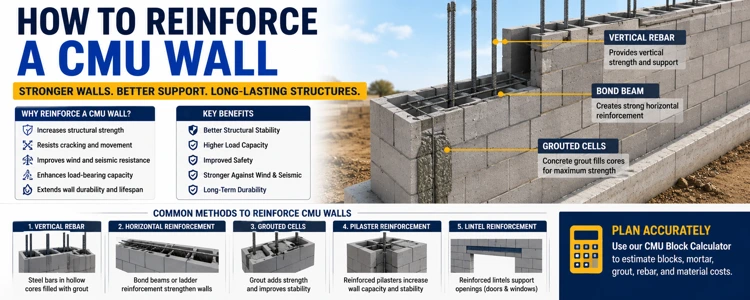
Common Methods to Reinforce a CMU Wall
Several reinforcement methods are commonly used in masonry construction.
1. Vertical Rebar Reinforcement
Vertical reinforcement bars are installed inside hollow CMU cells.
The process usually includes:
- Placing vertical rebar
- Aligning hollow block cores
- Filling cells with grout or concrete
Vertical reinforcement improves:
- Structural support
- Wall rigidity
- Load-bearing performance
2. Horizontal Reinforcement
Horizontal reinforcement helps strengthen masonry walls against:
- Lateral movement
- Cracking
- Structural stress
Common horizontal reinforcement methods include:
- Bond beam blocks
- Ladder wire reinforcement
- Truss reinforcement systems
You can also read:
What Is a Bond Beam Block?3. Grouted CMU Cells
Grouting hollow masonry cells improves:
- Structural integrity
- Wall strength
- Reinforcement bonding
Walls may use:
- Fully grouted cells
- Partially grouted cells
depending on engineering requirements.
4. Bond Beam Reinforcement
Bond beam systems create reinforced horizontal beams inside masonry walls.
Bond beam blocks commonly contain:
- Horizontal steel reinforcement
- Concrete grout filling
These systems improve:
- Structural continuity
- Wall stability
- Load distribution
5. Pilaster Reinforcement
Pilaster systems strengthen masonry walls using:
- Reinforced vertical columns
- Grouted masonry cells
- Structural reinforcement bars
Pilaster blocks are commonly used in:
- Tall masonry walls
- Commercial structures
- Heavy-load walls
You can also read:
What Is a Pilaster Block?Reinforcing CMU Walls Around Openings
Wall openings create weak points in masonry construction.
Areas around:
- Doors
- Windows
- Garage openings
often require:
- Lintel blocks
- Horizontal reinforcement
- Additional rebar
You can also read:
What Is a Lintel Block?Reinforcement and CMU Wall Height
Taller masonry walls usually require:
- Additional reinforcement
- Larger rebar
- More grout filling
- Bond beam systems
You can also read:
How Tall Can a CMU Wall Be?CMU Wall Thickness and Reinforcement
Wall thickness affects:
- Reinforcement requirements
- Structural capacity
- Load resistance
Common wall thicknesses include:
- 4 inch
- 6 inch
- 8 inch
- 12 inch
The:
8-inch reinforced CMU wall
is one of the most common structural masonry systems.
You can also read:
CMU Wall Thickness GuideReinforcement and Seismic Design
In earthquake-prone regions:
seismic reinforcement
is extremely important.
Seismic reinforcement may include:
- Vertical rebar
- Horizontal bond beams
- Fully grouted cells
- Reinforced foundations
These systems improve resistance against:
- Earthquakes
- Structural movement
- Lateral forces
You can also read:
CMU Seismic Design GuideReinforcement and Retaining Walls
CMU retaining walls often require:
- Vertical reinforcement
- Horizontal reinforcement
- Grouted cells
- Strong foundations
because retaining walls resist:
- Soil pressure
- Water pressure
- Lateral loads
Hollow vs Solid CMU Reinforcement
Most reinforced masonry walls use:
hollow CMU blocks
because hollow cores allow:
- Rebar installation
- Grout filling
- Structural reinforcement
You can also read:
Hollow vs Solid Concrete BlocksAdvantages of Reinforced CMU Walls
1. Increased Structural Strength
Reinforcement improves:
- Load-bearing capacity
- Structural performance
- Wall durability
2. Better Crack Resistance
Reinforced walls better resist:
- Structural stress
- Thermal movement
- Lateral pressure
3. Improved Wind Resistance
Reinforced masonry walls better resist:
- High winds
- Storm loads
- Structural movement
4. Better Seismic Performance
Reinforced walls improve safety during:
- Earthquakes
- Ground movement
- Structural vibration
5. Longer Wall Lifespan
Proper reinforcement improves:
- Masonry durability
- Structural reliability
- Long-term performance
Common Uses of Reinforced CMU Walls
Reinforced masonry walls are commonly used in:
- Commercial buildings
- Residential structures
- Retaining walls
- Foundation systems
- School buildings
- Industrial structures
Their:
- Strength
- Durability
- Fire resistance
make them ideal for structural construction.
Use a CMU Block Calculator
Before building a reinforced masonry wall, accurate material estimation is important.
Our:
CMU Block Calculatorhelps estimate:
- Concrete block quantities
- Mortar requirements
- Material costs
- Wall dimensions
You can also use:
- Foundation Calculator
- Rebar Calculator
- Concrete Volume Calculator
- Mortar Calculator
- Gravel Calculator
for additional construction estimation.
Frequently Asked Questions
Why are CMU walls reinforced?
CMU walls are reinforced to improve:
- Structural strength
- Crack resistance
- Wind resistance
- Seismic performance
Do all CMU walls require reinforcement?
Not all walls require reinforcement.
However:
- Structural walls
- Tall walls
- Retaining walls
- Load-bearing masonry systems
usually require reinforcement.
What type of reinforcement is used in CMU walls?
Common reinforcement includes:
- Vertical rebar
- Horizontal reinforcement
- Bond beam systems
- Grouted masonry cells
Are reinforced CMU walls stronger?
Yes.
Reinforced masonry walls provide:
- Higher load-bearing capacity
- Better structural stability
- Improved durability
Related Articles
- What Is a CMU Block?
- What Is a Bond Beam Block?
- What Is a Pilaster Block?
- What Is a Lintel Block?
- How Tall Can a CMU Wall Be?
- CMU Wall Thickness Guide
- CMU Seismic Design Guide
Final Thoughts
Reinforcing a CMU wall is essential for improving:
- Structural strength
- Wall stability
- Crack resistance
- Wind performance
- Seismic safety
Proper reinforcement methods such as:
- Vertical rebar
- Bond beams
- Grouted cells
- Pilaster systems
help create stronger and more durable masonry structures.
Understanding reinforced masonry construction helps contractors, engineers, builders, and homeowners design safer and longer-lasting CMU wall systems.