A:
load bearing CMU wall
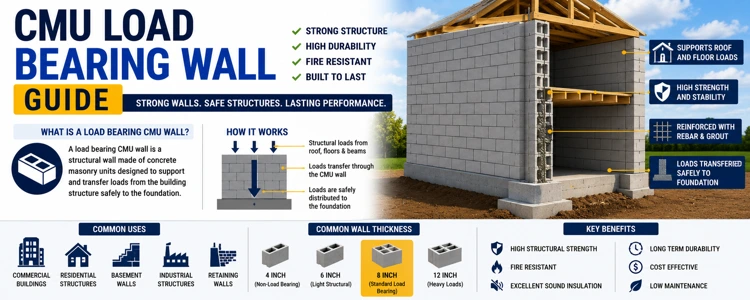
is a concrete masonry wall designed to support structural loads from:
- Roof systems
- Floors
- Beams
- Upper wall sections
These walls transfer loads safely to the:
- Foundation
- Footings
- Structural support system
Load-bearing CMU walls are commonly used in:
- Residential construction
- Commercial buildings
- Industrial structures
- Reinforced masonry systems
Because of their strength and durability, CMU load-bearing walls are widely used in modern masonry construction.
What Is a Load Bearing Wall?
A:
load bearing wall
is a structural wall that supports weight from other building components.
Unlike non-load-bearing walls:
load-bearing walls carry:
- Vertical loads
- Structural pressure
- Building weight
Removing or weakening a structural wall without proper engineering may cause:
- Structural damage
- Wall failure
- Building instability
What Does CMU Stand For?
CMU
stands for:
Concrete Masonry Unit
These concrete blocks are commonly used because they are:
- Strong
- Fire-resistant
- Durable
- Cost-effective
CMU blocks are widely used in:
- Structural walls
- Foundations
- Retaining walls
- Reinforced masonry systems
You can also read:
What Is a CMU Block?How CMU Load Bearing Walls Work
Load-bearing CMU walls transfer structural loads downward through:
- Masonry blocks
- Reinforcement systems
- Foundations
These walls safely distribute loads into:
- Footings
- Concrete foundations
- Structural support systems
Proper engineering design is essential for:
- Structural safety
- Load distribution
- Long-term durability
Common Uses of Load Bearing CMU Walls
CMU load-bearing walls are commonly used in:
- Commercial buildings
- Basement walls
- Apartment buildings
- Warehouses
- Retaining walls
- Structural masonry systems
Their:
- Strength
- Fire resistance
- Durability
make them ideal for structural construction.
CMU Wall Thickness for Load Bearing Walls
Wall thickness plays a major role in:
- Structural capacity
- Wall height
- Load resistance
Common thicknesses include:
| Wall Thickness | Typical Use |
|---|---|
| 4 inch | Non-load-bearing walls |
| 6 inch | Light structural walls |
| 8 inch | Standard load-bearing walls |
| 12 inch | Heavy structural loads |
The:
8-inch CMU wall
is one of the most commonly used load-bearing masonry systems.
You can also read:
CMU Wall Thickness GuideReinforcement in Load Bearing CMU Walls
Many structural masonry walls use reinforcement such as:
- Vertical rebar
- Horizontal reinforcement
- Bond beam systems
- Grouted cells
Reinforcement improves:
- Structural stability
- Load-bearing capacity
- Crack resistance
- Wind resistance
You can also read:
How to Reinforce a CMU WallBond Beam Reinforcement
Bond beam systems create reinforced horizontal beams inside masonry walls.
These systems help:
- Tie walls together
- Improve structural continuity
- Distribute structural loads
Bond beam blocks commonly contain:
- Horizontal steel reinforcement
- Concrete grout filling
You can also read:
<a href="/what-is-a-bond-beam-block/">What Is a Bond Beam Block?</a>Load Bearing Walls and Wall Height
The maximum height of a structural wall depends on:
- Wall thickness
- Reinforcement
- Structural loads
- Wind exposure
- Engineering design
You can also read:
How Tall Can a CMU Wall Be?CMU Block Sizes for Structural Walls
Several standard CMU sizes are commonly used for load-bearing construction.
| Nominal Size | Common Use |
|---|---|
| 6x8x16 | Light structural walls |
| 8x8x16 | Standard load-bearing walls |
| 12x8x16 | Heavy-load masonry systems |
The:
8x8x16 CMU block
is one of the most commonly used structural concrete blocks.
You can also read:
CMU Block Sizes ChartFully Grouted vs Partially Grouted Walls
Load-bearing masonry walls may use:
- Fully grouted systems
- Partially grouted systems
Fully grouted walls provide:
- Higher structural strength
- Improved reinforcement bonding
- Better seismic resistance
Partially grouted walls may reduce:
- Material costs
- Construction weight
depending on structural requirements.
Load Bearing Walls and Seismic Design
In earthquake-prone regions:
seismic reinforcement
is extremely important.
Seismic masonry systems may include:
- Vertical reinforcement
- Horizontal bond beams
- Grouted cells
- Reinforced foundations
You can also read:
CMU Seismic Design GuideAdvantages of CMU Load Bearing Walls
1. High Structural Strength
CMU walls provide:
- Excellent load-bearing capacity
- Strong structural support
- Long-term durability
2. Fire Resistance
Concrete masonry walls offer excellent:
- Fire resistance
- Heat resistance
- Building protection
3. Durability
CMU load-bearing systems resist:
- Weather exposure
- Moisture damage
- Structural wear
4. Better Sound Resistance
Concrete masonry walls improve:
- Noise control
- Acoustic performance
- Sound insulation
5. Long Lifespan
Properly designed masonry walls can last for:
decades
with minimal maintenance.
Load Bearing Walls vs Non-Load Bearing Walls
| Feature | Load Bearing Wall | Non-Load Bearing Wall |
|---|---|---|
| Supports Structural Loads | Yes | No |
| Reinforcement Required | Often | Sometimes |
| Structural Importance | High | Moderate |
| Common Use | Structural support | Interior partitions |
Removing a load-bearing wall usually requires:
structural engineering approval
Common Problems in Load Bearing CMU Walls
Structural masonry walls may experience:
- Cracking
- Moisture infiltration
- Settlement movement
- Reinforcement corrosion
Proper:
- Reinforcement
- Waterproofing
- Control joints
- Structural design
help reduce these issues.
Use a CMU Block Calculator
Before building a structural masonry wall, accurate material estimation is important.
Our:
CMU Block Calculatorhelps estimate:
- Concrete block quantities
- Mortar requirements
- Material costs
- Wall dimensions
You can also use:
- Foundation Calculator
- Rebar Calculator
- Concrete Volume Calculator
- Mortar Calculator
- Gravel Calculator
for additional construction estimation.
Frequently Asked Questions
What is a load-bearing CMU wall?
A load-bearing CMU wall is a structural masonry wall designed to support:
- Roof loads
- Floor loads
- Structural building weight
Are all CMU walls load-bearing?
No.
Some CMU walls are used only for:
- Interior partitions
- Non-structural applications
What thickness is best for load-bearing CMU walls?
The:
8-inch CMU wall
is one of the most common choices for structural masonry systems.
Do load-bearing CMU walls require reinforcement?
Many structural walls require:
- Vertical rebar
- Horizontal reinforcement
- Bond beam systems
- Grouted cells
depending on structural design requirements.
Related Articles
- What Is a CMU Block?
- How to Reinforce a CMU Wall
- What Is a Bond Beam Block?
- CMU Wall Thickness Guide
- How Tall Can a CMU Wall Be?
- CMU Block Sizes Chart
- CMU Seismic Design Guide
Final Thoughts
CMU load-bearing walls are an essential part of structural masonry construction because they provide:
- High structural strength
- Fire resistance
- Long-term durability
- Excellent load-bearing performance
Proper reinforcement, wall thickness, and structural design help create safer and stronger masonry systems for:
- Residential buildings
- Commercial construction
- Industrial structures
Understanding load-bearing masonry walls helps contractors, engineers, builders, and homeowners construct durable and reliable CMU wall systems.