A:
Bond Beam Block
is a special type of concrete masonry unit (CMU) designed to hold:
- Horizontal reinforcement bars (rebar)
- Grout
inside masonry walls.
Bond beam blocks are commonly used in:
- Structural masonry walls
- Reinforced CMU construction
- Load-bearing walls
- Seismic-resistant walls
- Foundation systems
These blocks help improve:
- Structural strength
- Wall stability
- Resistance to cracking
- Wind resistance
- Seismic performance
Bond beam blocks are widely used in residential, commercial, and industrial masonry construction throughout the United States.
What Does a Bond Beam Block Look Like?
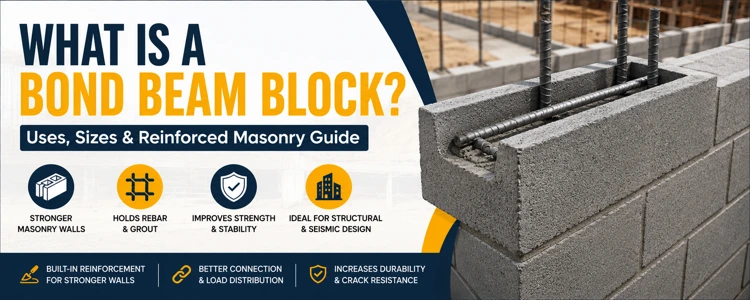
A bond beam block looks similar to a standard CMU block, but the top portion contains:
a continuous channel
This channel allows placement of:
- Horizontal steel reinforcement
- Grout concrete
inside the wall system.
The open channel creates a reinforced horizontal beam within the masonry wall.
Purpose of Bond Beam Blocks
The main purpose of a:
bond beam block
is to strengthen masonry walls by creating reinforced horizontal sections.
These reinforced sections help:
- Distribute loads evenly
- Improve wall stability
- Resist lateral forces
- Tie masonry walls together
Bond beam systems are especially important in:
- Earthquake-prone areas
- High-wind regions
- Large structural walls
How Bond Beam Blocks Work
Bond beam blocks create a reinforced concrete beam inside the wall.
The process usually includes:
- Placing bond beam blocks in a horizontal row
- Installing steel reinforcement bars
- Filling the channel with grout or concrete
Once cured, the reinforced beam improves the structural integrity of the wall.
Common Uses of Bond Beam Blocks
Bond beam blocks are commonly used in:
- Load-bearing walls
- Foundation walls
- Basement walls
- Retaining walls
- Commercial structures
- Reinforced masonry systems
They are often installed:
- At the top of walls
- Around window openings
- Around door openings
- At floor levels
- At roof connection points
Bond Beam Block Sizes
Bond beam blocks are available in several standard CMU sizes.
Common sizes include:
| Nominal Size | Common Use |
|---|---|
| 4x8x16 | Partition walls |
| 6x8x16 | Residential walls |
| 8x8x16 | Structural masonry |
| 12x8x16 | Heavy-load walls |
The:
8x8x16 bond beam block
is one of the most commonly used reinforced masonry blocks.
You can also read:
CMU Block Sizes ChartBond Beam Block vs Standard CMU Block
| Feature | Bond Beam Block | Standard CMU Block |
|---|---|---|
| Reinforcement Channel | Yes | No |
| Horizontal Rebar Support | Yes | Limited |
| Structural Strength | Higher | Standard |
| Grouting Capability | Excellent | Moderate |
| Common Use | Reinforced walls | General masonry |
Bond beam blocks are specifically designed for:
reinforced masonry construction
Advantages of Bond Beam Blocks
Bond beam systems provide several important benefits.
1. Improved Structural Strength
Bond beam blocks increase:
- Wall rigidity
- Structural performance
- Reinforcement capacity
2. Better Crack Resistance
Horizontal reinforcement helps reduce:
- Wall cracking
- Structural movement
- Stress concentration
3. Increased Wind Resistance
Bond beam reinforcement improves resistance against:
- High winds
- Storm loads
- Lateral pressure
4. Better Seismic Performance
Bond beam systems improve wall performance during:
- Earthquakes
- Ground movement
- Structural vibration
You can also read:
CMU Seismic Design Guide5. Stronger Wall Connections
Bond beam blocks help tie:
- Wall sections
- Floor systems
- Roof systems
together more effectively.
Where Bond Beam Blocks Are Installed
Bond beam blocks are commonly installed:
- At the top course of walls
- Above windows and doors
- At floor levels
- At roof support areas
- At specific vertical spacing intervals
Engineers determine placement based on:
- Structural loads
- Building design
- Local building codes
Bond Beam Reinforcement
Bond beam systems usually include:
- Horizontal steel reinforcement bars
- Grout filling
- Reinforced masonry cells
The reinforcement helps improve:
- Tensile strength
- Structural continuity
- Load distribution
You can estimate reinforcement using the:
Rebar CalculatorBond Beam Blocks in Reinforced Masonry
Modern reinforced masonry construction often combines:
- Vertical reinforcement
- Horizontal bond beams
- Grouted CMU cells
This creates stronger wall systems capable of handling:
- Structural loads
- Wind pressure
- Seismic forces
Bond Beam Blocks and Wall Thickness
Bond beam blocks are available in multiple wall thicknesses depending on structural requirements.
Common thicknesses include:
- 6 inch
- 8 inch
- 10 inch
- 12 inch
You can also read:
CMU Wall Thickness GuideHollow vs Solid Bond Beam Blocks
Most bond beam blocks are:
hollow CMU blocks
because hollow cores simplify:
- Reinforcement installation
- Grouting
- Structural integration
You can also read:
Hollow vs Solid Concrete BlocksCMU Block Weight and Bond Beam Systems
Bond beam walls may weigh more because of:
- Reinforcement steel
- Grout filling
- Additional concrete material
You can also read:
CMU Block Weight GuideHow Many Bond Beam Blocks Do You Need?
The number of bond beam blocks required depends on:
- Wall dimensions
- Structural design
- Reinforcement spacing
- Local building codes
Many walls use:
one bond beam course
every few feet vertically.
Structural engineers determine exact reinforcement spacing requirements.
Use a CMU Block Calculator
Before starting masonry construction, it is important to estimate:
- Block quantity
- Mortar requirements
- Reinforcement materials
- Material costs
Our:
CMU Block Calculatorhelps estimate:
- Concrete block quantities
- Mortar requirements
- Wall dimensions
- Material costs
You can also use:
- Foundation Calculator
- Concrete Volume Calculator
- Rebar Calculator
- Mortar Calculator
- Gravel Calculator
for additional construction estimation.
Frequently Asked Questions
What is a bond beam block used for?
Bond beam blocks are used to create:
- Reinforced horizontal beams
- Stronger masonry walls
- Improved structural reinforcement
Are bond beam blocks load-bearing?
Yes.
Bond beam blocks are commonly used in:
- Structural masonry
- Load-bearing walls
- Reinforced wall systems
Do bond beam blocks require rebar?
Yes.
Bond beam systems usually include:
- Horizontal reinforcement bars
- Grout filling
for structural strength.
Where are bond beam blocks installed?
They are commonly installed:
- At the top of walls
- Above openings
- At floor levels
- At roof connection points
Related Articles
- What Is a CMU Block?
- CMU Block Sizes Chart
- CMU Wall Thickness Guide
- CMU Seismic Design Guide
- CMU Block Weight Guide
- Hollow vs Solid Concrete Blocks
- Lightweight vs Normal Weight CMU
Final Thoughts
Bond beam blocks play an important role in reinforced masonry construction by improving:
- Structural strength
- Wall stability
- Crack resistance
- Wind resistance
- Seismic performance
These special CMU blocks help create stronger and more durable masonry walls for:
- Residential buildings
- Commercial construction
- Structural wall systems
Understanding bond beam blocks helps builders, contractors, and homeowners design safer and more reliable reinforced masonry structures 👍