
Concrete masonry walls experience:
- Expansion
- Contraction
- Structural movement
- Temperature changes
Without proper movement joints:
masonry walls may develop:
- Cracks
- Structural stress
- Water infiltration problems
- Wall separation
This is why:
CMU expansion joints
are important in large masonry construction projects.
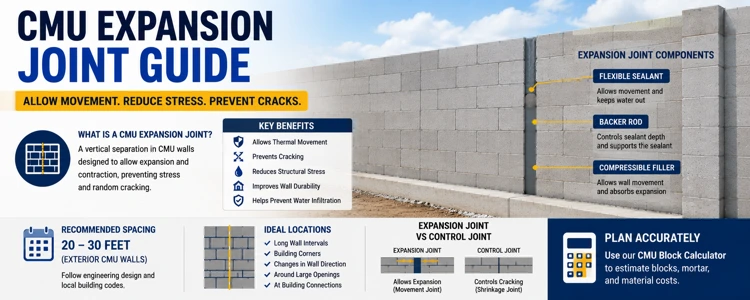
What Is a CMU Expansion Joint?
A:
CMU expansion joint
is a separation designed to allow masonry walls to:
- Expand safely
- Move without cracking
- Relieve structural stress
Expansion joints help prevent damage caused by:
- Thermal expansion
- Structural movement
- Moisture changes
- Building settlement
These joints are commonly used in:
- Long masonry walls
- Commercial buildings
- Industrial structures
- Reinforced masonry systems
Purpose of Expansion Joints in CMU Walls
The main purpose of:
expansion joints
is to allow controlled movement in masonry walls.
Concrete materials naturally expand and contract due to:
- Temperature changes
- Moisture variation
- Structural loads
Without movement joints:
pressure can build inside the wall system, leading to:
- Cracking
- Masonry failure
- Structural stress
Expansion joints reduce this pressure by allowing controlled movement.
How CMU Expansion Joints Work
Expansion joints create flexible separation points within masonry walls.
These joints:
- Absorb movement
- Reduce stress concentration
- Prevent random cracking
- Improve structural durability
Flexible materials are usually installed inside the joint to:
- Seal openings
- Prevent moisture penetration
- Maintain movement flexibility
Where Are CMU Expansion Joints Installed?
Expansion joints are commonly installed:
- At long wall intervals
- Near corners
- At building connections
- Between structural sections
- Around large openings
They are especially important in:
- Large commercial walls
- Long exterior masonry walls
- Reinforced structural masonry systems
Recommended Expansion Joint Spacing
Expansion joint spacing depends on:
- Wall length
- Climate conditions
- Structural design
- Reinforcement
- Building movement
Typical spacing recommendations include:
| Wall Type | Typical Joint Spacing |
|---|---|
| Exterior masonry walls | 20–30 feet |
| Large commercial walls | Based on engineering design |
| Reinforced masonry systems | Code-dependent |
Actual spacing should follow:
- Engineering standards
- Local building codes
- Masonry design requirements
Expansion Joint vs Control Joint
Many people confuse:
expansion joints
with:
control joints
However:
they serve different purposes.
| Feature | Expansion Joint | Control Joint |
|---|---|---|
| Main Purpose | Allow expansion | Control cracking |
| Common Use | Large structures | Masonry shrinkage control |
| Movement Type | Expansion movement | Shrinkage movement |
| Flexibility | High | Moderate |
Expansion joints mainly handle:
thermal and structural expansion
while control joints help control:
shrinkage cracking
You can also read:
CMU Control Joint GuideWhy Masonry Walls Expand
Concrete masonry walls may expand because of:
- Heat exposure
- Moisture absorption
- Structural loading
- Building movement
Large walls exposed to sunlight often experience significant thermal movement.
Without expansion joints:
stress may accumulate inside the wall system.
Expansion Joint Materials
Expansion joints commonly include:
- Flexible sealants
- Backer rods
- Waterproof fillers
- Compressible joint materials
These materials help:
- Maintain flexibility
- Prevent water infiltration
- Improve durability
Reinforced Masonry and Expansion Joints
Reinforced masonry systems may still require:
expansion joints
even when:
- Rebar reinforcement
- Bond beam systems
- Grouted cells
are used.
Reinforcement improves structural strength, but movement control remains important.
You can also read:
What Is a Bond Beam Block?Expansion Joints and Tall CMU Walls
Tall masonry walls may require:
- Additional movement control
- Structural reinforcement
- Engineered joint spacing
You can also read:
How Tall Can a CMU Wall Be?CMU Wall Thickness and Expansion Joints
Wall thickness may affect:
- Joint spacing
- Reinforcement requirements
- Structural movement behavior
Common CMU wall thicknesses include:
- 4 inch
- 6 inch
- 8 inch
- 12 inch
You can also read:
CMU Wall Thickness GuideCommon Uses of Expansion Joints
CMU expansion joints are commonly used in:
- Commercial masonry walls
- Warehouse walls
- Industrial structures
- School buildings
- Long retaining walls
- Reinforced masonry systems
They are especially important for:
- Long wall spans
- Exterior masonry systems
- High-temperature environments
Advantages of CMU Expansion Joints
1. Reduces Structural Stress
Expansion joints help reduce:
- Thermal stress
- Structural pressure
- Masonry strain
2. Helps Prevent Cracking
Movement joints reduce:
- Random wall cracking
- Masonry separation
- Structural damage
3. Improves Wall Durability
Proper movement control improves:
- Long-term performance
- Structural reliability
- Masonry lifespan
4. Improves Moisture Protection
Proper joint sealing helps reduce:
- Water infiltration
- Moisture damage
- Freeze-thaw deterioration
Expansion Joints and Building Codes
Many building codes require:
movement joints
for certain masonry wall applications.
Structural engineers determine:
- Joint placement
- Spacing requirements
- Reinforcement details
based on:
- Climate conditions
- Structural design
- Wall dimensions
Use a CMU Block Calculator
Before building a masonry wall, accurate material estimation is important.
Our:
CMU Block Calculatorhelps estimate:
- Concrete block quantities
- Mortar requirements
- Material costs
- Wall dimensions
You can also use: <
for additional construction estimation.
Frequently Asked Questions
What is a CMU expansion joint?
A CMU expansion joint is a flexible separation designed to:
- Allow wall movement
- Reduce structural stress
- Prevent masonry cracking
Why are expansion joints important?
Expansion joints help masonry walls safely handle:
- Thermal expansion
- Structural movement
- Moisture-related expansion
How far apart should expansion joints be?
Typical spacing ranges from:
20 to 30 feet
depending on:
- Wall type
- Climate conditions
- Structural design
- Engineering requirements
Are expansion joints required in reinforced masonry walls?
Yes.
Reinforced masonry systems may still require:
movement joints
to handle thermal and structural movement.
Related Articles
- CMU Control Joint Guide
- What Is a CMU Block?
- What Is a Bond Beam Block?
- How Tall Can a CMU Wall Be?
- CMU Wall Thickness Guide
- CMU Seismic Design Guide
- CMU Block Sizes Chart
Final Thoughts
CMU expansion joints are an important part of masonry construction because they help:
- Allow structural movement
- Reduce stress
- Prevent cracking
- Improve wall durability
Properly designed movement joints improve the long-term performance of:
- Commercial masonry walls
- Reinforced structural systems
- Large exterior masonry structures
Understanding expansion joints helps contractors, engineers, builders, and homeowners construct stronger and more durable masonry wall systems.