Concrete masonry unit (CMU) walls are strong, durable, and widely used in residential, commercial, industrial, foundation, basement, and retaining wall construction. However, even a properly constructed CMU wall can experience moisture problems if water does not have a proper path to drain away.
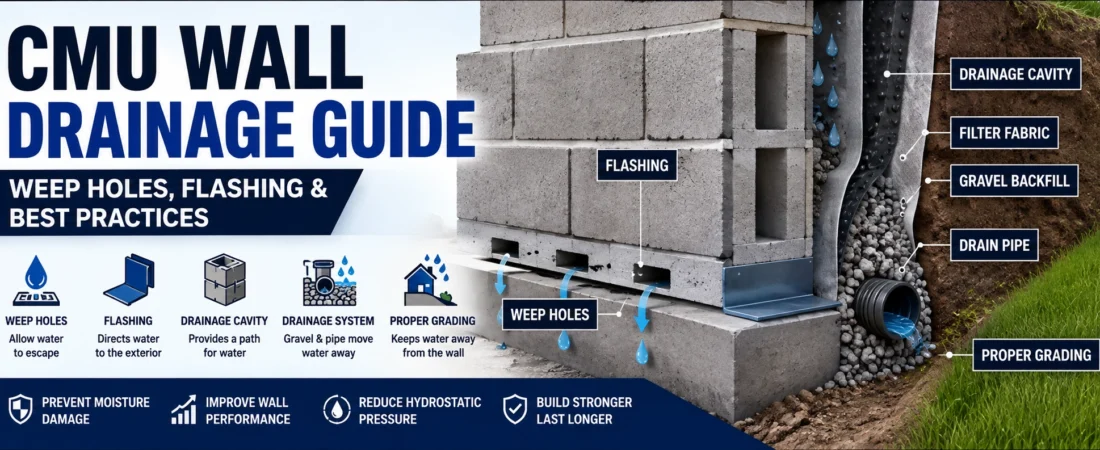
A well-designed CMU wall drainage system collects water that enters the wall assembly and directs it safely toward the exterior. Depending on the wall type and construction method, the drainage system may include flashing, weep holes, drainage cavities, gravel, drainage pipes, filter materials, drainage mats, and other moisture-control components.
Proper drainage is especially important for exterior walls, below-grade walls, foundation walls, basement walls, and retaining walls where water can accumulate around or behind the masonry.
In this guide, we will explain how CMU wall drainage works, the major drainage components, proper installation practices, common drainage problems, and practical methods for maintaining an effective drainage system.
What Is CMU Wall Drainage?
CMU wall drainage is the system used to collect and remove water from a concrete masonry wall or wall assembly.
Concrete masonry is not completely impervious to moisture. Depending on the construction, water can enter through masonry units, mortar joints, cracks, openings, penetrations, and connections between different building materials.
A drainage system provides a controlled pathway for this water to escape instead of allowing it to accumulate inside or behind the wall.
The basic concept is:
Water enters → Water is collected → Water moves downward → Water reaches flashing or drainage system → Water exits
This is different from waterproofing.
Waterproofing attempts to prevent water from entering, while drainage provides a pathway for water to escape if it does enter the wall assembly.
For complete moisture protection, drainage and waterproofing should normally be considered together.
Why Is Drainage Important for CMU Walls?
Without adequate drainage, water can accumulate inside or behind masonry walls.
Depending on the wall location and environmental conditions, excessive moisture can contribute to:
- Efflorescence
- Water staining
- Interior dampness
- Freeze-thaw damage
- Deterioration of mortar joints
- Corrosion of embedded reinforcement
- Damage to adjacent building materials
- Increased hydrostatic pressure
- Moisture-related problems inside buildings
Drainage becomes particularly important in areas exposed to heavy rainfall, groundwater, poor site drainage, or repeated wetting and drying cycles.
For retaining walls, drainage is especially important because accumulated water behind the wall can increase lateral pressure.
For more information about retaining wall construction and drainage, see our CMU Retaining Wall Guide.How Does a CMU Wall Drainage System Work?
A properly designed drainage system provides a continuous path for water to leave the wall.
A typical drainage arrangement may work like this:
Exterior moisture → Masonry or cavity → Drainage space → Flashing → Weep holes → Exterior
The exact arrangement depends on the type of CMU wall.
Common wall types include:
- Single-wythe CMU walls
- Multi-wythe walls
- Cavity walls
- Veneer walls
- Reinforced CMU walls
- Fully grouted walls
- Foundation walls
- Basement walls
- Retaining walls
Not every CMU wall uses exactly the same drainage system. The drainage design should be selected according to the wall assembly and the source of moisture.
Main Components of a CMU Wall Drainage System
A CMU wall drainage system may contain several components working together.
The most important components include:
- Flashing
- Weep holes
- Drainage cavities
- Drainage mats
- Drainage pipes
- Gravel or free-draining backfill
- Filter fabric
- Proper exterior grading
Each component has a specific purpose.
1. CMU Wall Flashing
Flashing is one of the most important components of a masonry drainage system.
Its main purpose is to collect water and direct it toward the exterior of the wall.
Flashing may be installed at locations such as:
- Base of walls
- Above doors
- Above windows
- Below window sills
- Above lintels
- Shelf angles
- Roof-wall intersections
- Parapets
- Other horizontal interruptions
Flashing should be properly integrated with the surrounding wall components so that collected water can reach the drainage outlet.
For more information about moisture protection, see our CMU Wall Waterproofing Guide.2. CMU Wall Weep Holes
Weep holes are openings that allow collected water to escape from the wall.
They are commonly positioned near the bottom of a drainage cavity or immediately above flashing.
Their basic purpose is:
Give collected water a path to the exterior.
However, a weep hole alone does not create an effective drainage system.
Water must first be able to reach the location of the weep hole through a properly designed drainage path.
Why Weep Holes Must Remain Open
One of the most common drainage problems is blocked weep holes.
They can become blocked by:
- Mortar droppings
- Dirt
- Paint
- Sealants
- Insects
- Leaves
- Construction debris
When weep holes become blocked, water may remain trapped inside the wall instead of escaping.
Therefore, weep holes should remain open and unobstructed after construction.
3. Drainage Cavities
Some CMU wall assemblies include a cavity or drainage space that allows water to move downward.
The drainage cavity needs to remain sufficiently clear for water to flow.
Excess mortar can fall into the cavity during construction and create obstructions.
This can result in:
- Blocked drainage
- Water accumulation
- Moisture penetration
- Increased risk of staining
- Reduced wall performance
Proper construction practices are therefore extremely important.
Preventing Mortar From Blocking Drainage
During masonry construction, excess mortar can fall behind the outer masonry layer.
If these mortar droppings accumulate on flashing or inside the drainage cavity, they can interfere with water movement.
To reduce this problem:
- Keep drainage cavities clean.
- Minimize excessive mortar buildup.
- Use appropriate mortar collection methods.
- Keep flashing clear.
- Inspect drainage areas before closing the wall.
- Ensure weep holes remain unobstructed.
This is one of the most important construction details for maintaining long-term drainage performance.
4. Drainage Mats
Drainage mats can be used in certain wall assemblies to create or maintain a drainage pathway.
They may help:
- Maintain water flow
- Reduce blockage
- Separate drainage spaces from debris
- Improve water movement toward flashing
- Reduce the effect of mortar accumulation
The type of drainage mat should be selected according to the wall design and manufacturer’s requirements.
5. CMU Wall Drainage Pipes
Drainage pipes are particularly important in below-grade and retaining wall applications.
A drainage pipe can collect water from the surrounding soil and transport it toward an approved discharge location.
A typical drainage system may include:
- Perforated drainage pipe
- Washed gravel
- Filter fabric
- Drainage layer
- Proper outlet
The drainage pipe should be installed correctly so that water can reach the pipe and flow toward the discharge point.
For below-grade applications, also see our CMU Foundation Wall Guide.6. Gravel Backfill
Free-draining gravel can help move water away from the wall and toward a drainage pipe or other outlet.
A properly designed drainage layer can help:
- Reduce water accumulation
- Improve water movement
- Reduce hydrostatic pressure
- Protect below-grade walls
- Improve drainage around foundations
- Improve retaining wall performance
However, gravel alone should not automatically be considered a complete drainage system.
Where significant groundwater is expected, a properly designed collection and discharge system may also be necessary.
7. Filter Fabric
Filter fabric can be used to separate fine soil particles from a drainage layer.
Without appropriate filtration, fine soil can migrate into the gravel and gradually reduce the drainage capacity.
A suitable filter system helps maintain the drainage layer while allowing water to move toward the drainage pipe.
The correct material and installation method depend on the soil conditions and project requirements.
CMU Wall Drainage at the Base of the Wall
The base of a CMU wall is one of the most important areas for moisture management.
Water moving downward through the wall needs to be collected and directed outside before it reaches areas where it can cause damage.
A drainage detail may include:
- Flashing
- Weep holes
- Drainage material
- Drainage pipe
- Proper foundation detailing
- Suitable exterior grading
The surrounding ground should also be designed so that rainwater does not accumulate against the wall.
Poor site drainage can create moisture problems even when the masonry drainage system itself is properly constructed.
CMU Wall Drainage Around Windows and Doors
Wall openings are another important location for moisture control.
Windows and doors interrupt the masonry assembly, so water needs to be prevented from moving into the wall or toward the interior.
Drainage and flashing may be required around:
- Window heads
- Window sills
- Door heads
- Lintels
- Masonry transitions
- Other openings
Proper detailing helps collect water and direct it toward the exterior.
CMU Wall Drainage for Retaining Walls
Retaining walls require special attention because water can accumulate behind the wall.
A typical retaining wall drainage system may include:
- Free-draining backfill
- Perforated drainage pipe
- Gravel
- Filter fabric
- Drainage layer
- Weep holes where appropriate
- Proper discharge outlet
The objective is to prevent excessive water accumulation behind the wall and reduce hydrostatic pressure.
For a more detailed discussion, see our CMU Retaining Wall Guide.CMU Foundation Wall Drainage
Below-grade CMU foundation walls can be exposed to several sources of moisture, including:
- Groundwater
- Soil moisture
- Surface runoff
- Hydrostatic pressure
- Poor site drainage
A foundation drainage strategy may include:
- Perimeter drainage
- Drainage pipes
- Free-draining backfill
- Drainage boards
- Waterproofing
- Dampproofing
- Proper site grading
Drainage and waterproofing should work together rather than treating one as a complete replacement for the other.
For more information, see our CMU Basement Wall Guide.CMU Wall Drainage for Single-Wythe Walls
Single-wythe CMU walls require careful moisture management because the masonry units form the primary wall assembly.
Depending on the wall design, moisture may enter through:
- Masonry pores
- Mortar joints
- Cracks
- Openings
- Penetrations
- Wall transitions
Moisture-control measures may include:
- Proper flashing
- Weep holes where applicable
- Water-repellent systems
- Sealants
- Proper mortar joints
- Crack control
- Appropriate wall detailing
The exact system should always be selected according to the specific wall construction and exposure conditions.
CMU Cavity Wall Drainage
Cavity wall construction provides a dedicated space where water can drain without entering the interior portion of the building.
A typical cavity wall drainage arrangement includes:
- Exterior masonry
- Drainage cavity
- Flashing
- Weep holes
- Interior backup wall
Water that reaches the cavity should move downward toward the flashing and then exit through the weep holes.
Keeping this cavity clear is essential for effective drainage.
Proper CMU Wall Flashing Installation
Flashing should be installed so that collected water is directed toward the exterior.
A properly detailed flashing system should:
- Collect water
- Provide a continuous drainage path
- Direct water toward the exterior
- Coordinate with weep holes
- Remain continuous where required
- Prevent water from bypassing the drainage system
Important flashing locations can include:
- Wall bases
- Window openings
- Door openings
- Lintels
- Shelf angles
- Roof intersections
- Parapets
Incorrect flashing installation can cause water intrusion even when weep holes are present.
Common CMU Wall Drainage Problems
Several problems can prevent a drainage system from working properly.
Blocked Weep Holes
Mortar, dirt, paint, insects, or debris can block the openings.
Solution: Inspect the drainage openings and keep them clear of obstructions.
Damaged Flashing
Cracked, discontinuous, or incorrectly installed flashing can allow water to bypass the intended drainage path.
Solution: Inspect flashing during construction and repair damaged sections appropriately.
Poor Site Grading
Water can accumulate against a wall when surrounding ground slopes toward the building.
Solution: Provide proper grading so surface water moves away from the wall.
Missing Drainage Path
A wall may contain weep holes but still fail to drain if there is no effective pathway connecting the collected water to those openings.
Solution: Inspect the complete drainage assembly rather than focusing only on visible weep holes.
Clogged Drainage Pipe
Below-grade drainage pipes may become blocked by sediment, soil, roots, or debris.
Solution: Use appropriate filtration and provide suitable access for inspection and maintenance where required.
Signs of Poor CMU Wall Drainage
Common warning signs include:
- Persistent dampness
- Water stains
- Efflorescence
- Interior moisture
- Deteriorated mortar joints
- Repeated water accumulation
- Standing water near the wall
- Blocked weep holes
- Moisture-related cracking
- Damage around wall openings
The cause should be investigated before simply applying a coating over the affected area.
For masonry cracking problems, see our CMU Wall Crack Repair Guide.CMU Wall Drainage Maintenance
Drainage systems should be inspected periodically, particularly after heavy rainfall or severe weather.
Check:
- Weep holes
- Drainage outlets
- Surface grading
- Drainage pipes
- Gravel drainage areas
- Accessible flashing
- Signs of water accumulation
- Cracks
- Deteriorated mortar joints
Regular inspection can identify drainage problems before they become expensive repairs.
For general maintenance, see our CMU Wall Maintenance Guide.CMU Wall Drainage Best Practices Checklist
Before considering a CMU wall drainage system complete, verify:
✔ Water has a clear path to the exterior
✔ Flashing is properly installed
✔ Weep holes are unobstructed
✔ Drainage cavities remain clear
✔ Mortar droppings are controlled
✔ Drainage pipes have suitable outlets
✔ Gravel drainage layers are properly installed
✔ Filter materials are used where appropriate
✔ Groundwater is considered for below-grade walls
✔ Surface water is directed away from the wall
✔ Cracks and deteriorated joints are addressed
✔ Drainage components can be inspected and maintained
Frequently Asked Questions
Do all CMU walls need weep holes?
Not necessarily. The need for weep holes depends on the wall type, drainage design, construction method, and project conditions.
Are weep holes the same as drainage pipes?
No. Weep holes discharge collected water from the masonry wall assembly, while drainage pipes are generally used to collect and transport water through soil or drainage layers.
Can waterproofing replace drainage?
No. Waterproofing and drainage perform different functions. Waterproofing helps prevent water penetration, while drainage provides a pathway for water to escape.
For more information, see our CMU Wall Waterproofing Guide.Why are my CMU wall weep holes not draining?
Possible causes include blocked openings, mortar accumulation, blocked flashing, poor grading, inadequate drainage pathways, or an incorrectly designed drainage system.
Can CMU walls be completely waterproof?
CMU walls are not inherently completely waterproof. Depending on the application, effective moisture protection may require proper drainage, flashing, waterproofing, crack control, and construction detailing.
Final Thoughts
A properly designed CMU wall drainage system helps control moisture and protects concrete masonry construction from many common water-related problems.
The most important principle is simple:
Water needs a clear and continuous path to escape.
Flashing, weep holes, drainage cavities, gravel, drainage pipes, filter materials, proper grading, and waterproofing can work together to provide effective moisture protection.
Good drainage also depends heavily on construction quality. Even high-quality CMU blocks can experience moisture problems if flashing is incorrectly installed, weep holes are blocked, cavities are filled with mortar, or water is allowed to accumulate around the wall.
For this reason, drainage should be considered during the design stage and carefully inspected during construction rather than treated as an afterthought.
Related Guides
- What Is a CMU Block?
- CMU Wall Waterproofing Guide
- CMU Foundation Wall Guide
- CMU Basement Wall Guide
- CMU Retaining Wall Guide
- CMU Wall Crack Repair Guide
- CMU Wall Maintenance Guide
- CMU Wall Inspection Guide
- CMU Rebar Spacing Guide
- How to Reinforce a CMU Wall