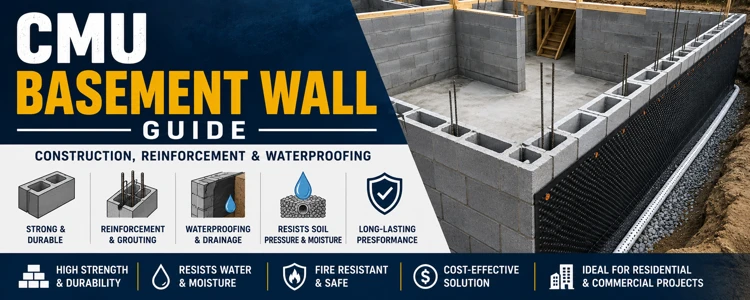
A CMU basement wall is a foundation wall constructed using concrete masonry units.
These walls are commonly used for:
- Residential basements
- Commercial buildings
- Storage areas
- Utility rooms
- Crawl spaces
CMU basement walls transfer building loads to the foundation while providing below-grade structural support.
You can also read:
What Is a CMU Block?Why Are CMU Basement Walls Popular?
CMU basement walls offer several advantages.
These include:
- High structural strength
- Cost-effective construction
- Fire resistance
- Easy installation
- Long service life
Because of these benefits, CMU foundations remain a popular choice for residential and commercial construction projects.
Common CMU Basement Wall Sizes
Most basement walls use standard concrete masonry units.
Common block sizes include:
| CMU Size | Common Use |
|---|---|
| 8x8x16 | Residential basements |
| 10x8x16 | Heavier structural loads |
| 12x8x16 | Commercial applications |
You can also read:
CMU Block Sizes ChartCMU Basement Wall Thickness
Wall thickness depends on:
- Basement height
- Soil conditions
- Building loads
- Local building codes
The most common basement wall thickness is:
8 inches
However, larger structures may require thicker walls and additional reinforcement.
You can also read:
CMU Wall Thickness GuideReinforcement Requirements
Basement walls commonly require reinforcement to resist:
- Soil pressure
- Structural loads
- Ground movement
Typical reinforcement includes:
- Vertical rebar
- Horizontal rebar
- Bond beam systems
- Grouted cells
Proper reinforcement improves wall strength and long-term performance.
You can also read:
CMU Rebar Spacing Guideand
How to Reinforce a CMU WallGrouting Basement Walls
Most reinforced basement walls require grout-filled cells.
Grouting helps:
- Secure reinforcement
- Improve structural strength
- Increase load capacity
- Improve wall stability
Common grouting methods include:
- Low-lift grouting
- High-lift grouting
- Fully grouted walls
- Partially grouted walls
You can also read:
CMU Grouting Methods Guideand use:
CMU Grout CalculatorWaterproofing CMU Basement Walls
Waterproofing is one of the most important parts of basement construction.
Without proper waterproofing, moisture can enter through:
- Mortar joints
- Masonry pores
- Foundation cracks
Common waterproofing methods include:
- Waterproof coatings
- Foundation membranes
- Drainage boards
- Exterior sealers
Proper waterproofing helps keep basements dry and reduces long-term maintenance costs.
Drainage Around Basement Walls
Drainage systems help reduce hydrostatic pressure around foundations.
Common drainage systems include:
- Perforated drain pipes
- Gravel backfill
- Drainage mats
- Sump pumps
Good drainage reduces water pressure against basement walls and improves foundation performance.
CMU Basement Walls vs Poured Concrete Walls
Both systems are commonly used in foundation construction.
| Feature | CMU Walls | Poured Concrete |
|---|---|---|
| Cost | Lower | Higher |
| Installation | Faster | Slower |
| Reinforcement | Easy | Easy |
| Waterproofing | More Important | Important |
| Durability | Excellent | Excellent |
Both systems can provide long-lasting foundation performance when properly designed and installed.
Common Problems With Basement Walls
Some common basement wall issues include:
- Water infiltration
- Foundation cracking
- Poor drainage
- Settlement movement
- Improper reinforcement
Many of these issues can be minimized through proper design, waterproofing, and reinforcement.
You can also read:
CMU Wall Crack Repair GuideAdvantages of CMU Basement Walls
High Strength
CMU basement walls provide excellent load-bearing capacity.
Cost Efficiency
Concrete block foundations are often more affordable than other foundation systems.
Fire Resistance
Concrete masonry provides excellent fire resistance.
Durability
Properly constructed CMU foundations can last for decades.
Easy Reinforcement
CMU walls allow reinforcement and grouting to be installed inside hollow cells.
Use a CMU Block Calculator
Before constructing a basement wall, accurate material estimation is important.
Our CMU Block Calculator helps estimate:
- Block quantities
- Mortar requirements
- Material costs
- Wall dimensions
Related Calculators
- CMU Block Calculator
- CMU Grout Calculator
- Mortar Calculator
- Foundation Calculator
- Rebar Calculator
- Concrete Calculator
Frequently Asked Questions
Are CMU basement walls strong?
Yes. Properly reinforced CMU basement walls provide excellent structural strength and durability.
What is the standard thickness of a CMU basement wall?
Most residential basement walls use 8-inch CMU blocks, although larger structures may require thicker walls.
Do basement walls require reinforcement?
Yes. Most basement walls use vertical rebar, horizontal reinforcement, and grout-filled cells.
Do CMU basement walls need waterproofing?
Yes. Waterproofing helps prevent moisture intrusion and protects the foundation system.
Related Articles
- What Is a CMU Block?
- CMU Foundation Wall Guide
- CMU Wall Thickness Guide
- CMU Rebar Spacing Guide
- How to Reinforce a CMU Wall
- CMU Grouting Methods Guide
- CMU Load Bearing Wall Guide
- CMU Retaining Wall Guide
- CMU Wall Crack Repair Guide
- CMU Block Sizes Chart
Final Thoughts
CMU basement walls remain one of the most reliable and cost-effective foundation systems used in construction. With proper reinforcement, grouting, drainage, and waterproofing, concrete masonry basement walls can provide decades of structural performance and protection.
Understanding wall thickness, reinforcement requirements, waterproofing methods, and drainage systems helps builders, contractors, and homeowners construct stronger and more durable basement foundations.