CMU grouting is one of the most important steps in reinforced masonry construction. Proper grouting improves wall strength, secures reinforcement, and increases the overall structural performance of concrete masonry walls.
Whether you are building a foundation wall, retaining wall, commercial structure, or load-bearing masonry system, understanding different grouting methods helps ensure a stronger and more durable wall.
What Is CMU Grout?
CMU grout is a fluid concrete mixture used to fill hollow concrete masonry units (CMU blocks). Grout is commonly used together with reinforcement bars to create stronger masonry walls.
Grout helps improve:
- Structural strength
- Load-bearing capacity
- Rebar bonding
- Seismic performance
- Long-term durability
You can also read:
What Is a CMU Block?Why Is Grouting Important?
Grouting provides several structural benefits.
These include:
- Improved wall strength
- Better reinforcement support
- Increased load resistance
- Improved wind resistance
- Better earthquake performance
Without proper grouting, reinforcement cannot effectively transfer structural loads through the masonry wall.
Common CMU Grouting Methods
Several grouting methods are used in masonry construction.
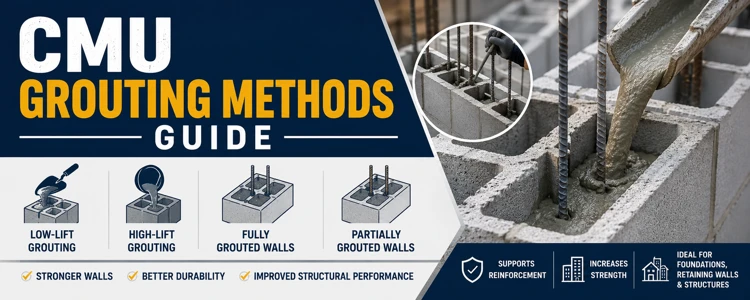
The most common methods include:
- Low-Lift Grouting
- High-Lift Grouting
- Fully Grouted Walls
- Partially Grouted Walls
Low-Lift Grouting
Low-lift grouting is one of the most commonly used methods in masonry construction.
In this method:
- Masonry is built in shorter sections
- Grout is placed at lower heights
- Reinforcement is installed as construction progresses
Advantages include:
- Easier quality control
- Better grout consolidation
- Reduced risk of voids
Low-lift grouting is commonly used in residential and small commercial projects.
High-Lift Grouting
High-lift grouting involves building taller wall sections before placing grout.
This method typically requires:
- Cleanout openings
- Grout inspection
- Proper consolidation
Advantages include:
- Faster construction
- Fewer grout placements
- Improved productivity on large projects
High-lift grouting is commonly used in large commercial masonry construction.
Fully Grouted Walls
A fully grouted wall has:
all masonry cells filled with grout
Fully grouted systems provide:
- Maximum structural strength
- Better load distribution
- Improved seismic resistance
- Increased durability
Fully grouted walls are often used in:
- Commercial buildings
- High-wind regions
- Seismic zones
- Retaining walls
You can also use:
CMU Grout CalculatorPartially Grouted Walls
Partially grouted walls only fill selected masonry cells.
Typically, grout is placed:
- Around reinforcement
- At corners
- At structural locations
- Inside bond beam systems
Advantages include:
- Lower material costs
- Reduced grout volume
- Faster installation
Partially grouted walls are commonly used in residential construction.
Grout Consolidation
Grout consolidation removes air pockets and improves grout distribution.
Common consolidation methods include:
- Mechanical vibration
- Manual rodding
- Grout settlement procedures
Proper consolidation helps:
- Reduce voids
- Improve strength
- Increase reinforcement bonding
Rebar and Grouting
Most reinforced masonry systems require both:
- Rebar
- Grout
These components work together to improve wall performance.
You can also read:
CMU Rebar Spacing Guideand
How to Reinforce a CMU WallBond Beam Grouting
Bond beam blocks often contain:
- Horizontal rebar
- Structural grout
Bond beam systems improve:
- Structural continuity
- Crack resistance
- Load transfer
You can also read:
What Is a Bond Beam Block?Grouting Foundation Walls
Foundation walls commonly require:
- Reinforcement
- Grout-filled cells
- Structural bond beams
Proper grouting helps foundation walls resist:
- Soil pressure
- Building loads
- Ground movement
You can also read:
CMU Foundation Wall GuideGrouting Retaining Walls
Retaining walls are subjected to:
- Soil pressure
- Hydrostatic pressure
- Structural movement
Because of these forces, retaining walls often require:
- Reinforcement
- Fully grouted cells
- Bond beam systems
You can also read:
CMU Retaining Wall GuideCommon Grouting Mistakes
Common mistakes include:
- Poor consolidation
- Incorrect grout mix
- Incomplete cell filling
- Improper reinforcement placement
- Excessive grout lifts
These issues may reduce wall performance and structural strength.
Advantages of Proper CMU Grouting
Improved Structural Strength
Proper grouting increases:
- Wall strength
- Load capacity
- Structural stability
Better Reinforcement Bonding
Grout secures reinforcement and improves load transfer.
Improved Seismic Performance
Grouted masonry systems perform better during:
- Earthquakes
- Ground movement
- Lateral loading
Better Durability
Properly grouted walls generally last longer and require fewer structural repairs.
Improved Wind Resistance
Grouted masonry systems better resist:
- High winds
- Storm forces
- Structural pressure
Use a CMU Block Calculator
Before starting masonry construction, accurate material estimation is important.
Our CMU Block Calculator helps estimate:
- Concrete block quantities
- Mortar requirements
- Material costs
- Wall dimensions
Related Calculators
- CMU Block Calculator
- CMU Grout Calculator
- Mortar Calculator
- Foundation Calculator
- Rebar Calculator
- Concrete Calculator
Frequently Asked Questions
What is the most common CMU grouting method?
Low-lift grouting is one of the most commonly used methods in residential masonry construction.
What is a fully grouted wall?
A fully grouted wall has all masonry cells filled with grout for maximum structural strength.
Why is grout used in CMU walls?
Grout improves wall strength, reinforcement bonding, and structural performance.
Do reinforced walls require grout?
Yes. Most reinforced masonry systems require grout to secure reinforcement and transfer structural loads.
Related Articles
- What Is a CMU Block?
- Types of CMU Blocks
- CMU Rebar Spacing Guide
- How to Reinforce a CMU Wall
- What Is a Bond Beam Block?
- CMU Foundation Wall Guide
- CMU Retaining Wall Guide
- CMU Load Bearing Wall Guide
- CMU Wall Thickness Guide
- CMU Grout Calculator
Final Thoughts
Understanding CMU grouting methods helps builders, contractors, engineers, and homeowners construct stronger and more durable masonry walls. Whether using low-lift grouting, high-lift grouting, fully grouted walls, or partially grouted systems, proper grout installation plays a major role in structural performance and long-term durability.