A:
pilaster block
is a special type of concrete masonry unit (CMU) designed to create:
- Vertical reinforced columns
- Structural supports
- Reinforced masonry sections
inside concrete block walls.
Pilaster blocks improve:
- Structural strength
- Load-bearing capacity
- Wall stability
- Reinforcement performance
These blocks are commonly used in:
- Commercial construction
- Structural masonry walls
- Reinforced CMU systems
- Industrial buildings
- Retaining walls
Pilaster blocks are especially important in walls that support:
- Heavy loads
- Roof systems
- Structural beams
- Long masonry spans
What Does a Pilaster Block Look Like?
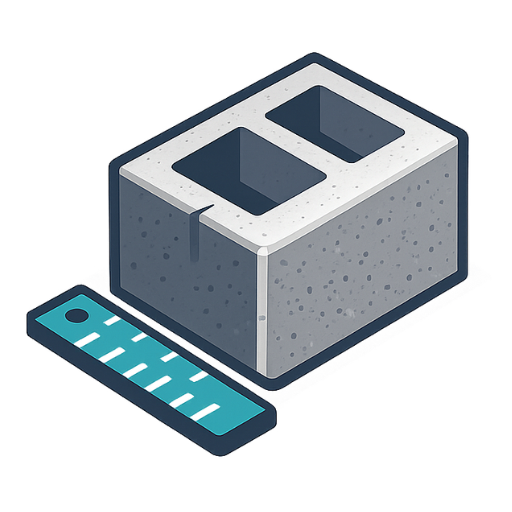
A pilaster block looks similar to a standard CMU block but contains:
larger vertical openings
These openings allow installation of:
- Vertical steel reinforcement bars (rebar)
- Concrete grout filling
Once reinforced and filled, the block forms a:
reinforced vertical column
inside the masonry wall system.
Purpose of a Pilaster Block
The main purpose of a:
pilaster block
is to strengthen masonry walls by creating reinforced vertical support sections.
Pilaster systems help:
- Carry structural loads
- Improve wall stability
- Resist bending forces
- Support beams and lintels
- Reinforce tall masonry walls
How Pilaster Blocks Work
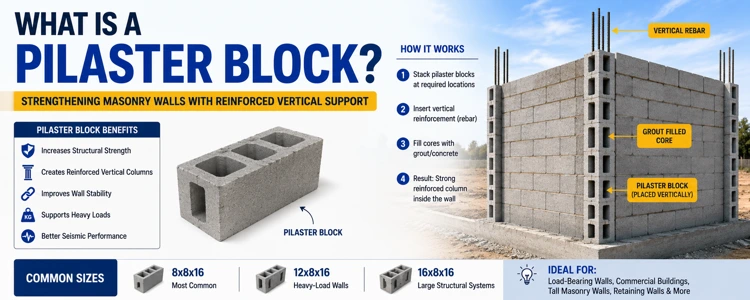
Pilaster blocks create reinforced vertical masonry columns.
The installation process usually includes:
- Stacking pilaster blocks vertically
- Installing vertical reinforcement bars
- Filling the cores with grout or concrete
Once cured:
the reinforced section becomes significantly stronger than standard masonry walls.
Common Uses of Pilaster Blocks
Pilaster blocks are commonly used in:
- Load-bearing walls
- Commercial buildings
- Warehouse walls
- Tall masonry walls
- Retaining walls
- Structural masonry systems
They are often installed:
- At wall intervals
- At corners
- Near large openings
- Under structural beams
- Along reinforced wall systems
Pilaster Block Sizes
Pilaster blocks are available in several standard CMU sizes.
Common sizes include:
| Nominal Size | Common Use |
|---|---|
| 8x8x16 | Standard structural masonry |
| 12x8x16 | Heavy-load walls |
| 16x8x16 | Large reinforced masonry systems |
The:
8x8x16 pilaster block
is one of the most commonly used reinforced masonry units.
You can also read:
CMU Block Sizes ChartPilaster Block vs Standard CMU Block
| Feature | Pilaster Block | Standard CMU Block |
|---|---|---|
| Vertical Reinforcement Space | Large | Limited |
| Structural Strength | Higher | Standard |
| Grouting Capacity | Excellent | Moderate |
| Common Use | Reinforced columns | General masonry |
| Load-Bearing Support | High | Moderate |
Pilaster blocks are specifically designed for:
reinforced structural masonry
Pilaster Block vs Bond Beam Block
Many people confuse:
pilaster blocks
with:
bond beam blocks
because both are used in reinforced masonry systems.
However:
their reinforcement direction is different.
| Feature | Pilaster Block | Bond Beam Block |
|---|---|---|
| Reinforcement Direction | Vertical | Horizontal |
| Main Purpose | Vertical support | Horizontal reinforcement |
| Common Location | Wall intervals | Horizontal wall courses |
| Structural Role | Reinforced columns | Reinforced beams |
You can also read:
What Is a Bond Beam Block?Advantages of Pilaster Blocks
1. Increased Structural Strength
Pilaster systems improve:
- Load-bearing performance
- Masonry wall strength
- Structural durability
2. Better Support for Heavy Loads
Pilaster blocks help support:
- Roof systems
- Structural beams
- Large openings
- Heavy masonry sections
3. Improved Wall Stability
Vertical reinforcement improves:
- Wall rigidity
- Structural continuity
- Wind resistance
4. Better Seismic Performance
Pilaster systems improve resistance against:
- Earthquakes
- Structural movement
- Lateral forces
You can also read:
CMU Seismic Design Guide5. Stronger Tall Masonry Walls
Pilaster blocks help reinforce:
- Tall CMU walls
- Long masonry spans
- Large structural walls
You can also read:
How Tall Can a CMU Wall Be?Reinforcement in Pilaster Blocks
Pilaster systems usually include:
- Vertical steel reinforcement bars
- Grout filling
- Reinforced masonry cells
These components improve:
- Structural integrity
- Tensile strength
- Load distribution
You can estimate reinforcement using the:
Rebar CalculatorPilaster Blocks and Wall Thickness
Pilaster blocks are available in several wall thicknesses depending on structural requirements.
Common thicknesses include:
- 8 inch
- 12 inch
- 16 inch
You can also read:
CMU Wall Thickness GuideHollow vs Solid Pilaster Blocks
Most pilaster blocks are:
hollow concrete masonry units
because hollow cores simplify:
- Rebar installation
- Grouting
- Reinforced structural integration
You can also read:
Hollow vs Solid Concrete BlocksWhere Are Pilaster Blocks Installed?
Pilaster blocks are commonly installed:
- At wall intervals
- At corners
- Near large wall openings
- Beneath structural supports
- In reinforced masonry systems
Structural engineers determine placement based on:
- Structural loads
- Wall height
- Wind pressure
- Building codes
Use a CMU Block Calculator
Before starting masonry construction, it is important to estimate:
- Block quantities
- Mortar requirements
- Reinforcement materials
- Material costs
Our:
CMU Block Calculatorhelps estimate:
- Concrete block quantities
- Mortar requirements
- Wall dimensions
- Material costs
You can also use:
- Foundation Calculator
- Concrete Volume Calculator
- Rebar Calculator
- Mortar Calculator
- Gravel Calculator
for additional construction estimation.
Frequently Asked Questions
What is a pilaster block used for?
Pilaster blocks are used to create:
- Reinforced vertical columns
- Structural wall supports
- Stronger masonry systems
Are pilaster blocks load-bearing?
Yes.
Pilaster blocks are designed for:
- Heavy structural loads
- Reinforced masonry walls
- Commercial construction
Do pilaster blocks require rebar?
Yes.
Most pilaster systems use:
- Vertical steel reinforcement
- Concrete grout filling
for structural support.
What is the difference between a pilaster block and a bond beam block?
Pilaster blocks provide:
vertical reinforcement
while bond beam blocks provide:
horizontal reinforcement
inside masonry walls.
Related Articles
- What Is a CMU Block?
- What Is a Bond Beam Block?
- What Is a Lintel Block?
- CMU Block Sizes Chart
- CMU Wall Thickness Guide
- How Tall Can a CMU Wall Be?
- CMU Seismic Design Guide
Final Thoughts
Pilaster blocks are an important part of reinforced masonry construction because they help create:
- Stronger structural walls
- Reinforced vertical columns
- Improved load-bearing systems
These specialized CMU blocks improve:
- Structural stability
- Reinforced masonry performance
- Wall durability
- Wind and seismic resistance
Understanding pilaster blocks helps contractors, engineers, builders, and homeowners design safer and stronger masonry wall systems.