
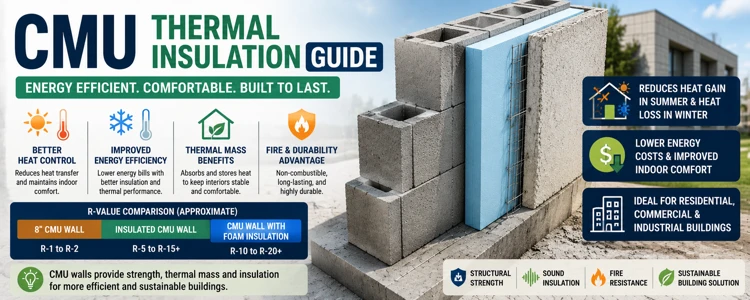
CMU walls are widely used in modern construction because they provide:
- Structural strength
- Fire resistance
- Durability
- Long service life
However:
many people also ask:
are CMU walls good for insulation?
Concrete masonry walls can provide effective:
- Thermal insulation
- Energy efficiency
- Temperature control
when properly designed.
This is why insulated CMU systems are commonly used in:
- Residential construction
- Commercial buildings
- Schools
- Warehouses
- Energy-efficient masonry projects
What Does CMU Stand For?
CMU
stands for:
Concrete Masonry Unit
These concrete blocks are commonly used because they are:
- Strong
- Durable
- Fire-resistant
- Cost-effective
CMU blocks are widely used in:
- Structural walls
- Foundation systems
- Retaining walls
- Reinforced masonry construction
You can also read:
What Is a CMU Block?What Is Thermal Insulation?
thermal insulation
helps reduce heat transfer between:
- Indoor spaces
- Outdoor environments
Good insulation improves:
- Energy efficiency
- Indoor comfort
- Temperature stability
- HVAC performance
Walls with poor insulation may allow:
- Heat loss
- Heat gain
- Higher energy costs
Are CMU Walls Good Insulators?
Concrete masonry walls provide:
moderate natural insulation
because concrete has:
- Thermal mass
- Heat storage capacity
- Dense structural properties
However:
standard hollow CMU walls alone may not provide enough insulation for modern energy codes in some climates.
Additional insulation systems are often added to improve:
- Thermal performance
- Energy efficiency
- Indoor comfort
What Is Thermal Mass?
thermal mass
refers to a material’s ability to:
- Absorb heat
- Store heat
- Slowly release heat
Concrete masonry walls help stabilize indoor temperatures by:
- Absorbing daytime heat
- Releasing stored heat gradually
This can improve:
- Energy efficiency
- Indoor comfort
- HVAC performance
R-Value of CMU Walls
R-value
measures how well a wall resists heat transfer.
Higher R-values mean:
- Better insulation
- Improved energy efficiency
- Reduced heat flow
Approximate R-values vary depending on:
- Block density
- Wall thickness
- Insulation type
- Grouting
| CMU Wall Type | Approximate R-Value |
|---|---|
| Standard hollow CMU wall | R-1 to R-2 |
| Insulated CMU wall | R-5 to R-15+ |
| Foam-filled CMU wall | Higher thermal performance |
Actual thermal performance depends on:
- Climate
- Construction method
- Wall assembly design
CMU Wall Thickness and Insulation
Thicker walls may improve:
thermal performance
because they provide:
- More thermal mass
- Increased material thickness
- Better temperature stability
Common wall thicknesses include:
- 4 inch
- 6 inch
- 8 inch
- 12 inch
The:
8-inch CMU wall
is one of the most common insulated masonry wall systems.
You can also read:
CMU Wall Thickness GuideCommon CMU Insulation Methods
Several methods improve thermal insulation in masonry walls.
1. Foam Insert Insulation
Foam inserts are placed inside hollow CMU cells to improve:
- Thermal resistance
- Energy efficiency
- Temperature control
2. Rigid Exterior Insulation
Rigid insulation boards are commonly installed on:
- Exterior wall surfaces
- Foundation walls
- Commercial masonry systems
These systems improve:
- Continuous insulation
- Energy performance
- Thermal efficiency
3. Spray Foam Insulation
Spray foam helps reduce:
- Air leakage
- Heat transfer
- Moisture infiltration
Spray insulation is commonly used in:
- Commercial buildings
- Residential masonry systems
- Energy-efficient construction
4. Insulated Concrete Masonry Units
Some concrete blocks are manufactured with:
- Built-in insulation
- Foam inserts
- Lightweight aggregates
These systems improve:
thermal efficiency
without major design changes.
CMU Walls and Energy Efficiency
Properly insulated CMU walls help improve:
- Indoor comfort
- HVAC efficiency
- Building energy performance
- Temperature stability
Energy-efficient masonry systems may reduce:
- Heating costs
- Cooling costs
- Energy consumption
Insulation and Moisture Control
Insulation systems should also help manage:
- Moisture
- Condensation
- Air leakage
Poor moisture control may reduce insulation performance.
You can also read:
CMU Moisture Control GuideInsulated CMU Walls vs Wood Framing
| Feature | Insulated CMU Wall | Wood Framing |
|---|---|---|
| Structural Strength | High | Moderate |
| Thermal Mass | Excellent | Lower |
| Fire Resistance | Excellent | Lower |
| Sound Resistance | Excellent | Moderate |
Concrete masonry walls provide:
strong thermal and structural performance
when properly insulated.
Reinforced Masonry and Thermal Performance
Reinforced masonry systems may include:
- Vertical rebar
- Horizontal bond beams
- Grouted cells
Proper wall design helps maintain:
- Structural strength
- Energy efficiency
- Thermal stability
You can also read:
How to Reinforce a CMU WallAdvantages of Insulated CMU Walls
1. Better Energy Efficiency
Insulated masonry walls help reduce:
- Energy loss
- Heating costs
- Cooling costs
2. Improved Indoor Comfort
Thermal insulation improves:
- Temperature stability
- Indoor comfort
- HVAC performance
3. Excellent Fire Resistance
Concrete masonry walls provide:
- Fire resistance
- Heat protection
- Structural safety
4. Better Sound Insulation
Insulated masonry systems help reduce:
- Noise transfer
- Airborne sound
- Exterior noise pollution
5. Long-Term Durability
CMU systems provide:
- Structural durability
- Long service life
- Low maintenance performance
Factors That Affect Thermal Performance
Several factors influence wall insulation:
- Wall thickness
- Block density
- Insulation type
- Grouting
- Air sealing
- Climate conditions
Proper wall design is important for:
energy-efficient construction
Use a CMU Block Calculator
Before building a masonry wall, accurate material estimation is important.
Our:
CMU Block Calculatorhelps estimate:
- Concrete block quantities
- Mortar requirements
- Material costs
- Wall dimensions
You can also use:
- Foundation Calculator
- Concrete Volume Calculator
- Rebar Calculator
- Mortar Calculator
- Gravel Calculator
for additional construction estimation.
Frequently Asked Questions
Are CMU walls energy efficient?
Yes.
Properly insulated CMU walls can provide:
- Good energy efficiency
- Thermal stability
- Reduced energy consumption
What is the R-value of a CMU wall?
Approximate R-values vary depending on:
- Wall thickness
- Insulation type
- Block density
- Grouting
Insulated CMU walls commonly achieve:
higher R-values
than standard hollow masonry walls.
Do insulated CMU walls reduce energy costs?
Yes.
Insulated masonry walls may reduce:
- Heating costs
- Cooling costs
- HVAC energy usage
Are insulated CMU walls better than wood framing?
Insulated masonry walls provide:
- Better thermal mass
- Higher fire resistance
- Improved durability
while wood framing may provide higher insulation in some lightweight wall systems.
Related Articles
- What Is a CMU Block?
- CMU Wall Thickness Guide
- CMU Moisture Control Guide
- How to Reinforce a CMU Wall
- CMU Sound Transmission Guide
- CMU Block Sizes Chart
- CMU Foundation Wall Guide
Final Thoughts
CMU thermal insulation systems help improve:
- Energy efficiency
- Indoor comfort
- Temperature control
- Building performance
Proper insulation methods such as:
- Foam inserts
- Rigid insulation
- Spray foam systems
- Insulated CMU units
help create more energy-efficient and durable masonry structures.
Understanding CMU thermal insulation helps contractors, engineers, builders, and homeowners design stronger and more energy-efficient masonry buildings.ry structures.