
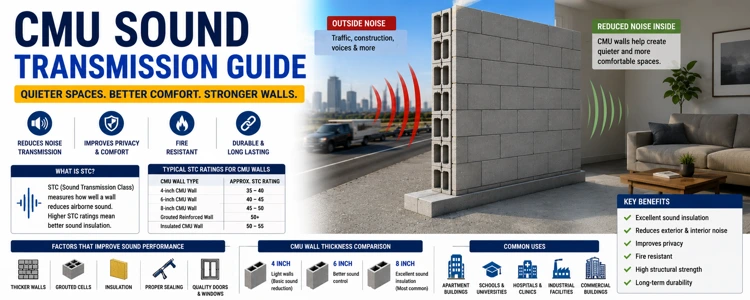
CMU walls are widely used in modern construction because they provide:
- Structural strength
- Fire resistance
- Durability
- Excellent sound control
One major advantage of concrete masonry construction is:
sound transmission reduction
Concrete block walls help reduce:
- Noise transfer
- Airborne sound
- Exterior noise pollution
- Building vibration
This is why CMU walls are commonly used in:
- Apartments
- Schools
- Commercial buildings
- Industrial facilities
- Sound-sensitive environments
What Does CMU Stand For?
CMU
stands for:
Concrete Masonry Unit
These concrete blocks are commonly used because they are:
- Strong
- Dense
- Durable
- Fire-resistant
CMU blocks are widely used in:
- Structural walls
- Partition walls
- Retaining walls
- Reinforced masonry systems
You can also read:
What Is a CMU Block?What Is Sound Transmission?
sound transmission
refers to how sound travels through:
- Walls
- Floors
- Ceilings
- Structural materials
Poor sound control may allow:
- Traffic noise
- Voices
- Machinery sounds
- Exterior noise
to pass through building walls.
CMU walls help reduce sound transfer because of their:
- Density
- Mass
- Structural composition
How CMU Walls Reduce Noise
Concrete masonry walls reduce sound transmission by:
- Absorbing sound energy
- Blocking airborne noise
- Reducing wall vibration
Heavier and denser walls generally provide:
better sound insulation
than lightweight wall systems.
What Is STC Rating?
STC
stands for:
Sound Transmission Class
STC ratings measure how well a wall reduces airborne sound transmission.
Higher STC ratings mean:
- Better sound isolation
- Lower noise transfer
- Improved acoustic performance
Typical STC Ratings for CMU Walls
Approximate STC ratings depend on:
- Wall thickness
- Block density
- Reinforcement
- Wall finish materials
| CMU Wall Type | Approximate STC Rating |
|---|---|
| 4-inch CMU wall | 35–40 |
| 8-inch CMU wall | 45–50 |
| Grouted reinforced wall | 50+ |
| Insulated CMU wall | 50–55 |
Actual ratings vary depending on:
- Construction method
- Insulation
- Finishes
- Openings
CMU Wall Thickness and Sound Control
Thicker masonry walls usually provide:
better sound insulation
because they contain:
- More mass
- Greater density
- Reduced vibration
Common wall thicknesses include:
- 4 inch
- 6 inch
- 8 inch
- 12 inch
The:
8-inch CMU wall
is one of the most common choices for:
- Residential sound control
- Commercial masonry walls
- Structural partition systems
You can also read:
CMU Wall Thickness GuideHollow vs Solid CMU Walls for Soundproofing
Solid masonry walls usually provide:
better sound resistance
because of their increased density.
However:
hollow CMU walls can also achieve excellent sound control when combined with:
- Insulation
- Grouting
- Wall finishes
You can also read:
Hollow vs Solid Concrete BlocksGrouted CMU Walls and Sound Transmission
Grouting masonry cells improves:
- Wall density
- Structural strength
- Acoustic performance
Fully grouted walls often provide:
higher STC ratings
than partially grouted systems.
Insulated CMU Walls
Insulated masonry walls improve:
- Thermal performance
- Acoustic insulation
- Energy efficiency
Common insulation systems include:
- Foam inserts
- Rigid insulation
- Mineral wool
- Spray insulation
Insulated CMU systems are commonly used in:
- Schools
- Apartments
- Hospitals
- Commercial buildings
CMU Walls vs Wood Framing for Soundproofing
| Feature | CMU Wall | Wood Framing |
|---|---|---|
| Mass | High | Lower |
| Sound Resistance | Excellent | Moderate |
| Fire Resistance | Excellent | Lower |
| Structural Strength | High | Moderate |
Concrete masonry walls generally provide:
better sound insulation
than lightweight wood-framed walls.
Common Uses of Sound-Resistant CMU Walls
CMU walls are commonly used in:
- Apartment buildings
- Hotels
- Schools
- Commercial buildings
- Recording studios
- Industrial facilities
because they help reduce:
- Noise transfer
- Sound leakage
- Exterior noise pollution
Reinforcement and Acoustic Performance
Reinforced masonry systems may improve:
- Wall rigidity
- Structural stability
- Vibration resistance
Proper reinforcement may help reduce:
- Structural vibration
- Noise transfer
You can also read:
How to Reinforce a CMU WallControl Joints and Sound Leakage
Improperly sealed joints may reduce acoustic performance.
Proper sealing around:
- Control joints
- Expansion joints
- Wall penetrations
helps reduce:
- Air leakage
- Sound transfer
- Vibration transmission
You can also read:
CMU Control Joint GuideAdvantages of CMU Walls for Sound Control
1. Excellent Noise Reduction
CMU walls reduce:
- Exterior noise
- Airborne sound
- Interior sound transfer
2. Better Privacy
Concrete masonry walls improve:
- Residential privacy
- Commercial sound separation
- Apartment acoustic performance
3. Strong Structural Performance
CMU walls provide:
- Structural strength
- Durability
- Long-term reliability
while also improving acoustic control.
4. Fire Resistance
Concrete masonry walls provide:
- Excellent fire protection
- Heat resistance
- Building safety
5. Long-Term Durability
CMU systems resist:
- Structural wear
- Weather exposure
- Material deterioration
for decades.
Factors That Affect Sound Transmission
Several factors influence acoustic performance:
- Wall thickness
- Block density
- Insulation
- Grouting
- Openings
- Wall finishes
Proper wall design is important for:
effective sound control
Use a CMU Block Calculator
Before building a masonry wall, accurate material estimation is important.
Our:
CMU Block Calculatorhelps estimate:
- Concrete block quantities
- Mortar requirements
- Material costs
- Wall dimensions
You can also use:
- Foundation Calculator
- Rebar Calculator
- Concrete Volume Calculator
- Mortar Calculator
- Gravel Calculator
for additional construction estimation.
Frequently Asked Questions
Are CMU walls good for soundproofing?
Yes.
CMU walls provide excellent:
- Noise reduction
- Sound insulation
- Acoustic separation
because of their density and mass.
What is the STC rating of an 8-inch CMU wall?
An:
8-inch CMU wall
commonly provides an approximate:
STC rating of 45–50
depending on construction details.
Do insulated CMU walls reduce noise?
Yes.
Insulated CMU systems improve:
- Acoustic performance
- Thermal efficiency
- Noise reduction
Are CMU walls better than wood framing for sound control?
Generally:
yes
Concrete masonry walls usually provide:
- Better sound resistance
- Higher mass
- Reduced vibration
than lightweight framed walls.
Related Articles
Final Thoughts
CMU walls are one of the best masonry systems for reducing:
- Noise transmission
- Airborne sound
- Exterior noise pollution
Their:
- Density
- Structural strength
- Durability
- Acoustic performance
make them ideal for:
- Apartments
- Commercial buildings
- Schools
- Sound-sensitive structures
Understanding CMU sound transmission helps contractors, engineers, builders, and homeowners design quieter and more comfortable masonry buildings.