
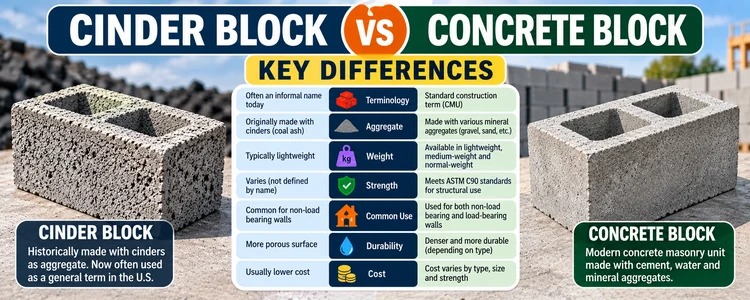
The terms cinder block and concrete block are often used interchangeably in the United States. That can make the difference between them seem more complicated than it really is.
Historically, a cinder block was a concrete masonry unit made with cinders as part of the aggregate. Modern concrete blocks, commonly called concrete masonry units (CMUs), can be manufactured with many different normal-weight or lightweight aggregates. Today, the name alone does not reliably tell you a block’s strength, density, weight, or structural capacity.
So when comparing cinder block vs concrete block, the most important question is not simply what the block is called. You should look at its actual material properties, dimensions, density classification, strength, and whether it meets the specification required for your project.
Cinder Block vs Concrete Block: Quick Comparison
| Feature | Cinder Block | Concrete Block / CMU |
|---|---|---|
| Modern meaning | Often an informal name for a concrete block | Standard construction term for a concrete masonry unit |
| Historical meaning | Concrete masonry made using cinders as aggregate | Concrete masonry made using mineral or other approved aggregates |
| Basic ingredients | Cement, water and aggregate | Cement, water and aggregate |
| Weight | Depends on aggregate and unit design | Available in lightweight, medium-weight and normal-weight classifications |
| Strength | Cannot be determined from the name alone | Depends on the manufactured unit and applicable specification |
| Structural use | Verify the actual unit specification | ASTM C90 units can be specified for loadbearing masonry |
| Common U.S. terminology | Informal/colloquial | CMU or concrete masonry unit is the more precise technical term |
What Is a Cinder Block?
The term cinder block has historical roots in concrete masonry manufacturing. During the early development of concrete masonry, some manufacturers used cinders as lightweight aggregate instead of relying only on conventional stone aggregates.
This helped reduce unit weight and made blocks easier to handle. Over time, “cinder block” became a familiar American term for rectangular concrete masonry blocks.
The important distinction is that the term survived even as masonry manufacturing changed. A person may walk into a store today and ask for a cinder block while actually referring to a modern concrete masonry unit.
Therefore, you should not assume that every product called a cinder block contains coal cinders, nor should you assume that a block called a cinder block is automatically weaker than another block called a concrete block.
What Is a Concrete Block or CMU?
A concrete masonry unit (CMU) is a manufactured masonry unit made primarily from hydraulic cement, water and aggregates. CMUs can be hollow or solid and are produced in different sizes, shapes, densities, strengths, colors and architectural finishes.
Modern CMUs may use normal-weight aggregates, lightweight aggregates, or combinations of aggregate types. This means two concrete blocks of the same nominal dimensions can have different weights and physical properties.
For a broader introduction to this material, see our What Is a CMU Block? guide.
What Is the Main Difference Between a Cinder Block and a Concrete Block?
The most accurate answer depends on whether you are talking about historical terminology or modern construction terminology.
Historically
A cinder block referred to concrete masonry that incorporated cinders as aggregate. The use of lightweight cinder aggregate helped reduce the density and handling weight of the masonry unit.
In Modern Construction
“Cinder block” is frequently used as an informal name for what contractors, manufacturers, engineers and specifications may call a concrete block or CMU.
For this reason, choosing a masonry unit based only on whether someone calls it a cinder block or concrete block can be misleading. The actual product specification is much more important.
Are Cinder Blocks Weaker Than Concrete Blocks?
Not necessarily. This is one of the most important misconceptions to understand.
A block’s strength depends on the properties of the manufactured masonry unit—not simply whether someone calls it a cinder block or concrete block.
Modern concrete masonry units are manufactured to specific physical requirements. ASTM C90, for example, covers dry-cast loadbearing concrete masonry units manufactured from hydraulic cement, water and mineral aggregates, with or without other materials.
Therefore, for structural construction, check the required masonry specification and unit strength rather than relying on the informal product name.
For more detail about masonry strength, see our CMU Compressive Strength Guide.
Which One Is Heavier?
It is also inaccurate to say that every cinder block is lighter and every concrete block is heavier.
Concrete masonry is available in different density classifications. The aggregate type, block geometry, moisture condition and unit configuration can all influence weight.
A lightweight CMU can weigh considerably less than a comparable normal-weight CMU even though both products are concrete masonry units.
If block weight matters for transportation, handling, dead load or estimating, use the manufacturer’s product data rather than estimating weight from the words “cinder” or “concrete.”
See our CMU Block Weight Guide and Lightweight vs Normal Weight CMU for more information.
Cinder Block vs Concrete Block Sizes
The familiar U.S. masonry block is commonly described by its nominal dimensions. A widely used example is the nominal 8 × 8 × 16-inch CMU.
Nominal dimensions include the space intended for the mortar joint. Therefore, the manufactured unit itself is typically smaller than its nominal dimensions.
| Nominal Width | Nominal Height | Nominal Length | Typical Application |
|---|---|---|---|
| 4 in. | 8 in. | 16 in. | Partitions and veneers depending on design |
| 6 in. | 8 in. | 16 in. | Partitions and wall applications |
| 8 in. | 8 in. | 16 in. | Common wall construction |
| 10 in. | 8 in. | 16 in. | Thicker masonry walls |
| 12 in. | 8 in. | 16 in. | Heavy-duty wall applications |
These are common nominal sizes rather than a complete list. Manufacturers can supply additional sizes and specialty shapes.
For detailed dimensions, use our Standard CMU Block Dimensions guide.
Hollow vs Solid Concrete Blocks
Another distinction that matters more than the words cinder block versus concrete block is the unit configuration.
Concrete masonry units can be hollow or solid depending on their design and intended application. Hollow units are especially common because their cells can accommodate reinforcement and grout where required by the wall design.
Unit configuration affects weight, material quantity and construction details. A hollow unit should not automatically be considered weak; structural performance depends on the complete masonry system, including the unit, mortar, grout, reinforcement, geometry and design.
Read Hollow vs Solid Concrete Blocks for a more detailed comparison.
Which Is Better for Load-Bearing Walls?
For a load-bearing wall, do not choose a unit simply because it is marketed as a “concrete block” rather than a “cinder block.”
The correct approach is to use masonry units that meet the project specifications and applicable building requirements. ASTM C90 covers loadbearing concrete masonry units and includes requirements relevant to manufactured CMUs.
The completed wall is also a system. Its structural capacity can depend on factors such as:
- CMU strength and dimensions
- Mortar type
- Grout
- Vertical and horizontal reinforcement
- Wall thickness and height
- Openings and lintels
- Lateral and gravity loads
- Connection and anchorage details
- Applicable building code and engineered design
For structural work, follow the construction documents and local code requirements rather than selecting masonry solely by its common name.
Which Is Better for Foundations?
Concrete masonry can be used in foundation construction when the wall system is properly designed for the applicable soil, structural, moisture and lateral-load conditions.
Again, the name “cinder block” versus “concrete block” is not enough information to determine whether a unit is suitable for a foundation.
For a new structural foundation, verify the required CMU specification, wall thickness, reinforcement, grout, footing dimensions and waterproofing or dampproofing requirements.
Our CMU Foundation Wall Guide explains the subject in greater detail.
Durability and Weather Resistance
Durability depends on the characteristics of the masonry unit and the environment in which the wall is built.
Moisture exposure, freeze-thaw conditions, drainage, flashing, coatings, workmanship and material specifications can all affect masonry performance. It is therefore too simplistic to say that every concrete block is durable while every cinder block is not.
When masonry will be exposed to severe weather, select units and construction details appropriate for the exposure conditions.
Related information is available in our CMU Freeze-Thaw Resistance Guide.
Fire Resistance
Concrete masonry is widely used in fire-resistance-rated construction, but the fire-resistance rating belongs to a tested, calculated or approved wall assembly—not merely to the informal name of an individual block.
Wall thickness, aggregate type, equivalent thickness, grout and other assembly characteristics can affect fire performance.
If your project requires a specific rating, such as a one-hour, two-hour or longer fire-resistance rating, use the required assembly information rather than assuming that “concrete block” automatically provides a particular rating.
See our CMU Fire Rating Guide for additional information.
Cinder Block vs Concrete Block Cost
There is no universal rule that a cinder block will always cost less than a concrete block.
Actual block prices depend on:
- Unit dimensions
- Density and aggregate type
- Strength requirements
- Architectural finish
- Specialty shape
- Order quantity
- Manufacturer and supplier
- Transportation distance
- Local market conditions
The total wall cost also includes mortar, grout, reinforcement, labor, equipment, delivery and waste. For estimating purposes, compare complete wall-system costs rather than only the purchase price of one block.
You can review related pricing factors in our CMU Block Cost Per Square Foot guide.
Are Cinder Blocks Still Used Today?
The term cinder block is certainly still used throughout the United States. However, it is often used colloquially for modern concrete masonry units regardless of the exact aggregate in the block.
That distinction is useful when working with older buildings. If you are evaluating existing masonry, especially historic construction, do not identify its composition only by appearance or terminology. Existing units may need to be inspected or tested when their condition or structural capacity is important.
Cinder Block vs CMU: Are They the Same?
In everyday conversation, they can refer to the same type of masonry product. In technical documents, however, CMU (concrete masonry unit) is the clearer term because it identifies the manufactured masonry product without assuming a particular historical aggregate.
This is why drawings, specifications and engineering documents commonly use terms such as CMU, concrete masonry, or concrete masonry unit.
What Should You Ask for When Buying Blocks?
Instead of asking only for “cinder blocks,” provide the supplier with the information relevant to your project. Depending on the application, this may include:
- Nominal block width, height and length
- Required unit type or shape
- Loadbearing or non-loadbearing application
- Required strength
- Density classification
- Architectural color or texture
- Quantity required
- Applicable project specification
This avoids confusion and helps ensure that the product supplied matches the design.
How Many Concrete or Cinder Blocks Do You Need?
Once you have selected the correct masonry unit, the next step is estimating the quantity required for the wall.
Block quantity depends on wall length and height, block face dimensions, openings and waste allowance. Mortar, grout and reinforcement may also need to be estimated separately.
Use our CMU Block Calculator to estimate the number of blocks required for your project. You can also use the Mortar Calculator and CMU Grout Calculator for related masonry quantities.
Frequently Asked Questions
Are cinder blocks and concrete blocks the same thing?
In modern everyday U.S. usage, the terms are often used interchangeably. Historically, “cinder block” referred to concrete masonry made using cinders as aggregate. For modern construction, verify the actual CMU specification instead of relying on the name.
Are cinder blocks weaker than concrete blocks?
You cannot determine strength from the term alone. Strength depends on the actual manufactured unit and its material properties. For structural construction, use units meeting the project specification and applicable standards.
Are cinder blocks lighter than concrete blocks?
A block containing lightweight aggregate may be lighter than a comparable normal-weight unit, but modern CMUs are available in several density classifications. The word “cinder” by itself is not a reliable weight classification.
Is CMU the same as concrete block?
Yes. CMU stands for concrete masonry unit and is the common technical term for manufactured concrete masonry blocks used in building construction.
What is the standard concrete block size?
A very common U.S. CMU has nominal dimensions of 8 × 8 × 16 inches. Other nominal widths such as 4, 6, 10 and 12 inches are also commonly available. Actual or specified unit dimensions are typically smaller than nominal dimensions to accommodate mortar joints.
Can cinder blocks be used for load-bearing walls?
Do not determine load-bearing suitability from the informal name “cinder block.” Verify that the actual masonry unit and complete wall assembly meet the structural specifications and applicable code requirements for the project.
Which is better: cinder block or concrete block?
For modern construction, the better question is which CMU specification is appropriate for the project. Compare unit size, strength, density, configuration, exposure requirements and structural design instead of choosing based solely on whether the product is called a cinder block or concrete block.
Final Thoughts
The cinder block vs concrete block debate is largely a matter of terminology unless you are discussing the actual aggregate used to manufacture a particular unit. Historically, cinders were used as lightweight aggregate in some concrete masonry units, which helped create the familiar term “cinder block.”
Modern concrete masonry is much more diverse. CMUs can use different aggregates and can be manufactured in lightweight, medium-weight and normal-weight classifications. They are available in many sizes, shapes, strengths and configurations.
For homeowners, contractors and estimators, the practical rule is simple: do not judge a masonry unit’s strength, weight or suitability from the words “cinder block” or “concrete block” alone. Check the actual product specification and make sure it matches the requirements of the wall you are building.