
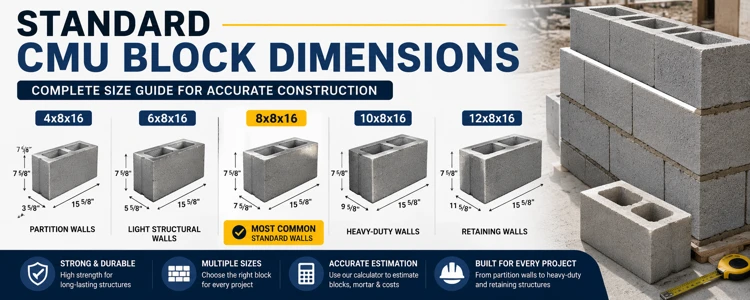
Understanding standard CMU block dimensions is important for accurate construction planning, masonry estimation, and structural design. Whether you are building a retaining wall, foundation, partition wall, garage, or commercial structure, selecting the correct concrete masonry unit size helps improve durability, reduce waste, and simplify installation.
In this guide, you will learn standard CMU block dimensions, nominal vs actual sizes, common block thicknesses, and the most popular CMU block applications used in modern construction.
What Are CMU Blocks?
CMU stands for:
Concrete Masonry Unit
These concrete blocks are widely used in residential, commercial, and industrial construction because they are:
- Strong
- Fire-resistant
- Durable
- Cost-effective
- Easy to install
CMU blocks are available in different sizes and thicknesses depending on structural requirements.
Standard CMU Block Dimensions
In the United States, CMU block sizes are usually referred to using:
Nominal dimensions
Nominal dimensions include:
- Block size
- Mortar joint thickness
Actual dimensions are slightly smaller to allow room for mortar joints.
Nominal vs Actual CMU Dimensions
Example:
Nominal Size:
8x8x16Actual Size:
7 5/8" × 7 5/8" × 15 5/8"The missing space allows for standard:
3/8-inch mortar joints
Common Standard CMU Block Sizes
| Nominal Size | Actual Size | Common Uses |
|---|---|---|
| 4x8x16 | 3 5/8″ × 7 5/8″ × 15 5/8″ | Partition walls |
| 6x8x16 | 5 5/8″ × 7 5/8″ × 15 5/8″ | Light structural walls |
| 8x8x16 | 7 5/8″ × 7 5/8″ × 15 5/8″ | Standard structural walls |
| 10x8x16 | 9 5/8″ × 7 5/8″ × 15 5/8″ | Heavy-duty walls |
| 12x8x16 | 11 5/8″ × 7 5/8″ × 15 5/8″ | Retaining walls |
Most Common CMU Block Dimension
The most widely used CMU block size is:
8x8x16 CMU Block
This block is commonly used for:
- Exterior walls
- Foundations
- Commercial buildings
- Structural masonry walls
- Garage walls
- Reinforced construction
Builders prefer this size because it provides a strong balance between:
- Strength
- Durability
- Installation speed
- Cost efficiency
4-Inch CMU Blocks
4-inch blocks are thinner and lightweight.
Common uses:
- Interior partitions
- Fence walls
- Decorative masonry
- Non-load-bearing walls
Advantages:
- Easy installation
- Lower cost
- Faster handling
6-Inch CMU Blocks
6-inch concrete blocks provide moderate strength while remaining relatively lightweight.
Common uses:
- Residential walls
- Exterior partitions
- Small commercial structures
These blocks are often selected for projects requiring a balance between strength and reduced wall thickness.
8-Inch CMU Blocks
8-inch blocks are considered:
Industry standard structural blocks
Advantages:
- High strength
- Better load-bearing capacity
- Improved fire resistance
- Excellent durability
They are commonly used in:
- Schools
- Warehouses
- Commercial buildings
- Residential foundations
10-Inch and 12-Inch CMU Blocks
Larger CMU blocks are used for:
- Retaining walls
- Industrial structures
- High-load walls
- Reinforced masonry systems
These blocks provide:
- Greater strength
- Better insulation
- Improved structural stability
However, they are:
- Heavier
- More expensive
- Harder to install
Standard CMU Block Thickness
CMU block thickness is determined by the first number in the nominal size.
Example:
8x8x16The:
8-inch thickness
affects:
- Wall strength
- Load-bearing capacity
- Insulation performance
Hollow vs Solid CMU Blocks
CMU blocks may be:
- Hollow
- Solid
Hollow CMU Blocks
These blocks contain hollow cores.
Advantages:
- Lighter weight
- Easier handling
- Better insulation
- Reduced material usage
Most standard CMU blocks used today are hollow.
Solid CMU Blocks
Solid blocks are:
- Heavier
- Stronger
- Denser
Common uses:
- Foundations
- Retaining walls
- High-strength applications
CMU Block Weight
Block weight depends on:
- Size
- Density
- Hollow or solid design
Typical weight ranges:
- 8x8x16 hollow block → 30–35 lbs
- Solid blocks → significantly heavier
Larger blocks weigh more and may require additional labor during installation.
Why Standard CMU Dimensions Matter
Using standard CMU dimensions helps:
- Simplify construction planning
- Improve material estimation
- Reduce cutting and waste
- Speed up installation
- Maintain structural consistency
Professional contractors rely on standard dimensions for accurate masonry layouts.
How to Choose the Right CMU Block Size
Selecting the correct block size depends on:
- Wall purpose
- Structural load
- Building type
- Insulation requirements
- Local building codes
Load-bearing walls usually require:
8-inch or larger CMU blocks
Non-structural walls may use:
4-inch or 6-inch blocks
Use a CMU Block Calculator
Manual masonry calculations can take time and may lead to errors.
Our online CMU Block Calculator helps you:
- Estimate block quantities
- Calculate mortar bags
- Estimate material costs
- Support multiple block sizes
- Add waste percentage
Using a calculator improves project planning and construction accuracy.
Final Thoughts
Understanding standard CMU block dimensions is essential for accurate masonry planning and efficient construction. Different block sizes are designed for different structural applications, from lightweight partitions to heavy-duty retaining walls.
The 8x8x16 CMU block remains the most common choice for modern construction projects because of its strength, durability, and versatility.
For accurate material estimation, use our online CMU Block Calculator to calculate blocks, mortar requirements, and construction costs instantly.