
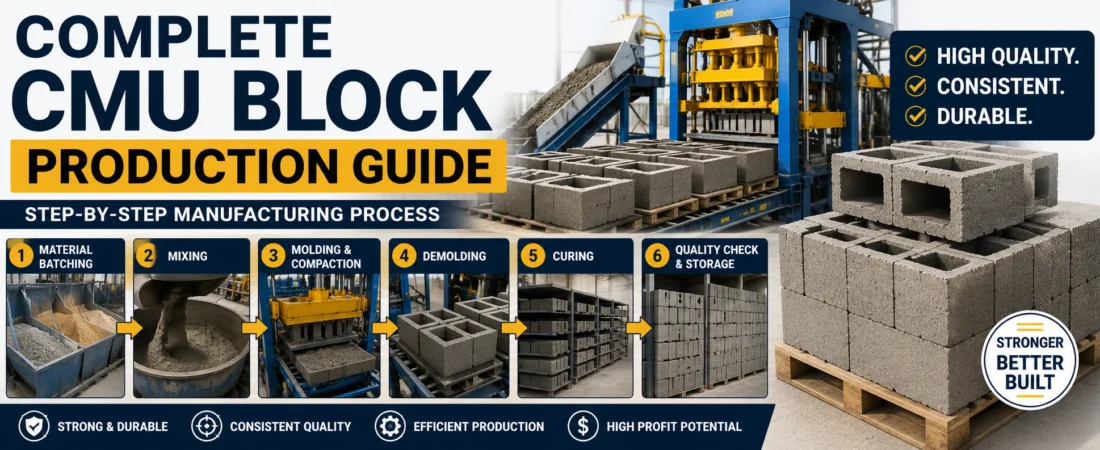
Concrete Masonry Units (CMU), commonly known as concrete blocks, are among the most widely used building materials in residential, commercial, industrial, and infrastructure construction. Their strength, durability, fire resistance, and cost-effectiveness make them a preferred choice for contractors, engineers, architects, and developers throughout the United States and many other countries.
As construction demand continues to grow, many entrepreneurs are exploring opportunities in CMU block manufacturing. However, producing high-quality concrete blocks involves much more than simply mixing cement, sand, and aggregates. A successful production process requires proper planning, quality raw materials, accurate mix design, suitable equipment, moisture control, curing techniques, and quality assurance at every stage.
Whether you are planning to establish a new CMU manufacturing plant, expand an existing production facility, or simply want to understand how concrete masonry units are produced, this guide provides a step-by-step overview of the complete manufacturing process.
In Part 1, we will focus on planning, raw materials, production requirements, and the preparation steps that form the foundation of every successful CMU block manufacturing operation.
What Is CMU Block Production?
CMU block production is the industrial process of manufacturing concrete masonry units using cement, aggregates, water, and specialized block-making equipment.
Unlike traditional concrete pouring, CMU blocks are manufactured under controlled conditions using carefully proportioned materials that are compacted and vibrated inside molds to produce uniform blocks.
Modern production facilities are designed to manufacture blocks with consistent dimensions, strength, and durability while maintaining high production efficiency.
The manufacturing process typically includes:
- Raw material selection
- Material storage
- Batching
- Concrete mixing
- Block molding
- Vibration and compaction
- Demolding
- Curing
- Quality inspection
- Storage
- Delivery
Every stage contributes to the final quality of the finished product.
Why Production Quality Matters
The quality of a CMU block directly affects the performance of the finished structure.
Poor production practices may result in:
- Weak compressive strength
- Surface cracks
- Excessive water absorption
- Poor dimensional accuracy
- Reduced durability
- Customer complaints
- Increased material waste
High-quality production helps manufacturers build a stronger reputation while reducing long-term operating costs.
Common Applications of CMU Blocks
Concrete masonry units are used in a wide variety of construction projects.
Typical applications include:
- Residential houses
- Commercial buildings
- Warehouses
- Schools
- Hospitals
- Industrial facilities
- Boundary walls
- Retaining walls
- Foundation walls
- Basement walls
- Agricultural buildings
- Infrastructure projects
Different applications may require different block sizes, strengths, and production methods.
Understanding Different Types of CMU Blocks
Before beginning production, manufacturers should understand the various types of concrete masonry units available.
Hollow CMU Blocks
Hollow blocks are the most commonly manufactured type.
Advantages include:
- Reduced weight
- Easier handling
- Better insulation
- Lower material consumption
- Space for reinforcement and grout
Most structural walls use hollow concrete blocks.
Solid CMU Blocks
Solid blocks contain significantly less hollow space.
They are commonly used where higher density and additional strength are required.
Applications include:
- Load-bearing walls
- Retaining structures
- Industrial construction
Split-Face CMU Blocks
Split-face blocks provide a decorative textured surface.
These blocks are frequently used for:
- Commercial buildings
- Schools
- Architectural facades
Lightweight CMU Blocks
Lightweight blocks use lightweight aggregates to reduce overall block weight.
Benefits include:
- Easier installation
- Reduced transportation costs
- Improved thermal performance
Planning Before Starting Production
Many new manufacturers focus on purchasing machinery before developing a proper production plan.
Successful factories begin with careful planning.
Important decisions include:
- Production capacity
- Product types
- Target customers
- Available investment
- Factory location
- Material suppliers
- Equipment selection
- Quality standards
Proper planning reduces future operational problems.
Selecting the Right Factory Location
Factory location influences production efficiency and operating costs.
A suitable production site should provide:
- Good road access
- Adequate storage space
- Reliable electricity
- Water supply
- Easy truck movement
- Room for expansion
Locating the factory close to construction markets may also reduce transportation expenses.
Raw Materials Used in CMU Block Production
The quality of every concrete block begins with the quality of its raw materials.
Each material serves a specific purpose in the manufacturing process.
Portland Cement
Portland cement acts as the primary binding material.
It reacts with water to create a hardened cement paste that binds aggregates together.
High-quality cement improves:
- Strength
- Durability
- Long-term performance
Manufacturers should always use fresh cement stored in dry conditions.
Sand
Sand fills the spaces between larger aggregates and improves workability.
Good masonry sand should be:
- Clean
- Well graded
- Free from organic materials
- Low in clay content
Poor-quality sand may reduce block strength and affect surface appearance.
Aggregates
Aggregates make up the largest portion of a CMU block.
Common aggregate types include:
- Crushed stone
- Gravel
- Manufactured aggregates
- Lightweight aggregates
Aggregate size directly affects block density, strength, and appearance.
Water
Water activates the cement hydration process.
However, more water does not always produce better concrete.
Excess water may:
- Reduce strength
- Increase shrinkage
- Cause surface defects
Manufacturers should use clean water and carefully control moisture content.
Chemical Admixtures
Some production facilities use chemical admixtures to improve specific properties.
These may help with:
- Workability
- Water reduction
- Early strength
- Freeze-thaw resistance
- Color consistency
Admixtures should always be used according to manufacturer recommendations.
Pigments for Colored CMU Blocks
Architectural CMU blocks often contain mineral pigments.
Common colors include:
- Gray
- Red
- Brown
- Black
- Tan
Consistent pigment measurement is important for uniform appearance.
Importance of Material Storage
Even high-quality materials can lose performance if stored incorrectly.
Manufacturers should protect materials from:
- Moisture
- Dirt
- Contamination
- Wind-blown debris
Proper storage improves production consistency.
Quality Inspection of Raw Materials
Before production begins, manufacturers should inspect incoming materials.
Typical quality checks include:
- Cement freshness
- Sand cleanliness
- Aggregate grading
- Moisture content
- Water quality
Detecting problems early reduces production losses.
Moisture Control Before Mixing
One of the most overlooked factors in CMU manufacturing is moisture control.
Moisture affects:
- Concrete consistency
- Compaction
- Block strength
- Surface finish
Manufacturers often adjust water quantities based on the moisture already present in the aggregates.
Consistent moisture control helps produce uniform blocks throughout the production cycle.
Understanding CMU Mix Design
A concrete mix design determines the proportion of each ingredient used during production.
The ideal mix depends on several factors, including:
- Block type
- Required strength
- Aggregate properties
- Manufacturing equipment
- Local standards
Rather than using a single universal recipe, manufacturers typically develop mix designs that meet their production goals and quality requirements.
Common Mistakes Before Production Begins
Many production problems occur before concrete is even mixed.
Common mistakes include:
- Purchasing low-quality materials
- Poor storage practices
- Inconsistent moisture control
- Selecting the wrong aggregates
- Ignoring material testing
- Inadequate production planning
Preventing these issues improves efficiency and reduces waste.
we discussed above production planning, factory setup, raw materials, moisture control, and mix design. Those preparation steps create the foundation for producing strong, consistent, and durable concrete masonry units.
Now it’s time to move inside the manufacturing plant and understand the complete production workflow. Every stage in the production line affects the strength, appearance, dimensional accuracy, and long-term performance of the finished CMU block.
Whether you use a manual machine, semi-automatic system, or a fully automatic production line, the manufacturing process follows the same basic principles.
Step 1 – Material Batching
Batching is the process of measuring the required quantity of each raw material before mixing.
Typical materials include:
- Portland cement
- Sand
- Coarse aggregates
- Water
- Admixtures (if required)
- Pigments (for colored blocks)
Modern factories often use automatic batching systems because they provide greater consistency than manual measurement.
Accurate batching helps maintain:
- Uniform strength
- Consistent block dimensions
- Stable production quality
- Lower material waste
Even small variations in material proportions can affect the final block quality.
Step 2 – Concrete Mixing
After batching, all materials are transferred into a concrete mixer.
The objective is to create a homogeneous concrete mixture where every particle is evenly distributed.
Good mixing produces:
- Uniform color
- Consistent moisture
- Better compaction
- Higher compressive strength
Poor mixing may create weak blocks with inconsistent density.
Manufacturers continuously monitor the concrete during mixing and adjust moisture when necessary.
Understanding the Correct Concrete Consistency
One of the biggest differences between poured concrete and CMU block production is concrete consistency.
CMU blocks are normally produced using low-slump concrete, sometimes called zero-slump concrete.
This mixture appears almost dry compared with conventional concrete.
The concrete should contain enough moisture to bind the materials together while remaining stiff enough to hold its shape immediately after the mold is removed.
If the mix becomes too wet:
- Blocks may collapse after demolding.
- Dimensions become inconsistent.
- Production speed decreases.
If the mix becomes too dry:
- Poor compaction
- Surface voids
- Lower strength
- Weak corners
Maintaining proper moisture is one of the most critical skills in CMU production.
Step 3 – Feeding the Block Machine
After mixing, concrete is transferred to the block-making machine.
Depending on the production system, material may be fed using:
- Conveyor belts
- Skip hoists
- Hoppers
- Manual loading
The machine hopper distributes concrete evenly into the mold.
Consistent feeding improves production quality and minimizes waste.
Step 4 – Filling the Mold
The mold determines the final size and shape of every block.
Each mold is specifically designed for a particular product, such as:
- 4-inch blocks
- 6-inch blocks
- 8-inch blocks
- Solid blocks
- Hollow blocks
- Specialty architectural blocks
Proper mold filling is essential.
Insufficient concrete may leave voids, while excessive concrete can create dimensional inaccuracies.
Step 5 – Vibration Process
Once the mold is filled, the machine applies vibration.
Vibration removes trapped air pockets and allows concrete particles to settle into a dense structure.
Benefits of proper vibration include:
- Better density
- Higher compressive strength
- Smoother surfaces
- Improved durability
- Reduced internal voids
Modern production machines precisely control vibration frequency and duration.
Step 6 – Hydraulic Compaction
After vibration, hydraulic pressure compresses the concrete inside the mold.
Compaction improves:
- Block density
- Edge quality
- Dimensional accuracy
- Structural strength
Poor compaction may result in:
- Weak blocks
- Surface defects
- Low compressive strength
- Increased breakage
Vibration and compaction work together to produce high-quality CMU blocks.
Step 7 – Demolding
Once compaction is complete, the mold is lifted while the newly formed block remains on the production pallet.
This stage is known as demolding.
Because CMU blocks use low-moisture concrete, they can retain their shape immediately after leaving the mold.
Any collapse or deformation at this stage usually indicates problems with:
- Moisture content
- Mix design
- Compaction
- Machine settings
Step 8 – Pallet Transfer
Freshly molded blocks remain on steel or wooden pallets.
Automatic production plants typically use conveyors to transport pallets to the curing area.
Proper pallet handling prevents:
- Corner damage
- Surface scratches
- Block deformation
Smooth handling also improves production efficiency.
Step 9 – Initial Curing
Fresh blocks should never be exposed to rapid drying immediately after production.
Initial curing allows cement hydration to begin under controlled conditions.
Manufacturers commonly use:
- Covered curing rooms
- Steam curing systems
- Controlled humidity chambers
Proper curing significantly improves:
- Strength development
- Durability
- Surface quality
- Crack resistance
Step 10 – Final Curing
After the initial curing period, blocks continue curing until they achieve the required strength.
Depending on the production method, curing may involve:
- Moist curing
- Steam curing
- Controlled air curing
Manufacturers monitor curing conditions to ensure consistent product quality.
Proper curing is one of the most important factors affecting long-term block performance.
Step 11 – Quality Inspection
Every production batch should undergo quality inspection before shipment.
Manufacturers commonly inspect:
- Block dimensions
- Surface appearance
- Corner quality
- Density
- Weight
- Cracks
- Honeycombing
- Color consistency
Regular inspections help identify production problems before products reach customers.
Common Manufacturing Defects
Quality control teams should monitor for defects such as:
- Surface cracks
- Broken corners
- Honeycombing
- Uneven dimensions
- Low density
- Color variation
- Poor edge definition
Identifying the root cause early reduces waste and improves production consistency.
Production Records
Professional manufacturers maintain detailed production records.
Typical records include:
- Batch numbers
- Material quantities
- Moisture readings
- Machine settings
- Production dates
- Quality inspection reports
Keeping accurate records helps improve traceability and continuous process improvement.
Factory Safety During Production
Safety should always remain a priority.
Workers should use appropriate personal protective equipment (PPE), including:
- Safety helmets
- Gloves
- Steel-toe boots
- Eye protection
- Hearing protection
Regular machine inspections and employee training also help reduce workplace accidents.
After learning about raw materials, production planning, batching, mixing, molding, compaction, curing, and quality inspection, the next step is understanding how to operate a CMU production facility efficiently.
Successful manufacturers don’t simply produce concrete blocks—they continuously improve production efficiency, reduce costs, maintain consistent quality, and satisfy customer expectations.
This final section focuses on production management, quality standards, maintenance, cost optimization, and long-term business success.
Daily Production Planning
Every successful factory begins the day with a production schedule.
Production planning helps manufacturers:
- Meet customer deadlines
- Reduce downtime
- Improve labor productivity
- Manage inventory
- Prevent material shortages
A typical daily production plan includes:
- Production target
- Machine availability
- Employee assignments
- Material availability
- Delivery schedule
- Equipment inspection
Proper planning minimizes production delays.
Understanding Production Capacity
Every production machine has a maximum production capacity.
Actual production depends on:
- Machine type
- Number of operators
- Working hours
- Mold changes
- Material supply
- Maintenance downtime
Instead of operating at maximum capacity every day, many factories maintain consistent production levels to improve quality and reduce machine wear.
Machine Maintenance
Production equipment should be inspected regularly.
Preventive maintenance helps avoid:
- Unexpected breakdowns
- Production delays
- Higher repair costs
- Poor block quality
Maintenance schedules typically include:
Daily
- Cleaning molds
- Lubricating moving parts
- Inspecting hydraulic systems
Weekly
- Checking vibration systems
- Inspecting conveyors
- Tightening bolts
Monthly
- Hydraulic inspection
- Motor inspection
- Mold wear measurement
- Calibration checks
Routine maintenance extends machine life and improves production consistency.
Quality Control During Production
Quality control should continue throughout the production process rather than only after blocks are manufactured.
Manufacturers commonly inspect:
- Concrete consistency
- Block dimensions
- Surface finish
- Block weight
- Color consistency
- Corner quality
- Mold condition
Continuous monitoring reduces rejected products.
Compressive Strength Testing
One of the most important quality tests for CMU blocks is compressive strength.
This test measures the amount of load a block can withstand before failure.
Manufacturers perform strength testing to:
- Verify product quality
- Meet project specifications
- Maintain production consistency
Testing is usually carried out in a laboratory using specialized compression testing equipment.
Water Absorption Testing
Concrete blocks naturally absorb some moisture.
However, excessive water absorption may reduce durability and affect long-term performance.
Water absorption testing helps manufacturers evaluate:
- Material quality
- Density
- Durability
- Production consistency
Proper curing and good mix design generally improve performance.
Dimensional Accuracy
Customers expect every block to have consistent dimensions.
Dimensional accuracy affects:
- Wall alignment
- Mortar joint thickness
- Construction speed
- Material consumption
Regular mold inspection helps maintain dimensional consistency.
Storage of Finished Blocks
After curing, blocks should be stored correctly before shipment.
Proper storage includes:
- Level stacking
- Dry storage areas
- Protection from contamination
- Organized inventory
Good storage practices reduce product damage and improve loading efficiency.
Loading and Transportation
CMU blocks are heavy products that require careful handling.
Manufacturers should:
- Use appropriate pallets
- Secure loads properly
- Prevent excessive movement
- Protect block corners during transportation
Safe transportation helps reduce customer complaints.
Reducing Production Costs
Lower production costs improve profitability without reducing product quality.
Manufacturers commonly reduce costs by:
- Improving production efficiency
- Reducing material waste
- Optimizing labor schedules
- Preventive machine maintenance
- Better inventory management
Cost reduction should never compromise product quality.
Reducing Material Waste
Waste increases operating expenses.
Common waste sources include:
- Broken blocks
- Excess concrete
- Poor storage
- Incorrect batching
- Damaged pallets
Tracking waste helps identify production problems.
Improving Factory Productivity
Higher productivity allows factories to produce more blocks using the same resources.
Ways to improve productivity include:
- Employee training
- Standard operating procedures
- Better production planning
- Equipment maintenance
- Efficient material handling
Small improvements can significantly increase long-term output.
Automation in CMU Manufacturing
Many modern factories use automation to improve efficiency.
Automated systems may include:
- Automatic batching
- Conveyor systems
- Robotic pallet handling
- Automated curing chambers
- Computerized quality monitoring
Automation reduces manual handling and improves production consistency.
Environmental Considerations
Modern manufacturers increasingly focus on sustainable production.
Examples include:
- Recycling returned concrete
- Reducing dust emissions
- Water conservation
- Energy-efficient equipment
- Using recycled aggregates where appropriate
These practices can improve environmental performance while reducing operating costs.
Common Challenges in CMU Manufacturing
Even experienced manufacturers face production challenges.
Common issues include:
- Inconsistent moisture
- Material shortages
- Machine downtime
- Mold wear
- Labor shortages
- Seasonal weather changes
- Transportation delays
Planning ahead helps minimize these risks.
Tips for New CMU Manufacturers
If you’re starting a new production facility:
- Invest in quality equipment
- Buy reliable raw materials
- Train your production team
- Develop written production procedures
- Maintain equipment regularly
- Monitor quality every day
- Build long-term supplier relationships
- Focus on customer satisfaction instead of production volume alone
Consistent quality is often more valuable than producing the highest number of blocks.
Related Calculators
- CMU Block Calculator
- CMU Material Cost Calculator
- CMU Labor Cost Calculator
- CMU Construction Cost Per Square Foot
- CMU Grout Calculator
- How to Price CMU Wall Jobs
Related Articles
- How to Start a CMU Block Business in USA
- CMU Block Business Profit Margin
- CMU Construction Cost Per Square Foot
- CMU Mortar Mix Ratio Guide
- How to Price CMU Wall Jobs
- What Is a CMU Block?
Frequently Asked Questions
How long does the CMU block manufacturing process take?
The production process includes batching, mixing, molding, curing, inspection, and storage. The overall timeline depends on the curing method, production equipment, and quality requirements.
Why is curing important in CMU block production?
Proper curing allows cement hydration to continue, helping blocks develop strength, durability, and long-term performance.
What is the biggest challenge in CMU manufacturing?
Maintaining consistent material quality, moisture control, equipment reliability, and production efficiency are among the biggest challenges.
Can production efficiency improve profitability?
Yes. Reducing waste, improving labor productivity, maintaining equipment, and optimizing production planning can all contribute to better profitability.
Final Thoughts
Producing high-quality CMU blocks requires much more than mixing cement and aggregates. Every stage—from raw material selection and batching to curing, quality control, storage, and delivery—plays an important role in the final product.
Manufacturers who invest in quality materials, maintain their equipment, train their workforce, and monitor production carefully are better positioned to produce reliable concrete masonry units and build long-term customer trust.
Whether you are planning a new manufacturing plant or improving an existing production line, understanding the complete CMU block production process provides a strong foundation for consistent quality, efficient operations, and sustainable business growth.