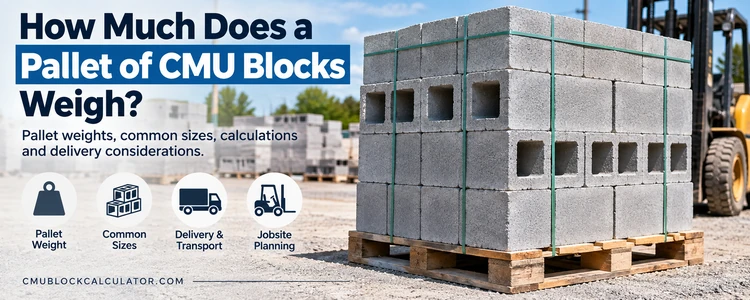
A pallet of CMU blocks can weigh several thousand pounds, depending on the block size, unit weight, number of blocks on the pallet, density, and manufacturer.
For contractors, suppliers, and homeowners, knowing the approximate pallet weight is important when planning:
- Material delivery
- Truck capacity
- Forklift requirements
- Jobsite unloading
- Material storage
- Equipment selection
- Transportation costs
An individual concrete masonry unit may not seem extremely heavy, but a full pallet can quickly become a substantial load.
This guide explains how to estimate the weight of a pallet of CMU blocks, including common sizes such as 4×8×16, 6×8×16, 8×8×16, 10×8×16, and 12×8×16 CMU.
How Much Does a Pallet of CMU Blocks Weigh?
There is no single weight for every pallet of CMU because both the weight per block and the number of blocks per pallet can vary.
A basic calculation is:
Pallet Weight = Number of Blocks × Weight Per Block
For example, if:
- One CMU weighs 35 lb
- The pallet contains 72 blocks
Then the blocks alone weigh:
72 × 35 = 2,520 lb
The actual shipping weight can be somewhat higher after accounting for the pallet and packaging materials.
For this reason, manufacturer or supplier data should be used whenever an exact shipping weight is required.
CMU Pallet Weight Chart
The following table provides useful estimating ranges for common CMU sizes.
| Nominal CMU Size | Approx. Unit Weight | Example Blocks per Pallet | Approx. Block Load |
|---|---|---|---|
| 4×8×16 | 17–26 lb | 144 | 2,448–3,744 lb |
| 6×8×16 | 25–35 lb | 96 | 2,400–3,360 lb |
| 8×8×16 | 28–40 lb | 72 | 2,016–2,880 lb |
| 10×8×16 | 35–50 lb | Varies | Varies |
| 12×8×16 | 45–65 lb | 48 | 2,160–3,120 lb |
Important: These are estimating ranges, not universal pallet specifications. CMU weight and pallet quantities can vary significantly by manufacturer, block configuration, density, and product.
How Much Does a Pallet of 8×8×16 CMU Blocks Weigh?
The 8×8×16 CMU is one of the most common concrete masonry units, making its pallet weight especially useful for construction estimating.
If an 8×8×16 block weighs approximately:
28–40 lb
and an example pallet contains:
72 blocks
then the approximate block load would be:
Lower estimate
72 × 28 = 2,016 lb
Higher estimate
72 × 40 = 2,880 lb
Therefore, an example pallet could contain roughly:
2,016–2,880 lb of CMU
before accounting for the pallet and packaging.
The actual weight should always be confirmed with the supplier when planning transportation or lifting.
Why Does 8×8×16 CMU Pallet Weight Vary?
Two pallets containing nominally the same size CMU can have different weights.
Major factors include:
- Concrete density
- Aggregate type
- Block configuration
- Hollow-core geometry
- Moisture condition
- Manufacturer
- Number of blocks per pallet
- Lightweight vs normal-weight CMU
This is why using only the nominal dimensions cannot determine the exact pallet weight.
How Much Does a Pallet of 4×8×16 Concrete Blocks Weigh?
A 4×8×16 CMU is thinner than a standard 8-inch unit and an individual block generally weighs less.
Using an approximate unit-weight range of:
17–26 lb
and an example pallet quantity of:
144 blocks
the block load would be approximately:
144 × 17 = 2,448 lb
to:
144 × 26 = 3,744 lb
Notice something important:
Even though each 4-inch block may weigh less, a pallet can contain more units.
Therefore, a pallet of thinner blocks is not necessarily lighter than a pallet of larger blocks.
How Much Does a Pallet of 6×8×16 CMU Weigh?
Using an approximate individual block weight of:
25–35 lb
and an example pallet quantity of:
96 blocks, the block load would be:
Lower estimate
96 × 25 = 2,400 lb
Higher estimate
96 × 35 = 3,360 lb
So an example pallet could contain approximately:
2,400–3,360 lb of blocks
before pallet and packaging weight.
How Much Does a Pallet of 12×8×16 CMU Weigh?
A 12-inch CMU is substantially thicker than an 8-inch block.
Using an approximate block weight of:
45–65 lb
and an example pallet quantity of:
48 blocks, the block load would be:
48 × 45 = 2,160 lb
to:
48 × 65 = 3,120 lb
Again, fewer units per pallet can partly offset the higher weight of each individual block.
CMU Block Weight vs Pallet Weight
These two measurements should not be confused.
CMU Block Weight
This refers to the weight of one individual concrete masonry unit.
CMU Pallet Weight
This refers to the combined weight of:
- Multiple CMU units
- Pallet
- Packaging or wrapping where applicable
If you are looking specifically for individual block weights rather than full pallet loads, see:
This separation is important because someone selecting a block by hand has a different question from someone planning to unload an entire pallet.
How Many CMU Blocks Are on a Pallet?
Pallet quantity is one of the main variables used to calculate total pallet weight.
The number of blocks can depend on:
- CMU size
- Manufacturer
- Product configuration
- Pallet dimensions
- Shipping method
- Supplier packaging
Instead of duplicating the complete pallet-count information here, see our dedicated guide:
That guide focuses on block quantity per pallet, while this article focuses specifically on pallet weight.
How to Calculate CMU Pallet Weight
If you know the number of blocks and individual block weight, the calculation is straightforward.
Step 1: Find the Block Quantity
Determine how many blocks are actually included on the pallet.
Step 2: Find the Unit Weight
Check the manufacturer’s specifications for the approximate weight of one block.
Step 3: Multiply the Two Values
For example:
- 90 blocks
- 32 lb each
90 × 32 = 2,880 lb
The blocks therefore weigh approximately:
2,880 lb
Step 4: Include Pallet and Packaging When Required
If you need the total shipping or lifting weight, the pallet and packaging should also be considered.
For equipment or transportation decisions, use the supplier’s confirmed shipment weight rather than relying only on a general estimate.
Lightweight vs Normal-Weight CMU Pallets
CMU can be manufactured using different aggregates and densities.
Lightweight CMU
Lightweight units can reduce:
- Individual block weight
- Overall wall dead load
- Handling effort
- Potential pallet load
Normal-Weight CMU
Normal-weight units generally contain denser aggregates and can weigh more per unit.
Two pallets with the same:
- Nominal block size
- Number of blocks
can therefore have different total weights if one contains lightweight CMU and the other contains normal-weight CMU.
For a detailed comparison:
Hollow vs Solid Concrete Block Pallet Weight
Block configuration also affects weight.
Hollow CMU
Hollow units contain internal cores that reduce the amount of concrete in each block.
Solid or More Heavily Filled Units
Units containing more concrete can weigh substantially more.
Therefore, two blocks with similar outside dimensions can have very different unit weights.
A pallet containing heavier units can consequently place a much greater load on:
- Delivery trucks
- Forklifts
- Trailers
- Slabs
- Storage areas
For more information:
Why CMU Pallet Weight Matters on a Jobsite
Knowing pallet weight is useful before the truck arrives.
It can affect:
Delivery Planning
The total material load can affect the number and type of deliveries required.
Forklift Selection
Material-handling equipment must have sufficient rated capacity for the actual load and lifting conditions.
Trailer and Truck Loading
Multiple pallets can add substantial total weight.
Material Storage
The supporting surface needs to be suitable for the concentrated loads created by stored masonry materials.
Jobsite Access
Heavy delivery vehicles and handling equipment may require appropriate access and stable working surfaces.
Construction Estimating
Pallet weight can also affect:
- Freight
- Delivery
- Handling
- Equipment
- Logistics costs
Estimating Total Weight for Multiple CMU Pallets
For large projects, calculate the approximate weight of all pallets.
For example, suppose:
- One pallet load ≈ 2,500 lb
- Project requires 10 pallets
Then:
10 × 2,500 = 25,000 lb
The blocks would represent approximately:
25,000 lb
or:
12.5 U.S. short tons
before considering pallets and other project materials.
This illustrates why CMU delivery and storage should be planned rather than treated as a minor logistical detail.
Using the CMU Block Calculator
If you first need to determine how many concrete blocks your wall requires, use our main calculator:
Once the estimated block quantity is known, you can use the applicable unit weight and supplier pallet configuration to estimate:
- Total CMU weight
- Approximate number of pallets
- Approximate pallet loads
- Delivery requirements
CMU Pallet Weight by Project Quantity
Once you know the approximate weight of one block, you can estimate the total CMU weight required for a project.
For example, suppose a project requires:
1,000 CMU blocks
and each block weighs approximately:
35 lb
The total block weight would be:
1,000 × 35 = 35,000 lb
Converted to U.S. short tons:
35,000 ÷ 2,000 = 17.5 tons
This calculation can help with preliminary planning for:
- Material delivery
- Number of pallets
- Truck loads
- Unloading equipment
- Jobsite storage
The actual shipping weight should still be confirmed with the supplier.
CMU Pallet Weight in Pounds vs Tons
CMU pallet weights are commonly discussed in pounds, but converting the load to tons can make large project quantities easier to understand.
In the United States:
1 short ton = 2,000 lb
For example:
| Pallet Weight | Approx. Short Tons |
|---|---|
| 2,000 lb | 1.00 ton |
| 2,400 lb | 1.20 tons |
| 2,500 lb | 1.25 tons |
| 2,800 lb | 1.40 tons |
| 3,000 lb | 1.50 tons |
| 3,500 lb | 1.75 tons |
Therefore, even a single pallet of CMU can represent a substantial load.
Estimating the Number of CMU Pallets
If you know the total number of blocks required and the supplier’s pallet quantity, you can estimate the number of pallets.
For example:
- Required blocks = 1,000
- Blocks per pallet = 72
Calculation:
1,000 ÷ 72 = 13.89 pallets
Since a fraction of a full pallet may still require additional units, the order could involve approximately:
14 pallet-equivalents of CMU
However, the actual shipment may include full pallets plus a partial pallet or loose units depending on the supplier.
For detailed pallet quantities, see:
Estimating Total Weight From Number of Pallets
If the approximate weight of one pallet is known, estimating the total material weight is straightforward.
Suppose:
- Number of pallets = 14
- Approximate block load per pallet = 2,500 lb
Then:
14 × 2,500 = 35,000 lb
Converted to short tons:
35,000 ÷ 2,000 = 17.5 tons
This gives an approximate material load for preliminary logistics planning.
CMU Pallet Weight and Delivery Trucks
A masonry project may require several pallets of concrete blocks.
The total shipment weight can become substantial very quickly.
Delivery planning should consider:
- Number of pallets
- Actual pallet weights
- Vehicle payload limits
- Trailer configuration
- Road restrictions
- Delivery access
- Unloading method
- Other materials carried on the vehicle
For example, ten pallets averaging 2,500 lb of blocks each would represent:
25,000 lb of CMU
before adding pallets, packaging, and any other materials.
Truck selection and loading should therefore be based on actual rated capacities and supplier shipping information.
CMU Pallet Weight and Forklift Capacity
A full pallet of concrete masonry units may weigh several thousand pounds.
This makes forklift selection an important jobsite consideration.
Before lifting a CMU pallet, verify:
- Actual pallet weight
- Forklift rated capacity
- Load center
- Fork position
- Lift height
- Ground conditions
- Equipment configuration
A forklift’s stated maximum capacity should not be interpreted as the safe capacity for every possible load position or lifting condition.
Always use the equipment manufacturer’s rated load information for the actual configuration.
Unloading CMU Pallets
Before the delivery truck arrives, determine how the pallets will be unloaded.
Possible equipment may include:
- Forklift
- Telehandler
- Truck-mounted forklift
- Crane
- Other suitable material-handling equipment
The appropriate method depends on:
- Pallet weight
- Jobsite access
- Ground conditions
- Lift distance
- Required placement location
- Equipment capacity
Heavy pallets should not be moved using equipment that is not rated for the actual load and operating conditions.
Jobsite Storage of CMU Pallets
CMU pallets should be stored in a location suitable for the concentrated load.
Consider:
- Stable ground
- Level surface
- Drainage
- Access for equipment
- Distance from excavation edges
- Construction sequencing
- Protection from vehicle traffic
Multiple pallets concentrated in a small area can represent a very large total load.
This is particularly important when materials are placed on:
- Elevated slabs
- Suspended floors
- Temporary platforms
- Existing structures
The ability of a structure to support stored masonry materials should not be assumed from a general pallet-weight estimate.
Example: Weight of 5 Pallets of 8×8×16 CMU
Suppose an example 8×8×16 CMU pallet contains:
72 blocks
and each block weighs:
35 lb
One pallet contains:
72 × 35 = 2,520 lb
For five pallets:
5 × 2,520 = 12,600 lb
Converted to short tons:
12,600 ÷ 2,000 = 6.3 tons
So five pallets would contain approximately:
12,600 lb or 6.3 tons of CMU
before accounting for pallet and packaging weight.
Example: Weight of 10 Pallets of CMU
Suppose each pallet contains approximately:
2,800 lb of blocks
For 10 pallets:
10 × 2,800 = 28,000 lb
Converted to tons:
28,000 ÷ 2,000 = 14 tons
This example shows why delivery planning becomes increasingly important on larger masonry projects.
Example: Calculate Pallet Weight From Individual Block Weight
Suppose a supplier provides the following information:
- Block weight = 38 lb
- Blocks per pallet = 72
Calculate:
38 × 72 = 2,736 lb
The blocks on the pallet weigh approximately:
2,736 lb
If the exact shipping weight is needed, add the applicable pallet and packaging weight or use the supplier’s stated shipping weight.
Example: Calculate Individual Block Weight From Pallet Data
The calculation can also work in reverse.
Suppose:
- Block load = 2,520 lb
- Number of blocks = 72
Then:
2,520 ÷ 72 = 35 lb
The average block weight would be approximately:
35 lb per unit
This can be useful when a supplier provides total product weight but individual unit weight is not immediately available.
Why Supplier Pallet Weights Can Be Different
Two suppliers may list different pallet weights for blocks with the same nominal dimensions.
Possible reasons include:
- Different aggregates
- Different concrete densities
- Different core geometry
- Different moisture conditions
- Different block configurations
- Different pallet quantities
- Lightweight vs normal-weight units
- Different specialty-unit designs
Therefore, a general online pallet-weight chart should be used for estimating, not as a replacement for the manufacturer’s product data.
Does a Wet CMU Pallet Weigh More?
Concrete masonry units can contain moisture.
Therefore, the actual weight of a pallet can vary depending on the moisture condition of the units.
This is another reason why calculated pallet weights should be treated as estimates.
When transportation, lifting capacity, or structural loading depends on the actual weight, use verified project-specific information.
Does a Pallet of Solid Concrete Blocks Weigh More?
Generally, a unit containing more concrete can weigh more than a hollow unit with similar external dimensions.
However, total pallet weight also depends on how many units are included on the pallet.
Therefore:
heavier individual block ≠ automatically the heaviest pallet
because pallet quantity can also change.
For a detailed comparison:
CMU Pallet Weight for Construction Estimating
Pallet weight can also be useful during the estimating process.
Contractors may need to consider:
- Freight costs
- Delivery quantities
- Number of truckloads
- Forklift rental
- Telehandler requirements
- Crane requirements
- Material handling
- Jobsite storage
For a complete masonry quantity-estimating workflow, see:
Common CMU Pallet Weight Estimating Mistakes
1. Assuming Every 8×8×16 Block Weighs the Same
Block weights vary by manufacturer, density, aggregate, and configuration.
2. Assuming Every Pallet Contains the Same Number of Blocks
Pallet quantities can vary between manufacturers and products.
3. Ignoring Lightweight CMU
Lightweight and normal-weight units can have substantially different unit weights.
4. Confusing Block Weight With Pallet Weight
An individual block weight must be multiplied by the actual pallet quantity.
5. Forgetting the Pallet and Packaging
The calculated block load is not necessarily identical to the complete shipping weight.
6. Using Estimated Weight for Equipment Selection
General estimating figures should not replace verified load information when selecting lifting equipment.
7. Ignoring Multiple-Pallet Weight
One pallet may seem manageable, but several pallets can represent tens of thousands of pounds.
8. Assuming a Larger Block Always Creates a Heavier Pallet
Larger blocks may be packaged in smaller quantities, so total pallet weight depends on both unit weight and pallet quantity.
CMU Pallet Weight Checklist
Before ordering or moving CMU pallets, check:
☑ CMU size confirmed
☑ Individual unit weight confirmed
☑ Blocks per pallet confirmed
☑ Approximate pallet weight calculated
☑ Supplier shipping weight checked where required
☑ Number of pallets estimated
☑ Total project material weight estimated
☑ Truck capacity verified
☑ Unloading method planned
☑ Forklift or telehandler capacity verified
☑ Jobsite access reviewed
☑ Storage location selected
☑ Supporting surface considered
☑ Specialty blocks identified separately
☑ Manufacturer data checked for critical loads
Related CMU Articles
- How Many CMU Blocks Per Pallet?
- CMU Block Weight Guide
- CMU Block Takeoff & Estimating Guide
- CMU Block Sizes Chart
- 8x8x16 CMU Block Dimensions
- Lightweight vs Normal Weight CMU
- Hollow vs Solid Concrete Blocks
- CMU Block Cost Guide
Related Calculators
- CMU Block Calculator
- Mortar Calculator
- Concrete Calculator
- Rebar Calculator
- Foundation Calculator
- Gravel Calculator
Frequently Asked Questions
How much does a pallet of CMU blocks weigh?
A pallet of CMU blocks can weigh several thousand pounds. The exact weight depends on the block size, unit weight, pallet quantity, density, configuration, and manufacturer.
How much does a pallet of 8×8×16 blocks weigh?
As an estimating example, if a pallet contains 72 blocks weighing 28–40 lb each, the blocks alone would weigh approximately 2,016–2,880 lb. Actual pallet configurations and unit weights vary.
How much does a pallet of 8×8×16 concrete blocks weigh in tons?
Using the example range above, 2,016–2,880 lb equals approximately 1.01–1.44 U.S. short tons, excluding pallet and packaging weight.
How do I calculate concrete block pallet weight?
Multiply the number of blocks on the pallet by the weight of one block:
Pallet Block Weight = Blocks per Pallet × Weight per Block
How many blocks are on a pallet?
The quantity varies by block size, manufacturer, and packaging configuration. See our dedicated How Many CMU Blocks Per Pallet? guide for pallet-count information.
Does pallet weight include the wooden pallet?
Not necessarily. A calculated value based on block quantity × unit weight represents the blocks themselves. Supplier shipping weight may include the pallet and packaging.
Are lightweight CMU pallets lighter?
They can be, because lightweight CMU generally weighs less per unit. However, total pallet weight also depends on the number of units packaged on the pallet.
Can I use an estimated CMU pallet weight to select a forklift?
For preliminary planning, an estimate can help identify the likely load range. For actual lifting, use verified load information and the equipment manufacturer’s rated-capacity requirements for the specific operating configuration.
How much do 1,000 CMU blocks weigh?
It depends on the weight of each unit. For example, if each block weighs 35 lb:
1,000 × 35 = 35,000 lb, or 17.5 U.S. short tons.
Why do CMU pallet weights vary?
The main variables include block size, density, aggregate, hollow-core configuration, moisture, manufacturer, and the number of blocks placed on each pallet.
Final Thoughts
A full pallet of CMU can represent a very substantial construction load, even when the individual blocks are relatively easy to handle.
The most reliable way to estimate pallet weight is to know:
- Individual CMU weight
- Number of blocks per pallet
- Block type and density
- Manufacturer configuration
- Pallet and packaging weight when relevant
For preliminary estimating:
Number of Blocks × Unit Weight = Approximate Block Load
But when pallet weight affects truck loading, lifting equipment, structural loading, or jobsite safety, use the actual supplier and equipment specifications rather than relying solely on generalized estimates.