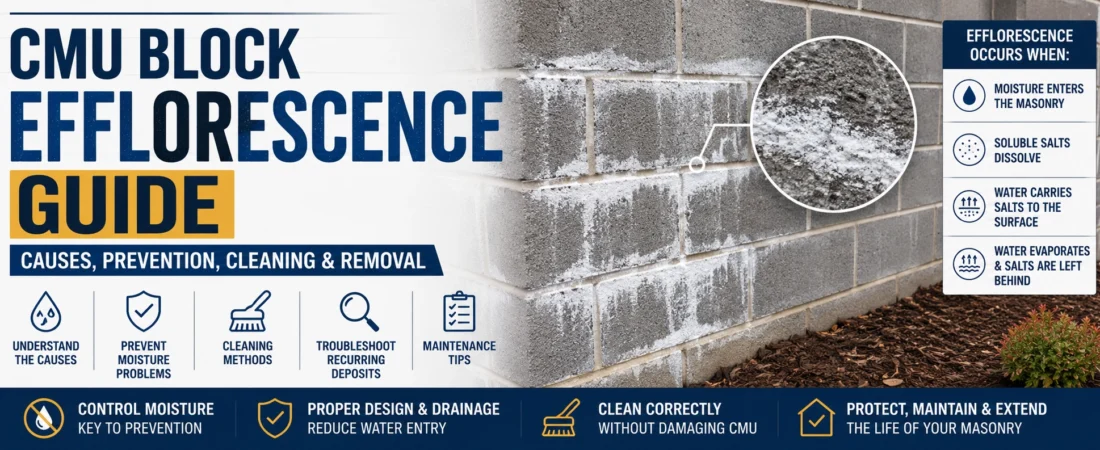
Efflorescence is one of the most common appearance-related problems that can occur on concrete masonry walls. It appears as a white, gray, or sometimes light-colored powdery deposit on the surface of CMU blocks or mortar joints.
Although efflorescence is usually an aesthetic problem rather than a direct indication of structural failure, it can be a sign that moisture is moving through the masonry system and carrying soluble salts toward the surface.
Understanding why efflorescence occurs is important for contractors, builders, architects, masonry manufacturers, and property owners. Proper material selection, drainage, moisture control, construction practices, and maintenance can significantly reduce the likelihood of recurring deposits.
This guide explains what CMU efflorescence is, why it occurs, where it comes from, how to prevent it, and how to clean it when it appears.
What Is CMU Efflorescence?
Efflorescence is a visible deposit of soluble salts that forms on the surface of concrete masonry when moisture moves through the material and evaporates.
As water travels through the masonry, it can dissolve small quantities of soluble compounds present in:
- CMU blocks
- Mortar
- Grout
- Cement-based materials
- Soil
- Other masonry components
When the moisture reaches the surface and evaporates, the dissolved materials can remain behind as a crystalline or powdery deposit.
The result is often a white or light-colored stain across the face of the masonry.
What Does CMU Efflorescence Look Like?
Efflorescence commonly appears as:
- White powder
- Light gray deposits
- Chalky stains
- Crystalline residue
- Irregular white patches
- Streaks below joints
- Deposits around cracks or openings
The appearance can range from a few small spots to extensive white discoloration covering large sections of a masonry wall.
Efflorescence can be more noticeable on dark-colored or decorative CMU because the white deposits create strong visual contrast.
Is CMU Efflorescence a Structural Problem?
In many cases, efflorescence is primarily an aesthetic issue.
The presence of white deposits does not automatically mean that the CMU wall has lost its structural capacity.
However, recurring or severe efflorescence should not simply be ignored.
Persistent deposits can indicate that moisture is repeatedly entering and moving through the masonry system.
The underlying moisture source may be related to:
- Rainwater
- Poor drainage
- Ground moisture
- Leaking joints
- Inadequate flashing
- Improper waterproofing
- Plumbing leaks
- Condensation
- Poorly detailed wall openings
Therefore, removing the visible white deposit without addressing the moisture source may only provide a temporary solution.
How Does Efflorescence Form on CMU?
Efflorescence generally requires three basic conditions:
- Soluble salts
- Moisture
- A pathway for moisture movement
When these conditions occur together, water can transport dissolved materials through the masonry.
A simplified process looks like this:
Moisture enters masonry → salts dissolve → water moves through CMU → moisture reaches surface → water evaporates → salts remain behind
This is why controlling moisture is one of the most important strategies for preventing recurring efflorescence.
Main Causes of CMU Efflorescence
Several factors can contribute to efflorescence.
1. Excessive Moisture
Moisture is one of the most important factors.
The more water that enters the masonry system, the greater the opportunity for soluble materials to dissolve and move toward the surface.
Sources may include:
- Rain
- Poor drainage
- Groundwater
- Splashing water
- Leaks
- Improper flashing
- Wet construction materials
Reducing unnecessary water exposure can therefore help reduce efflorescence.
2. Poor Wall Drainage
A masonry wall needs an appropriate method of managing water that reaches the wall system.
If water becomes trapped behind or within the masonry, it can increase the likelihood of moisture movement toward the visible surface.
Proper flashing, weep holes, drainage paths, and wall detailing can help manage water.
For a more detailed explanation, see our:
Proper water management is essential for reducing moisture-related masonry problems. Learn how flashing, weep holes, and drainage paths work in our CMU Wall Drainage Guide.
3. Ground Moisture
CMU walls that are exposed to ground moisture can experience increased water movement.
This is particularly important for:
- Basement walls
- Foundation walls
- Retaining walls
- Below-grade masonry
- Poorly drained areas
Below-grade walls require appropriate moisture protection and drainage rather than relying on the CMU itself to prevent water penetration.
4. Mortar and Grout
Efflorescence does not necessarily originate only from the CMU block.
Mortar and grout can also contain soluble materials that may contribute to visible deposits.
This is why the entire masonry assembly should be considered when investigating recurring efflorescence.
Proper mortar selection, mixing, placement, and curing can help maintain better masonry quality.
Efflorescence vs Moisture Resistance
Efflorescence and moisture resistance are related, but they are not the same thing.
A wall can have moisture-resistant components and still develop some efflorescence under certain conditions.
Moisture resistance focuses on limiting water penetration and movement, while efflorescence describes the visible deposit that may result from moisture transporting soluble materials.
For a broader discussion of moisture behavior in concrete masonry, see our:
Efflorescence is closely related to moisture movement through masonry. Learn more about water resistance and moisture-related considerations in our CMU Moisture Resistance Guide.
Efflorescence During New CMU Construction
Efflorescence can sometimes appear relatively soon after a masonry wall has been constructed.
New construction may involve considerable moisture from:
- Fresh mortar
- Grout
- CMU units
- Rain
- Cleaning
- Curing
- Construction exposure
As the wall dries, moisture can move toward the surface and leave behind deposits.
This means that some early efflorescence may reduce naturally as the masonry dries and the moisture conditions stabilize.
However, persistent or recurring deposits should still be investigated for an ongoing moisture source.
Can CMU Surface Finish Affect Efflorescence Appearance?
The surface finish does not necessarily create efflorescence, but it can affect how visible the deposits are.
For example:
- Smooth CMU may show powdery deposits clearly.
- Split-face CMU can make deposits appear irregular.
- Dark-colored CMU can show white deposits strongly.
- Textured surfaces may trap deposits in grooves.
- Polished or decorative finishes may make discoloration more noticeable.
This is particularly important for exposed architectural masonry.
For more information about different exposed masonry finishes, see our:
Different textures and finishes can change the appearance of exposed masonry and how visible surface deposits become. See our CMU Block Surface Finishes Guide for a comparison of common finishes.
How to Identify CMU Efflorescence
Before attempting to clean a white deposit, determine whether it is actually efflorescence.
Typical efflorescence is:
- White or light colored
- Powdery or crystalline
- Located on the masonry surface
- Associated with moisture movement
- Sometimes removable with dry brushing
Other white substances may include:
- Mortar residue
- Construction dust
- Cement deposits
- Paint or coating residue
- Chemical stains
Correct identification is important because different deposits may require different cleaning methods.
Should CMU Efflorescence Be Removed?
Yes, visible efflorescence can generally be removed when it affects the appearance of the masonry.
However, removing the deposit is only part of the solution.
If moisture continues to enter the wall, efflorescence can return.
The best approach is:
Identify moisture source → correct moisture problem → allow masonry to dry → clean remaining deposits
This approach is more effective than repeatedly cleaning the wall without addressing the underlying cause.
Types of CMU Efflorescence
Efflorescence can occur at different stages of masonry construction and can have different underlying causes.
Two useful categories are:
- Primary efflorescence
- Secondary efflorescence
Understanding the difference can help identify when and why deposits are appearing.
Primary Efflorescence
Primary efflorescence generally occurs as masonry materials dry after manufacturing or construction.
Fresh CMU, mortar, and grout can contain moisture. As this moisture moves toward the surface and evaporates, dissolved salts can be left behind.
Primary efflorescence may become visible:
- Shortly after construction
- During the initial drying period
- After wet weather
- As new masonry dries
In some cases, the deposits become less noticeable naturally as the wall continues to dry.
Secondary Efflorescence
Secondary efflorescence is generally associated with moisture entering the masonry after construction.
Potential moisture sources include:
- Rain
- Groundwater
- Leaking plumbing
- Poor drainage
- Roof runoff
- Defective flashing
- Damaged sealants
- Irrigation systems
If the moisture source remains active, deposits may continue to return even after the wall has been cleaned.
This is why recurring efflorescence deserves closer investigation.
Why Efflorescence Keeps Coming Back
One of the most common mistakes is treating only the visible stain.
For example:
Clean wall → moisture continues → salts move to surface → white deposits return
If the underlying moisture problem is not corrected, repeated cleaning may become necessary.
Recurring efflorescence can therefore be a useful indication that the masonry should be inspected for moisture entry or drainage problems.
Construction Practices That Can Increase Efflorescence
Certain construction practices can increase the amount of moisture entering or remaining in masonry.
Exposing CMU to Rain
Freshly constructed masonry can absorb significant amounts of water if it is left exposed to heavy rain.
Protecting materials and newly constructed walls from unnecessary water exposure can help reduce moisture-related problems.
Poor Material Storage
CMU should be stored in a manner that limits unnecessary exposure to standing water and contamination.
Blocks that become saturated before installation can introduce additional moisture into the wall.
Excessive Mortar Water
Mortar with excessive water can contribute to increased moisture during construction.
Proper mixing and placement practices are therefore important.
Poor Drainage Details
If water cannot drain effectively from the wall system, moisture may remain within the masonry for extended periods.
This can increase the opportunity for soluble materials to move toward the surface.
How to Prevent CMU Efflorescence
There is no single method that guarantees that efflorescence will never occur.
Instead, prevention focuses on controlling moisture and maintaining good masonry construction practices.
Important measures include:
- Use suitable CMU materials
- Store blocks properly
- Protect masonry from excessive rain
- Use appropriate mortar
- Maintain proper wall drainage
- Install flashing correctly
- Provide suitable weep holes
- Control groundwater
- Use appropriate waterproofing
- Maintain roof drainage
- Repair leaks promptly
Proper CMU Storage
Proper storage begins before the blocks are installed.
CMU should be protected from:
- Standing water
- Mud
- Soil contamination
- Excessive rain
- Construction debris
Blocks should be stored on suitable surfaces and handled carefully.
Keeping masonry materials reasonably clean and dry before installation can reduce unnecessary moisture and contamination.
Protecting Fresh CMU Construction
Fresh masonry should be protected when weather conditions could introduce excessive water.
Depending on the project, protection may involve:
- Covering materials
- Protecting unfinished wall sections
- Controlling runoff
- Protecting open wall tops
- Preventing standing water around the masonry
Weather protection is particularly important during periods of heavy rain.
Importance of Proper Flashing
Flashing helps direct water away from vulnerable parts of the masonry system.
It may be required around:
- Wall openings
- Roof intersections
- Parapets
- Window sills
- Door openings
- Wall bases
Improperly installed or damaged flashing can allow water to enter areas where it should instead be redirected.
Weep Holes and Efflorescence
Weep holes can provide a drainage path for water within certain masonry wall systems.
They can help prevent water from remaining trapped behind the wall’s exterior surface.
However, weep holes must be correctly located and kept clear of mortar and debris.
A blocked drainage path can reduce the effectiveness of the wall’s moisture-management system.
Waterproofing and Efflorescence Prevention
Waterproofing can be an important part of moisture control, particularly for walls exposed to ground moisture or significant water exposure.
However, waterproofing should not be treated as a replacement for proper drainage.
A complete moisture-control strategy may include:
- Drainage
- Flashing
- Waterproofing
- Sealants
- Proper grading
- Weep holes
- Correct wall detailing
How to Remove CMU Efflorescence
Once the moisture source has been addressed, visible efflorescence can be removed from the masonry surface.
The appropriate cleaning method depends on:
- Amount of deposit
- Type of surface
- Age of masonry
- CMU finish
- Severity of staining
- Manufacturer recommendations
For relatively light deposits, a dry cleaning method may be sufficient.
1. Dry Brushing
Dry brushing is often one of the simplest approaches for light, loose deposits.
A suitable stiff-bristle brush can be used to loosen the powdery material from the masonry surface.
The advantages include:
- Simple process
- No additional water
- Low equipment requirement
- Suitable for light deposits
Avoid using excessive force that could damage decorative or delicate finishes.
2. Water Cleaning
Water can sometimes be used to remove masonry deposits, but it should be applied carefully.
Adding excessive water can create an unwanted cycle:
Water cleaning → masonry becomes wet → moisture moves through wall → deposits may return
Therefore, water cleaning should be appropriate for the specific masonry condition and followed by adequate drying.
3. Chemical Cleaning
Some persistent deposits may require a masonry cleaning solution.
However, chemical cleaners should not be selected or applied casually.
Before using a chemical product:
- Read the manufacturer’s instructions
- Check compatibility with the CMU finish
- Protect surrounding materials
- Test a small area
- Use appropriate protective equipment
- Follow required dilution instructions
An aggressive cleaning solution can discolor masonry or damage certain surface finishes.
Cleaning Decorative CMU
Extra care may be required when cleaning:
- Split-face CMU
- Ground-face CMU
- Polished CMU
- Colored CMU
- Ribbed CMU
- Fluted CMU
Different surfaces can respond differently to cleaning methods.
For example, aggressive cleaning can alter the appearance of a decorative finish even if the efflorescence itself is removed successfully.
For more information about different masonry finishes, refer to our CMU Block Surface Finishes Guide.
Common CMU Efflorescence Cleaning Mistakes
Avoid these common mistakes:
- Cleaning without identifying the moisture source
- Using excessive water
- Using an overly aggressive chemical
- Scrubbing too aggressively
- Ignoring surrounding materials
- Applying chemicals without testing
- Cleaning during unsuitable weather
- Assuming every white stain is efflorescence
- Repeatedly cleaning a wall without investigating recurring moisture
The goal should be to remove the visible deposit without damaging the masonry or creating additional moisture problems.
How to Troubleshoot Recurring Efflorescence
If efflorescence keeps returning, inspect the wall systematically.
Step 1: Identify Where It Appears
Look for patterns.
Is it concentrated:
- Near the base?
- Around windows?
- Below roof lines?
- Around joints?
- Near cracks?
- Across the entire wall?
The location can provide clues about the moisture source.
Step 2: Check Drainage
Inspect:
- Ground slope
- Downspouts
- Gutters
- Drainage paths
- Weep holes
Water should be directed away from the masonry where possible.
Step 3: Check Flashing
Inspect areas around:
- Windows
- Doors
- Roof intersections
- Wall caps
- Parapets
Step 4: Look for Leaks
Check for plumbing, roof, or other water leaks that could introduce moisture into the wall.
Step 5: Inspect Waterproofing
If the wall is exposed to significant moisture or is below grade, inspect the applicable waterproofing system.
Step 6: Allow the Wall to Dry
After correcting the moisture source, allow the masonry sufficient time to dry before evaluating whether deposits continue to form.
Efflorescence on Basement and Foundation CMU
Basement and foundation walls require particular attention because they may be exposed to soil moisture.
Potential moisture sources include:
- Groundwater
- Poor grading
- Hydrostatic pressure
- Inadequate drainage
- Damaged waterproofing
- Foundation leaks
If efflorescence is repeatedly appearing on a basement CMU wall, simply cleaning the surface may not solve the problem.
The moisture source should be investigated first.
For more information about below-grade masonry, see our CMU Foundation Wall Guide and CMU Basement Wall Guide.
Efflorescence and CMU Wall Maintenance
Regular inspection can help identify moisture problems before they become more serious.
During maintenance, look for:
- New white deposits
- Cracks
- Damp areas
- Staining
- Damaged mortar joints
- Block deterioration
- Blocked weep holes
- Damaged flashing
- Sealant failures
Early identification makes it easier to determine whether the problem is cosmetic or related to a larger moisture issue.
For a broader maintenance checklist, see our CMU Wall Maintenance Guide.
Can Efflorescence Be Completely Prevented?
It is difficult to guarantee that efflorescence will never occur.
Concrete masonry contains cementitious materials and may be exposed to moisture during construction and throughout its service life.
However, the risk can be reduced by controlling moisture and using good construction practices.
The most important principle is:
Keep unnecessary water away from the masonry and provide effective drainage for water that does reach the wall.
CMU Efflorescence Prevention Checklist
Before and during construction, consider:
✔ Store CMU properly
✔ Protect masonry from excessive rain
✔ Use appropriate mortar materials
✔ Control construction moisture
✔ Install flashing correctly
✔ Provide appropriate drainage
✔ Keep weep holes clear
✔ Control groundwater
✔ Use suitable waterproofing where required
✔ Maintain gutters and downspouts
✔ Repair leaks promptly
✔ Inspect masonry after construction
Frequently Asked Questions
What causes white powder on CMU blocks?
White powder is often efflorescence, which occurs when moisture moves through masonry and leaves soluble materials behind as the water evaporates.
Is CMU efflorescence dangerous?
Efflorescence is usually an appearance-related issue, but recurring deposits can indicate ongoing moisture movement that should be investigated.
Does rain cause CMU efflorescence?
Rain can contribute by introducing moisture into the masonry. The risk is higher when drainage or moisture-control details are inadequate.
Can efflorescence be removed?
Yes. Light deposits may sometimes be removed by dry brushing, while more persistent deposits may require appropriate masonry cleaning methods.
Will efflorescence come back after cleaning?
It can. If the underlying moisture source remains, dissolved materials can continue moving toward the surface and produce new deposits.
Is pressure washing safe for CMU efflorescence?
Pressure washing should be used cautiously. Excessive pressure can damage masonry surfaces, force water deeper into the wall, or affect decorative finishes.
Does waterproofing prevent efflorescence?
Proper waterproofing can reduce moisture entry in suitable applications, but it should be combined with appropriate drainage and wall detailing.
Can colored CMU develop efflorescence?
Yes. Efflorescence can occur on colored CMU, and the white deposits may be particularly noticeable against darker or decorative surfaces.
Why does efflorescence appear more heavily near the bottom of a CMU wall?
The bottom of a wall may be exposed to ground moisture, splashback, poor drainage, or other sources of water. The exact cause should be determined from the site’s drainage and wall conditions.
Final Thoughts
CMU block efflorescence is primarily a visible symptom of moisture movement and soluble materials within the masonry system.
The most effective approach is not simply to clean the white deposits. Instead, identify and control the source of moisture, improve drainage where necessary, protect the masonry during construction, and then remove remaining deposits using an appropriate cleaning method.
Proper storage, flashing, drainage, waterproofing, mortar practices, and regular maintenance can all help reduce the risk of recurring efflorescence.
For contractors and building owners, the key principle is simple:
Fix the moisture problem first, then clean the visible efflorescence.
Related Calculators
- CMU Block Calculator
- Mortar Calculator
- Concrete Calculator
- CMU Material Cost Calculator
- CMU Grout Calculator