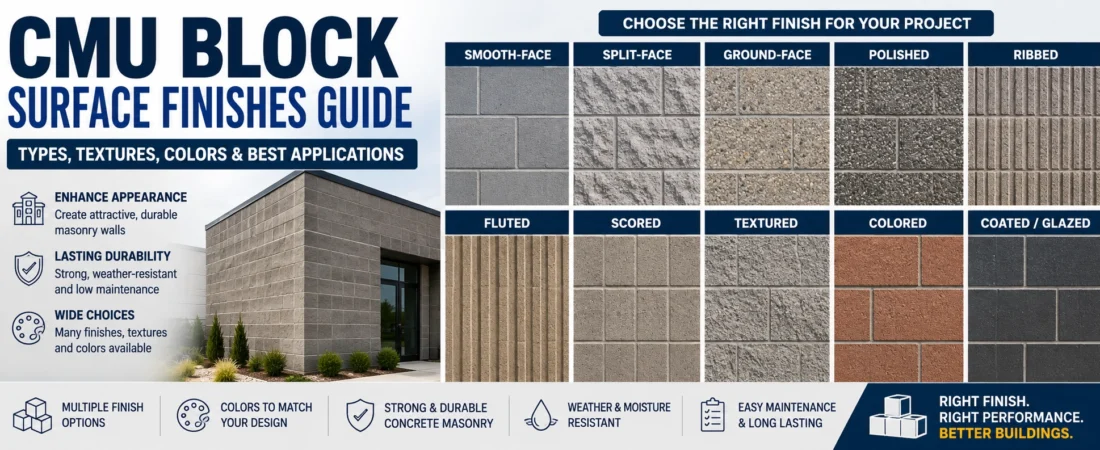
Concrete masonry units (CMU) are available in many different surface finishes, textures, colors, and patterns. While standard smooth concrete blocks are widely used for structural construction, architectural CMU finishes can provide a more attractive appearance for exposed masonry walls.
The right CMU block surface finish can affect the appearance, texture, maintenance requirements, cleaning, color consistency, and overall architectural character of a building.
Some finishes are created directly during the manufacturing process, while others require additional grinding, polishing, splitting, scoring, or coating after the block has been produced.
Common CMU finishes include smooth-face, split-face, ground-face, polished, ribbed, fluted, scored, textured, and colored finishes.
In this guide, we will explain the major types of CMU surface finishes, how they are produced, where they are used, their advantages and disadvantages, and how to choose the right finish for your project.
What Is a CMU Block Surface Finish?
A CMU block surface finish refers to the texture, appearance, pattern, or treatment applied to the visible surface of a concrete masonry unit.
Common surface finishes include:
- Smooth
- Split-face
- Ground-face
- Polished
- Ribbed
- Fluted
- Scored
- Textured
- Colored
- Coated
Surface finish becomes particularly important when CMU blocks are going to remain exposed instead of being covered with plaster, paint, siding, or another material.
Architects and designers can use different finishes to create specific visual effects while maintaining the durability and functionality of concrete masonry.
Why CMU Surface Finishes Matter
The surface finish of a CMU is not only an aesthetic decision.
It can influence:
- Building appearance
- Surface texture
- Light and shadow
- Color perception
- Cleaning requirements
- Maintenance
- Paint or coating application
- Visual consistency
- Architectural style
For exposed masonry, consistency is particularly important because small variations in texture or color can become very noticeable when hundreds of blocks are installed together.
Main Types of CMU Block Surface Finishes
The most common CMU surface finishes include:
- Smooth-face finish
- Split-face finish
- Ground-face finish
- Polished finish
- Ribbed finish
- Fluted finish
- Scored finish
- Textured finish
- Colored finish
- Coated or glazed finish
The availability of each finish depends on the manufacturer, mold design, aggregate selection, production equipment, and finishing process.
1. Smooth-Face CMU Finish
Smooth-face CMU is one of the most basic and widely used concrete masonry finishes.
The exposed face has a relatively uniform texture and is generally produced directly from the manufacturing mold.
Smooth-face blocks are suitable when a clean and simple architectural appearance is desired.
Common Applications
Smooth-face CMU can be used for:
- Commercial buildings
- Schools
- Warehouses
- Garages
- Utility buildings
- Interior masonry walls
- Partition walls
- Industrial buildings
- Exterior walls
Advantages of Smooth-Face CMU
Smooth-face blocks provide:
- Clean appearance
- Simple architectural style
- Uniform surface
- Easy visual inspection
- Wide availability
- Compatibility with many coatings
A smooth surface can also provide a neutral appearance when the building’s overall design is intended to remain simple.
2. Split-Face CMU Finish
Split-face CMU is one of the most popular decorative concrete masonry finishes.
The block is manufactured so that the exposed face has a rough, irregular texture. This produces a natural-looking appearance that can resemble stone.
Split-face blocks are particularly popular for exposed exterior masonry.
Common Applications
They are commonly used for:
- Commercial buildings
- Office buildings
- Schools
- Exterior walls
- Architectural facades
- Entry features
- Decorative walls
- Landscape structures
Advantages
Split-face CMU can provide:
- Strong visual texture
- Natural appearance
- Architectural character
- Attractive exposed masonry
- Durable exterior surface
The irregular texture also creates interesting light and shadow patterns across the wall.
Smooth-Face vs Split-Face CMU
| Feature | Smooth-Face | Split-Face |
|---|---|---|
| Surface | Smooth and uniform | Rough and textured |
| Appearance | Clean and simple | Natural and architectural |
| Texture | Low | High |
| Visual variation | Low | Higher |
| Cleaning | Generally easier | May require more attention |
| Architectural effect | Subtle | Strong |
The best choice depends on the architectural design, environmental exposure, maintenance requirements, and budget.
3. Ground-Face CMU Finish
Ground-face CMU is produced by grinding the surface of the block after manufacturing.
Grinding removes part of the outer concrete layer and exposes the aggregate inside the block.
This can produce a more refined architectural appearance.
The exposed surface may reveal:
- Fine aggregate
- Coarse aggregate
- Different stone colors
- Natural patterns
- Subtle texture
The final appearance depends heavily on the type and color of aggregate used in the CMU mix.
How Ground-Face CMU Is Produced
A typical process includes:
- Manufacturing the CMU.
- Curing the blocks.
- Selecting suitable blocks.
- Grinding the exposed surface.
- Cleaning the surface.
- Inspecting the finished blocks.
- Sorting blocks according to appearance.
The grinding process needs to be controlled carefully because inconsistent grinding can produce noticeable variations between blocks.
4. Polished CMU Finish
Polished CMU uses additional grinding and polishing to create a refined and relatively smooth architectural surface.
Depending on the process, polishing can expose the aggregate while producing a more finished appearance.
Polished CMU can provide:
- Smooth texture
- Visible aggregate
- Refined appearance
- Greater light reflection
- Decorative architectural character
It is generally selected for projects where exposed masonry is intended to be an important visual element.
5. Ribbed CMU Finish
Ribbed CMU contains raised or recessed lines across the exposed surface.
The ribs create shadows and patterns that give the wall additional visual depth.
Different mold designs can produce different rib sizes and patterns.
Common Applications
Ribbed CMU can be used for:
- Feature walls
- Commercial buildings
- Architectural facades
- Interior accent walls
- Institutional buildings
The direction and spacing of the ribs can significantly change the appearance of the finished wall.
6. Fluted CMU Finish
Fluted CMU has repeated grooves or channels across the exposed surface.
These grooves can create strong vertical or horizontal lines depending on the block design.
Fluted finishes can be used to create:
- Vertical architectural patterns
- Repeated visual lines
- Light and shadow effects
- Decorative masonry surfaces
The depth and spacing of the flutes can have a major effect on the final appearance.
7. Scored CMU Finish
Scored CMU contains intentional grooves or lines across the face of the block.
The scoring can make one standard block visually resemble multiple smaller masonry units.
This can create:
- Decorative patterns
- Horizontal lines
- Vertical lines
- Detailed architectural facades
- Visual variation
Scored finishes are useful when the designer wants to control the visual scale of a large masonry wall.
8. Textured CMU Finish
Textured CMU is designed to provide more surface detail than a standard smooth block.
Texture can be produced through:
- Mold patterns
- Aggregate exposure
- Split-face production
- Ribbed patterns
- Fluted patterns
- Other surface treatments
Textured blocks are often selected when the masonry itself is intended to contribute strongly to the architectural appearance of the building.
9. Colored CMU Finish
Colored CMU is produced by incorporating pigments into the concrete mixture.
This allows manufacturers to produce blocks in different colors instead of relying only on traditional gray concrete.
Common architectural colors include:
- Gray
- Tan
- Brown
- Red
- Buff
- Earth tones
Color consistency is particularly important for large projects because variations between production batches can become highly visible after installation.
Advantages of Colored CMU
Colored CMU can:
- Improve architectural appearance
- Reduce the need for additional finishing
- Create visual contrast
- Complement other building materials
- Establish a consistent design theme
The final color can depend on the pigment, cement, aggregate, moisture, curing conditions, and manufacturing consistency.
10. Coated or Glazed CMU Finish
Some architectural applications use additional coatings or surface treatments over CMU.
These treatments can change the appearance of the masonry and may provide a specific architectural effect.
Before applying a coating, the surface should be evaluated for:
- Cracks
- Dust
- Dirt
- Moisture
- Surface contamination
- Uneven areas
- Existing coatings
Proper surface preparation is essential because the final result depends heavily on the condition of the masonry underneath the coating.
How CMU Surface Finish Is Created
The final appearance of a CMU block is influenced by several stages of manufacturing.
Material Selection
The cement, sand, aggregate, water, pigments, and optional admixtures are selected according to the desired block properties.
Aggregate selection is particularly important for architectural finishes because it can influence the visible texture and color.
A properly designed CMU block mix design plays an important role in achieving consistent color, texture, density, and overall surface quality.
Mixing
The raw materials are mixed to create a consistent concrete mixture.
Consistency is important because variations in the mix can affect:
- Color
- Texture
- Density
- Strength
- Surface appearance
Mold Filling
The concrete mixture is placed into the mold.
The condition and design of the mold have a direct effect on the finished surface.
A properly maintained mold helps produce:
- Uniform faces
- Sharp edges
- Accurate dimensions
- Consistent block geometry
Vibration and Compaction
Vibration and compaction help distribute the concrete throughout the mold and reduce trapped air.
Proper vibration can improve:
- Surface quality
- Density
- Mold filling
- Dimensional consistency
- Overall block quality
Poor vibration can contribute to rough or uneven surfaces.
Demolding
After compaction, the mold is removed from the newly formed blocks.
Careful handling is important because fresh blocks can be damaged during demolding or transfer.
Curing
The newly manufactured blocks are moved to the curing area.
Proper curing helps the cement develop strength and durability.
Proper curing is also important for developing durable and consistent masonry products. Learn more about the CMU block curing process and how controlled curing affects finished blocks.
Final Inspection
After curing and finishing, blocks should be inspected for:
- Surface texture
- Color consistency
- Cracks
- Chips
- Broken edges
- Dimensional accuracy
- Surface defects
Common CMU Surface Finish Problems
Even when a decorative finish is intentionally selected, manufacturing problems can reduce the quality of the finished surface.
Rough Surface
A rough or uneven surface can reduce the visual quality of concrete blocks.
Possible causes include:
- Inadequate vibration
- Poor aggregate grading
- Incorrect moisture content
- Dirty molds
- Low compaction
- Manufacturing inconsistencies
The problem can often be reduced through better mold maintenance, consistent materials, proper moisture control, and optimized vibration and compaction.
Broken or Chipped Surface
CMU faces and corners can become damaged during:
- Demolding
- Handling
- Transportation
- Stacking
- Installation
Damaged blocks can create visible defects in an exposed masonry wall.
Proper handling and storage are therefore important, particularly for architectural CMU.
Delamination
Delamination occurs when layers within the concrete separate from one another.
This can reduce the integrity of the block and may become more noticeable during handling or under load.
Blocks showing significant delamination should be evaluated before being used in construction.
How to Choose the Right CMU Surface Finish
The right finish depends on several factors.
1. Building Design
A smooth finish may work well for a simple modern building, while split-face or textured CMU may be more suitable for a decorative architectural facade.
2. Exterior or Interior Application
Exterior masonry is exposed to weather and moisture, while interior masonry may have different requirements.
3. Desired Appearance
Determine whether the project requires:
- Smooth
- Split-face
- Ground-face
- Polished
- Ribbed
- Fluted
- Scored
- Textured
- Colored
4. Maintenance
Highly textured surfaces may require more cleaning attention than smooth surfaces.
5. Color
Colored CMU requires careful consideration of color consistency between blocks and production batches.
6. Budget
Additional manufacturing and finishing processes can increase the cost of architectural CMU.
7. Environmental Exposure
Rain, moisture, temperature changes, freezing conditions, and other environmental factors should be considered for exterior masonry.
CMU Surface Finish and Waterproofing
Surface finish should not be considered separately from moisture control.
CMU is durable and water-resistant, but it should not automatically be considered completely waterproof.
For exterior or below-grade walls, proper moisture management may include:
- Waterproofing
- Drainage
- Sealants
- Flashing
- Proper wall detailing
Moisture protection is also important for exposed masonry. Learn more about CMU wall waterproofing and the methods used to protect masonry from moisture.
Proper drainage should also be considered when designing exterior CMU walls. Our CMU Wall Drainage Guide explains flashing, weep holes, drainage systems, and moisture-control practices.
CMU Surface Finish Maintenance
Regular maintenance helps preserve both the appearance and performance of finished CMU walls.
Maintenance may include:
- Cleaning the surface
- Inspecting for cracks
- Repairing damaged areas
- Checking mortar joints
- Inspecting waterproofing
- Removing stains
- Checking for moisture problems
A regular inspection program can identify small problems before they become expensive repairs.
Regular inspection and maintenance can help preserve the appearance of finished masonry. See our CMU Wall Maintenance Guide for practical maintenance recommendations.
Cleaning Different CMU Surface Finishes
Different textures may require different cleaning approaches.
Smooth CMU
Smooth surfaces are generally easier to clean because they have fewer irregularities.
Split-Face CMU
The rough texture can collect more dirt and may require additional attention during cleaning.
Ribbed and Fluted CMU
Grooves can collect dust and debris, making careful cleaning important.
Ground and Polished CMU
These finishes should be cleaned using methods appropriate for their particular surface treatment.
Before using a chemical cleaner, test the cleaning method on a small inconspicuous area and follow the manufacturer’s recommendations.
CMU Surface Finish and Paint
Some CMU walls are painted or coated after construction.
Before applying paint, the surface should be:
- Clean
- Dry
- Free from loose material
- Free from excessive dust
- Properly prepared
The coating system should be compatible with concrete masonry and the environmental conditions of the building.
A decorative architectural CMU finish may also be intentionally left exposed instead of painted.
CMU Surface Finish Quality Control
Quality control is particularly important when manufacturing architectural CMU.
Manufacturers should inspect:
- Surface texture
- Color consistency
- Block dimensions
- Corners
- Edges
- Cracks
- Chips
- Aggregate exposure
- Finish uniformity
For a production facility, regular inspection helps identify recurring problems before a large quantity of defective blocks is produced.
CMU Surface Finish Inspection Checklist
Before accepting architectural CMU, check:
✔ Surface texture is consistent
✔ Color is reasonably uniform
✔ No major cracks are present
✔ Corners are not excessively damaged
✔ Edges are properly formed
✔ Block dimensions are consistent
✔ Surface treatment is uniform
✔ Mortar joints are properly finished
✔ Visible stains or contamination are addressed
✔ Damaged blocks are removed or evaluated
Frequently Asked Questions
What is the most common CMU surface finish?
Smooth-face CMU is one of the most common basic finishes. Split-face CMU is also widely used where a more decorative and textured appearance is desired.
What is split-face CMU?
Split-face CMU has a rough, irregular exposed surface that provides a more natural and architectural appearance.
Can CMU blocks be colored?
Yes. Pigments can be incorporated into the concrete mixture to produce colored CMU blocks.
What causes rough CMU surfaces?
Rough surfaces can result from inadequate vibration, poor aggregate grading, incorrect moisture content, dirty molds, insufficient compaction, or other manufacturing problems.
Does CMU surface finish affect maintenance?
Yes. Different textures can have different cleaning and maintenance requirements. Rough and deeply textured surfaces may require more attention than smooth surfaces.
Are CMU blocks waterproof?
No. CMU blocks are water-resistant but should not automatically be considered completely waterproof. Proper moisture protection depends on the wall design and application.
Which CMU finish is best for exterior walls?
There is no single finish that is best for every exterior wall. Smooth, split-face, textured, ground-face, and other finishes can all be suitable depending on the architectural design, environmental exposure, maintenance requirements, and budget.
Which CMU finish is easiest to clean?
Smooth-face CMU is generally easier to clean because its surface contains fewer grooves and irregularities.
Is split-face CMU more expensive than standard CMU?
It can be more expensive because it requires a specialized manufacturing process and is generally selected as an architectural finish. Actual cost depends on the manufacturer, color, aggregate, location, quantity, and project requirements.
Final Thoughts
CMU surface finishes allow concrete masonry to provide both structural performance and architectural appearance.
Smooth-face, split-face, ground-face, polished, ribbed, fluted, scored, textured, colored, and coated finishes can produce very different visual results.
The best finish depends on the project’s:
- Architectural design
- Location
- Environmental exposure
- Maintenance requirements
- Desired appearance
- Budget
- Construction method
For manufacturers, consistent raw materials, proper mold maintenance, vibration, compaction, curing, and quality control are essential for producing consistent surface finishes.
For builders and architects, selecting the appropriate finish before construction helps ensure that the completed masonry wall provides the desired appearance while meeting the project’s performance requirements.
Related Calculators
- CMU Block Calculator
- CMU Grout Calculator
- Mortar Calculator
- Concrete Calculator
- CMU Material Cost Calculator
- CMU Labor Cost Calculator
Related Guides
- CMU Block Mix Design Guide
- CMU Block Curing Process Guide
- CMU Block Quality Control Guide
- CMU Block Manufacturing Machine Guide
- Common CMU Manufacturing Defects
- CMU Block ASTM Standards Explained
- CMU Wall Waterproofing Guide
- CMU Wall Drainage Guide
- CMU Wall Maintenance Guide
- CMU Wall Inspection Guide