CMU blocks are one of the most widely used construction materials in residential, commercial, and industrial masonry projects.
However, many people do not realize that there are several different:
types of CMU blocks
Each type is designed for a specific purpose such as:
- Wall construction
- Reinforcement
- Corners
- Openings
- Structural support
Understanding the different types of concrete masonry units helps contractors, engineers, builders, and homeowners choose the correct block for their projects.
What Does CMU Stand For?
CMU
stands for:
Concrete Masonry Unit
CMU blocks are manufactured from:
- Cement
- Sand
- Aggregate
- Water
These blocks are commonly used because they are:
- Strong
- Durable
- Fire-resistant
- Cost-effective
Why Different Types of CMU Blocks Exist
Not every part of a masonry wall performs the same function.
Some areas require:
- Reinforcement
- Openings
- Corners
- Structural beams
This is why manufacturers produce specialized concrete masonry units for different construction applications.
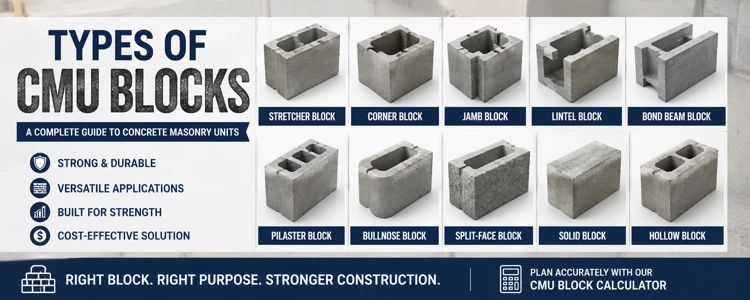
1. Stretcher Block
The:
stretcher block
is the most common type of CMU block used in construction.
It is typically used in:
- Exterior walls
- Interior walls
- Foundation walls
- Load-bearing walls
Characteristics:
- Two hollow cores
- Straight sides
- Standard masonry construction
Most CMU walls are built primarily with stretcher blocks.
2. Corner Block
The:
corner block
is used at wall corners.
These blocks provide:
- Clean corner finishes
- Better structural continuity
- Improved appearance
Corner blocks help create strong masonry corners without excessive cutting.
3. Jamb Block
The:
jamb block
is designed for:
- Door openings
- Window openings
These blocks contain special slots that allow:
- Reinforcement placement
- Concrete grouting
Jamb blocks improve the strength around openings where additional support is needed.
4. Lintel Block
The:
lintel block
is used above:
- Doors
- Windows
- Wall openings
These blocks create a reinforced masonry beam that supports loads above openings.
Benefits include:
- Improved structural support
- Better load distribution
- Reinforcement placement
You can also read:
What Is a Lintel Block?5. Bond Beam Block
The:
bond beam block
contains a channel designed to hold:
- Horizontal reinforcement
- Concrete grout
Bond beam systems improve:
- Structural continuity
- Load distribution
- Wall strength
These blocks are commonly used in:
- Reinforced masonry walls
- Seismic construction
- Load-bearing structures
You can also read:
What Is a Bond Beam Block?6. Pilaster Block
The:
pilaster block
is designed to create:
- Reinforced columns
- Structural supports
Pilaster blocks provide:
- Increased strength
- Better load-bearing capacity
- Improved structural stability
These blocks are commonly used in:
- Commercial buildings
- Structural walls
- Heavy-load applications
You can also read:
What Is a Pilaster Block?7. Bullnose Block
The:
bullnose block
has rounded edges instead of sharp corners.
These blocks are commonly used where:
- Safety is important
- Decorative finishes are desired
- Exposed masonry is visible
Bullnose blocks improve:
- Appearance
- Safety
- Architectural aesthetics
8. Split-Face Block
The:
split-face block
has a rough textured surface.
These blocks are commonly used for:
- Decorative walls
- Commercial buildings
- Architectural masonry
Benefits include:
- Attractive appearance
- Increased texture
- Durable exterior finishes
9. Solid Concrete Block
Solid blocks contain little or no hollow space.
Advantages:
- Higher density
- Greater strength
- Improved durability
Common applications:
- Retaining walls
- Foundations
- Heavy-load structures
You can also read:
Hollow vs Solid Concrete Blocks10. Hollow Concrete Block
The:
hollow concrete block
is the most commonly used masonry unit.
Advantages:
- Reduced weight
- Easier handling
- Lower transportation costs
- Space for reinforcement
Most residential and commercial CMU walls use hollow concrete blocks.
Common CMU Block Sizes
Different CMU block types are available in several sizes.
Common sizes include:
| Nominal Size | Common Use |
|---|---|
| 4x8x16 | Partition walls |
| 6x8x16 | Residential walls |
| 8x8x16 | Structural walls |
| 10x8x16 | Commercial walls |
| 12x8x16 | Heavy-load walls |
You can also read:
CMU Block Sizes ChartChoosing the Right Type of CMU Block
Choosing the correct block depends on:
- Wall type
- Structural requirements
- Building codes
- Reinforcement needs
- Architectural design
For example:
- Stretcher blocks for standard walls
- Jamb blocks for openings
- Lintel blocks above doors and windows
- Bond beam blocks for reinforcement
- Pilaster blocks for structural supports
Advantages of Specialized CMU Blocks
1. Improved Structural Strength
Specialized blocks help improve:
- Load distribution
- Reinforcement support
- Wall performance
2. Faster Construction
Using the correct block type reduces:
- Cutting
- Modifications
- Labor time
3. Better Reinforcement Placement
Specialized blocks provide space for:
- Rebar
- Grout
- Structural reinforcement
4. Improved Appearance
Decorative blocks improve:
- Architectural design
- Exterior appearance
- Finished masonry quality
5. Better Long-Term Performance
Using the proper block type helps improve:
- Durability
- Structural reliability
- Construction quality
Use a CMU Block Calculator
Before starting masonry construction, accurate material estimation is important.
Our:
CMU Block Calculatorhelps estimate:
- Concrete block quantities
- Mortar requirements
- Material costs
- Wall dimensions
You can also use:
for additional construction estimation.
Frequently Asked Questions
What is the most common type of CMU block?
The:
stretcher block
is the most commonly used concrete masonry unit in wall construction.
What is a lintel block used for?
Lintel blocks are used above:
- Doors
- Windows
- Openings
to support loads and create reinforced masonry beams.
What is the purpose of a bond beam block?
Bond beam blocks provide space for:
- Horizontal reinforcement
- Grouting
- Structural strengthening
What type of CMU block is used at corners?
Corner blocks are specifically designed for:
masonry wall corners
and provide improved appearance and strength.
Related Articles
- What Is a CMU Block?
- What Is a Lintel Block?
- What Is a Bond Beam Block?
- What Is a Pilaster Block?
- Hollow vs Solid Concrete Blocks
- CMU Block Sizes Chart
- CMU Load Bearing Wall Guide
Final Thoughts
Understanding the different types of CMU blocks helps builders select the right concrete masonry unit for each construction application.
From:
- Stretcher blocks
- Corner blocks
- Jamb blocks
- Lintel blocks
- Bond beam blocks
- Pilaster blocks
to decorative masonry units, each block serves a unique purpose in modern masonry construction.
Using the correct CMU block type improves:
- Structural strength
- Construction efficiency
- Durability
- Long-term building performance