A:
lintel block
is a special type of concrete masonry unit (CMU) designed to support loads above:
- Doors
- Windows
- Openings in masonry walls
Lintel blocks create a horizontal reinforced beam that helps distribute structural loads safely across wall openings.
These blocks are commonly used in:
- Residential construction
- Commercial buildings
- Structural masonry walls
- Reinforced CMU systems
Lintel blocks improve:
- Structural strength
- Load distribution
- Wall stability
- Crack resistance
They are an important part of reinforced masonry construction throughout the United States.
What Does a Lintel Block Look Like?
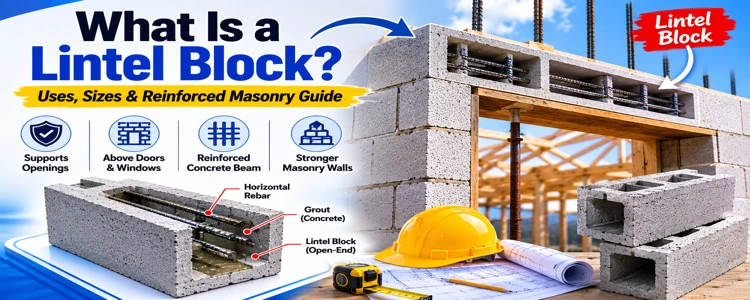
A lintel block looks similar to a standard CMU block but contains:
an open-ended channel
This channel allows placement of:
- Horizontal reinforcement bars (rebar)
- Grout or concrete filling
Once reinforced and filled, the lintel block forms a:
reinforced concrete beam
inside the wall.
Purpose of a Lintel Block
The main purpose of a:
lintel block
is to support structural loads above wall openings.
Without proper support:
- Cracking may occur
- Structural movement may develop
- Wall stability may weaken
Lintel blocks help transfer loads around:
- Doors
- Windows
- Garage openings
- Large wall penetrations
How Lintel Blocks Work
Lintel blocks create reinforced horizontal support beams inside masonry walls.
The installation process usually includes:
- Placing lintel blocks above openings
- Installing horizontal steel reinforcement
- Filling the channel with grout or concrete
After curing:
the reinforced beam distributes loads safely across the opening.
Common Uses of Lintel Blocks
Lintel blocks are commonly used for:
- Window openings
- Door openings
- Garage doors
- Structural wall openings
- Reinforced masonry walls
They are widely used in:
- CMU wall systems
- Basement walls
- Commercial buildings
- Reinforced structural masonry
Lintel Block Sizes
Lintel blocks are available in several standard CMU sizes.
Common sizes include:
| Nominal Size | Common Use |
|---|---|
| 4x8x16 | Small openings |
| 6x8x16 | Residential walls |
| 8x8x16 | Structural masonry |
| 12x8x16 | Heavy-load walls |
The:
8x8x16 lintel block
is one of the most commonly used sizes in reinforced masonry construction.
You can also read:
CMU Block Sizes ChartLintel Block vs Bond Beam Block
Many people confuse:
lintel blocks
with:
bond beam blocks
because both contain reinforcement channels.
However:
their purposes are slightly different.
| Feature | Lintel Block | Bond Beam Block |
|---|---|---|
| Main Purpose | Support openings | Reinforce horizontal wall sections |
| Common Location | Above doors/windows | Throughout wall system |
| Reinforcement | Horizontal | Horizontal |
| Structural Role | Load transfer | Wall reinforcement |
You can also read:
What Is a Bond Beam Block?Advantages of Lintel Blocks
1. Supports Structural Loads
Lintel blocks safely transfer structural loads above:
- Doors
- Windows
- Openings
2. Improves Wall Stability
Reinforced lintel beams help improve:
- Structural integrity
- Wall rigidity
- Load distribution
3. Reduces Cracking
Lintel reinforcement helps minimize:
- Stress cracking
- Structural movement
- Masonry separation
4. Improves Reinforced Masonry Performance
Lintel blocks improve:
- Reinforced wall systems
- Structural continuity
- Masonry durability
5. Allows Reinforcement Installation
The open channel design simplifies:
- Rebar placement
- Grouting
- Reinforcement integration
Reinforcement in Lintel Blocks
Lintel systems usually include:
- Horizontal steel reinforcement
- Concrete grout filling
- Reinforced masonry cells
These components improve:
- Tensile strength
- Structural support
- Load-bearing performance
You can estimate reinforcement using the:
Rebar CalculatorLintel Blocks and Wall Thickness
Lintel blocks are available in different wall thicknesses depending on structural requirements.
Common wall thicknesses include:
- 6 inch
- 8 inch
- 10 inch
- 12 inch
You can also read:
CMU Wall Thickness GuideHollow vs Solid Lintel Blocks
Most lintel blocks are:
hollow masonry units
because hollow cores simplify:
- Reinforcement installation
- Grouting
- Structural integration
You can also read:
Hollow vs Solid Concrete BlocksCMU Block Weight and Lintel Systems
Lintel systems may increase wall weight because of:
- Steel reinforcement
- Grout filling
- Additional concrete material
You can also read:
CMU Block Weight GuideWhere Are Lintel Blocks Installed?
Lintel blocks are typically installed:
- Above windows
- Above doors
- Above garage openings
- Over structural penetrations
Structural engineers determine reinforcement requirements based on:
- Opening size
- Wall loads
- Building codes
- Structural design
Use a CMU Block Calculator
Before starting masonry construction, it is important to estimate:
- Block quantity
- Mortar requirements
- Material costs
- Reinforcement materials
Our:
CMU Block Calculatorhelps estimate:
- Concrete block quantities
- Mortar requirements
- Wall dimensions
- Material costs
You can also use:
- Foundation Calculator
- Concrete Volume Calculator
- Rebar Calculator
- Mortar Calculator
- Gravel Calculator
for additional construction estimation.
Frequently Asked Questions
What is a lintel block used for?
Lintel blocks are used to support structural loads above:
- Doors
- Windows
- Openings in masonry walls
Are lintel blocks load-bearing?
Yes.
Lintel blocks help transfer structural loads safely around wall openings.
Do lintel blocks require rebar?
Yes.
Most lintel systems use:
- Horizontal steel reinforcement
- Grout filling
for structural support.
What is the difference between a lintel block and a bond beam block?
Lintel blocks mainly support:
- Openings
- Windows
- Doors
while bond beam blocks reinforce:
- Horizontal wall sections
- Structural wall systems
Related Articles
- What Is a CMU Block?
- What Is a Bond Beam Block?
- CMU Block Sizes Chart
- CMU Wall Thickness Guide
- CMU Block Weight Guide
- Hollow vs Solid Concrete Blocks
- CMU Seismic Design Guide
Final Thoughts
Lintel blocks are an essential part of reinforced masonry construction because they help support structural loads above:
- Doors
- Windows
- Wall openings
These specialized concrete masonry units improve:
- Structural stability
- Reinforced wall performance
- Crack resistance
- Load distribution
Understanding lintel blocks helps contractors, builders, engineers, and homeowners build safer and stronger masonry structures.