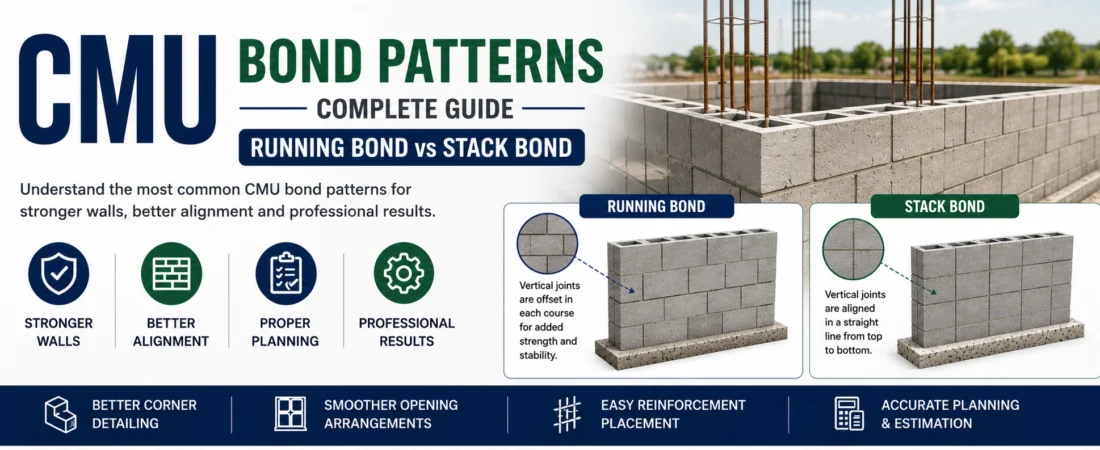
Concrete masonry units (CMU) are installed in different patterns depending on the wall design, structural requirements, appearance, and construction method. The arrangement of CMU blocks is commonly referred to as the bond pattern.
A proper bond pattern helps create a continuous masonry wall and can affect how individual units work together within the wall system.
This guide explains common CMU bond patterns, how blocks are arranged, where different patterns are used, and what factors should be considered when selecting a pattern.
What Is a CMU Bond Pattern?
A CMU bond pattern describes how concrete masonry units are arranged from one course to the next.
The position of each block relative to the blocks below it can influence:
- Wall appearance
- Load distribution
- Masonry continuity
- Corner construction
- Openings
- Reinforcement layout
- Construction efficiency
The selected bond pattern should be compatible with the wall design and the requirements of the masonry system.
For more information about the overall behavior of masonry walls, see our:Learn more about the structural behavior and design considerations of concrete masonry walls in our CMU Structural Wall Guide.
Why Are CMU Bond Patterns Important?
CMU blocks are not simply stacked randomly.
The arrangement of units needs to provide an appropriate wall configuration for the intended application.
A suitable bond pattern can help with:
- Maintaining wall alignment
- Connecting adjacent masonry units
- Constructing corners
- Forming wall intersections
- Building around openings
- Coordinating reinforcement
- Achieving the desired appearance
The correct pattern depends on the type of wall and the design requirements.
Common CMU Bond Patterns
Several masonry arrangements can be used with concrete masonry units.
Some of the most relevant patterns include:
- Running bond
- Stack bond
- Stack Bond vs Running Bond
- Traditional Brick Bond Patterns
- Bond patterns around corners
- Bond patterns around openings
Not every traditional brick bond pattern is commonly used with standard CMU construction.
Running Bond CMU Pattern
The running bond is one of the most common arrangements used in masonry construction.
In a running bond, vertical joints between units are offset from the joints in the course below.
A simplified arrangement looks like this:
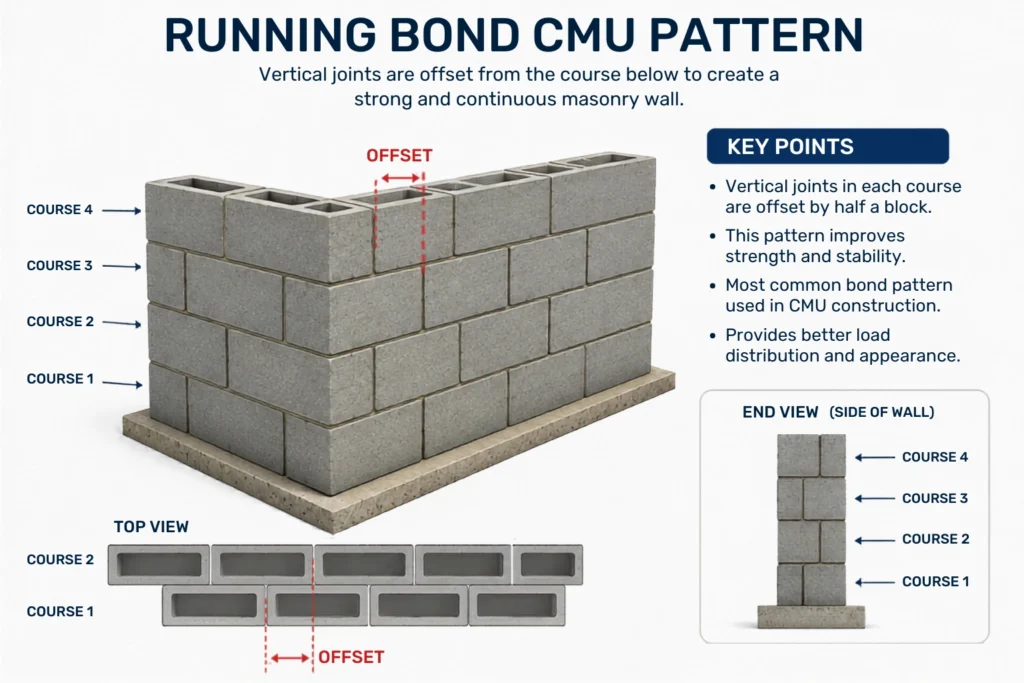
The offset between courses creates a continuous overlapping arrangement.
Running bond is commonly associated with:
- Exterior masonry walls
- Structural masonry
- Partition walls
- Residential construction
- Commercial construction
The exact overlap and unit arrangement depend on the masonry design and block dimensions.
Stack Bond CMU Pattern
In a stack bond, the vertical joints are aligned from one course to the next rather than being offset.
A simplified example looks like this:
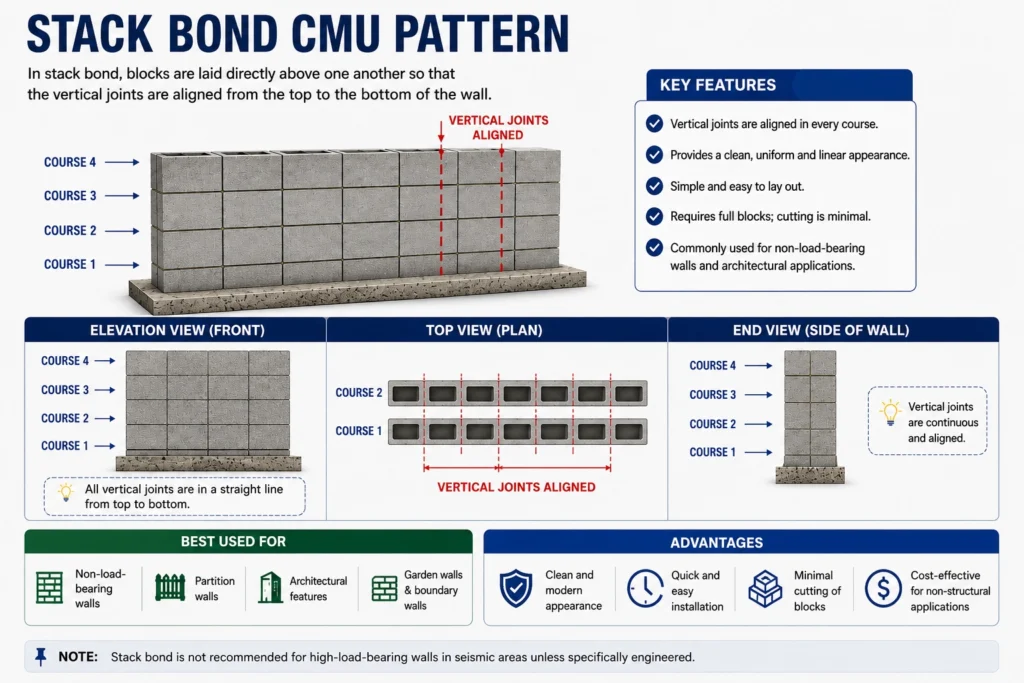
The straight vertical joint lines create a distinctive appearance.
Stack bond can be used where a more uniform architectural appearance is desired.
However, the structural behavior of a stack-bonded wall can differ from an offset bond arrangement, so structural requirements and reinforcement must be considered.
Stack Bond vs Running Bond
The main visual difference is the position of vertical joints.
| Feature | Running Bond | Stack Bond |
|---|---|---|
| Vertical joints | Offset | Aligned |
| Appearance | Traditional masonry pattern | More uniform/grid-like |
| Common application | General masonry | Architectural applications |
| Structural considerations | Depends on wall design | Often requires additional design consideration |
| Joint alignment | Staggered | Continuous |
The appropriate pattern should be selected based on the wall’s design rather than appearance alone.
Traditional Brick Bonds
English Bond and Flemish Bond are traditional masonry bond patterns that are more commonly associated with brick masonry. Although these terms can appear in broader masonry discussions, they are not among the primary bond patterns typically discussed for standard CMU wall construction. For concrete masonry, running bond and stack bond are more relevant patterns to discuss
CMU Bond Patterns at Corners
Corners require careful planning because the block arrangement must maintain the intended wall layout.
At a corner, masonry units may need to be arranged using:
- Corner units
- Half blocks
- Special shapes
- Alternating courses
- Properly coordinated reinforcement
The exact arrangement depends on the wall configuration.
Poorly planned corners can result in:
- Misaligned joints
- Cutting problems
- Weak detailing
- Difficult reinforcement placement
- Uneven wall appearance
Corners should therefore be planned before block installation begins.
CMU Bond Patterns Around Door and Window Openings
Door and window openings require additional planning because the normal bond pattern is interrupted.
The masonry arrangement around an opening may need to coordinate with:
- Jambs
- Lintels
- Reinforcement
- Grout
- Flashing
- Window or door dimensions
The block layout should be planned before construction so that unnecessary cutting and adjustment can be minimized.
For door and window masonry construction, see our:CMU jambs help form and reinforce masonry around door and window openings. Learn more in our CMU Jamb Block Guide.
CMU Bond Pattern and Wall Strength
Bond pattern is only one component of masonry performance.
Wall strength can also depend on:
- CMU type
- Block thickness
- Mortar
- Grout
- Reinforcement
- Wall height
- Lateral loads
- Vertical loads
- Openings
- Connections
- Construction quality
Therefore, a particular bond pattern should not automatically be described as stronger or weaker without considering the complete masonry wall system.
For information about wall thickness and its applications, see our:Different CMU wall thicknesses are used for different masonry applications. See our CMU Wall Thickness Guide for more information.
Bond Pattern and Mortar Joints
Mortar joints are an important part of CMU construction.
The bond pattern determines where vertical and horizontal joints occur, while mortar joints connect the masonry units and help create a continuous wall.
Important considerations include:
- Joint alignment
- Joint thickness
- Mortar coverage
- Tooling
- Consistency
- Workmanship
Most conventional CMU construction uses mortar joints of approximately 3/8 inch, although the actual requirements should follow the applicable project specifications.
Choosing a CMU Bond Pattern
The appropriate bond pattern depends on several factors.
Before selecting a pattern, consider:
Wall Type
Is the wall:
- Load-bearing?
- Non-load-bearing?
- Exterior?
- Interior?
- Retaining?
- Architectural?
Structural Requirements
Structural masonry may require specific unit arrangements, reinforcement, grout, and detailing.
Appearance
Architectural walls may use a particular arrangement to create a desired visual pattern.
Openings
Doors and windows can affect the block layout and require coordinated detailing.
Corners and Intersections
Wall intersections and corners need to be considered when planning the pattern.
Construction Efficiency
A pattern that requires excessive cutting or special units may increase labor and material requirements.
Common CMU Bond Pattern Mistakes
1. Selecting a Pattern Only for Appearance
A visually attractive pattern may not be appropriate for every structural application.
2. Ignoring Corners
The pattern should be planned from the beginning so that corners can be constructed properly.
3. Ignoring Openings
Door and window openings can significantly affect the normal block layout.
4. Failing to Coordinate Reinforcement
Reinforcement and grout locations should be considered before finalizing the masonry layout.
5. Excessive Block Cutting
Poor planning can result in unnecessary cutting and wasted blocks.
6. Ignoring Wall Dimensions
Block dimensions and mortar joints should be considered when developing the layout.
CMU Bond Pattern Planning
Before construction begins, a basic layout should identify:
- Wall length
- Wall height
- Block dimensions
- Mortar joint dimensions
- Corners
- Openings
- Wall intersections
- Special units
- Reinforcement locations
- Grout locations
- Required cuts
Planning the layout before installation can reduce material waste and construction problems.
Estimating Blocks for a CMU Wall
Once the wall dimensions and block size are established, the required number of CMUs can be estimated.
The calculation should consider:
- Wall length
- Wall height
- Block size
- Mortar joints
- Door openings
- Window openings
- Waste
Estimate the number of concrete masonry units required for your wall with our CMU Block Calculator.
CMU Bond Patterns for Structural Walls
The bond pattern is one part of a larger masonry system. For structural CMU walls, the block arrangement needs to work with the wall thickness, mortar, grout, reinforcement, connections, and overall structural design.
Important considerations include:
- Block orientation
- Vertical joint arrangement
- Wall thickness
- Reinforcement locations
- Grouted cells
- Horizontal reinforcement
- Openings
- Wall intersections
- Connections to other structural elements
A bond pattern should therefore be selected as part of the overall wall design rather than treated as an isolated visual feature.
Bond Patterns for Reinforced CMU Walls
Reinforced CMU walls may contain vertical and horizontal reinforcement.
The block layout needs to accommodate reinforcement without creating unnecessary cutting or interfering with properly grouted cells.
Vertical reinforcement may be placed within:
- Reinforced cells
- End cells
- Corner cells
- Jamb areas
- Other designated locations
Horizontal reinforcement may be incorporated through:
- Bond beams
- Reinforcing systems
- Horizontal joint reinforcement where specified
The exact reinforcement arrangement should follow the structural design and applicable building requirements.
For more information about reinforced masonry construction, see our:Reinforced masonry requires coordination between CMU units, grout, reinforcement, and wall design. Learn more in our How to Reinforce a CMU Wall guide.
CMU Bond Patterns at T-Wall Intersections
A T-wall intersection occurs when one masonry wall meets another wall at approximately a right angle.
The block layout needs to provide an appropriate connection between the two walls.
Depending on the design, the intersection may involve:
- Interlocking masonry units
- Reinforcement
- Grouted cells
- Wall ties
- Mechanical connections
The connection method depends on whether the walls are structurally connected, separated, or designed to move independently.
CMU Bond Patterns at Wall Intersections
Other wall intersections can include:
- L-shaped corners
- T-intersections
- Cross intersections
- Offset wall connections
These locations require careful planning because the standard running pattern may not continue automatically through the intersection.
Before construction, the layout should identify:
- Block orientation
- Joint locations
- Special units
- Reinforcement
- Grout
- Connection details
This helps reduce field modifications and unnecessary block cutting.
Half Blocks in CMU Bond Patterns
Half blocks can be useful when completing a masonry layout that requires shorter units.
They may be used around:
- Corners
- Openings
- Wall ends
- Pattern transitions
- Staggered joints
Using appropriately manufactured half blocks can provide a cleaner and more consistent result than excessive cutting of full-size units.
However, the required units depend on the specific CMU system and project design.
Corner CMU Units
Corner blocks are designed to provide an appropriate finished surface at wall corners.
They may be particularly useful when:
- Both sides of a wall are exposed
- Architectural appearance is important
- A clean corner is required
- Standard units cannot provide the desired finish
Corner units can help maintain the intended bond pattern while producing a consistent exterior appearance.
For more information about block geometry and specialized units, see our:CMU units can have different shapes and configurations for specific construction applications. Learn more about face shells, webs, and block geometry in our CMU Block Face Shell & Web Thickness Guide.
CMU Bond Pattern and Wall Thickness
Wall thickness can influence the way masonry units are arranged.
Common CMU nominal wall thicknesses include:
- 4 inches
- 6 inches
- 8 inches
- 10 inches
- 12 inches
The selected thickness may depend on:
- Structural requirements
- Fire-resistance requirements
- Sound-control requirements
- Thermal performance
- Building use
- Design requirements
Different CMU wall thicknesses are used for different applications. See our CMU Wall Thickness Guide.
Architectural CMU Bond Patterns
Architectural masonry can use bond patterns to create visual interest.
Instead of using the same arrangement throughout the wall, designers may vary:
- Block orientation
- Joint alignment
- Block color
- Surface texture
- Projection
- Recesses
- Pattern repetition
Architectural CMU may use standard units or specially manufactured units.
When appearance is a major consideration, the pattern should be coordinated with the block finish and overall building design.
For information about different CMU surface appearances, see our:CMU surface textures and finishes can significantly affect the appearance of a masonry wall. Learn more in our CMU Block Surface Finishes Guide.
Bond Patterns and CMU Openings
Door and window openings interrupt the normal block layout.
The surrounding masonry may require special units or coordinated construction at:
- Jambs
- Sills
- Lintels
- Bond beams
- Reinforced cells
The opening dimensions should be considered during the initial wall layout rather than after the masonry has already been constructed.
This can reduce cutting, waste, and alignment problems.
Bond Patterns and Lintels
A lintel spans an opening and supports masonry or other loads above it.
The CMU layout above and around the opening needs to coordinate with the lintel arrangement.
Depending on the construction system, lintels may involve:
- Lintel blocks
- Reinforcement
- Grout
- Structural steel
- Precast components
The exact lintel design depends on the structural requirements.
CMU Bond Pattern and Bond Beams
Bond beams are horizontal structural elements incorporated into masonry walls.
They can be used for purposes such as:
- Horizontal reinforcement
- Structural continuity
- Connecting portions of a wall
- Supporting certain loads
- Improving wall behavior
The block layout must accommodate the bond beam locations and reinforcement requirements.
Planning a CMU Bond Pattern
A simple planning process can help reduce construction problems.
Step 1: Determine Wall Dimensions
Establish:
- Wall length
- Wall height
- Wall thickness
Step 2: Select the CMU
Determine:
- Block size
- Block type
- Surface finish
- Special units
Step 3: Locate Openings
Mark:
- Doors
- Windows
- Other openings
Step 4: Plan Corners
Determine how the selected bond pattern will continue around each corner.
Step 5: Coordinate Reinforcement
Mark vertical and horizontal reinforcement locations before finalizing the block layout.
Step 6: Identify Special Units
Determine where half blocks, corner units, lintel units, or other special shapes may be required.
Step 7: Estimate Material Quantity
Calculate the number of blocks and other masonry materials required.
Our calculator can help with basic block quantity estimation:Use the CMU Block Calculator to estimate the number of concrete masonry units needed for a wall.
Common CMU Bond Pattern Problems
Misaligned Vertical Joints
Poor layout can cause joints to appear inconsistent or create an unintended pattern.
Improper Corner Layout
If corners are not planned before construction, the intended bond may become difficult to maintain.
Excessive Cutting
Poor planning can result in too many cut blocks.
Reinforcement Conflicts
Block placement should be coordinated with reinforcement and grouted cells.
Opening Problems
Door and window dimensions should be considered during the initial masonry layout.
Inconsistent Appearance
Differences in block orientation, color, texture, or joint tooling can affect the final appearance.
How to Improve CMU Bond Pattern Layout
Before laying the first course, review the complete wall layout.
Check:
✓ Wall dimensions
✓ Block dimensions
✓ Mortar joint dimensions
✓ Corners
✓ Wall intersections
✓ Door openings
✓ Window openings
✓ Reinforcement
✓ Grouted cells
✓ Special units
✓ Block quantity
✓ Waste allowance
A properly planned layout can make construction more efficient and reduce unnecessary adjustments.
CMU Bond Pattern and Material Estimation
The bond pattern can influence the number of full blocks, half blocks, and special units required.
When estimating materials, consider:
- Total wall area
- Openings
- Block dimensions
- Mortar joints
- Special units
- Waste
A simple area calculation may provide an initial estimate, but a detailed takeoff should account for the actual wall layout.
CMU Bond Pattern vs Block Size
The block size should be considered when planning the bond.
For example, a wall constructed with standard 8 × 8 × 16 CMU will have a different layout from one using narrower or wider units.
The actual dimensions of the blocks are also important because nominal dimensions include allowance for mortar joints.
For more information, see our:Learn how nominal and actual CMU dimensions differ and why the distinction matters during masonry layout in our CMU Nominal vs Actual Dimensions guide.
Frequently Asked Questions
What is the most common CMU bond pattern?
Running bond is one of the most common arrangements used in concrete masonry construction, with vertical joints offset between courses.
What is stack bond CMU?
Stack bond is an arrangement where vertical joints are aligned from one course to the next, creating continuous vertical joint lines.
Is running bond stronger than stack bond?
Bond pattern alone does not determine the strength of a masonry wall. Strength depends on the complete wall system, including CMU, mortar, reinforcement, grout, connections, loads, and design.
Are half blocks used in CMU construction?
Yes. Half blocks and other special units can be used to complete layouts, corners, openings, and pattern transitions.
Does CMU bond pattern affect material quantity?
Yes. Different layouts can require different combinations of full blocks, half blocks, and special units.
Does CMU bond pattern affect appearance?
Yes. The arrangement of blocks and joints can significantly change the visual appearance of a masonry wall.
Should bond patterns be planned before construction?
Yes. Planning the layout before construction helps coordinate corners, openings, reinforcement, special units, and material quantities.
Related Calculators
Related Guides
- CMU Structural Wall Guide
- CMU Wall Thickness Guide
- CMU Jamb Block Guide
- CMU Block Surface Finishes Guide
- CMU Nominal vs Actual Dimensions
- How to Reinforce a CMU Wall
Final Thoughts
CMU bond patterns determine how concrete masonry units are arranged within a wall. Running bond and stack bond are two commonly discussed arrangements, but the appropriate layout depends on the wall design, construction requirements, appearance, openings, corners, reinforcement, and block dimensions.
Proper planning is especially important around:
- Corners
- Wall intersections
- Doors
- Windows
- Lintels
- Bond beams
- Reinforced cells
Before construction, the bond pattern should be coordinated with the complete masonry design rather than selected only for appearance.