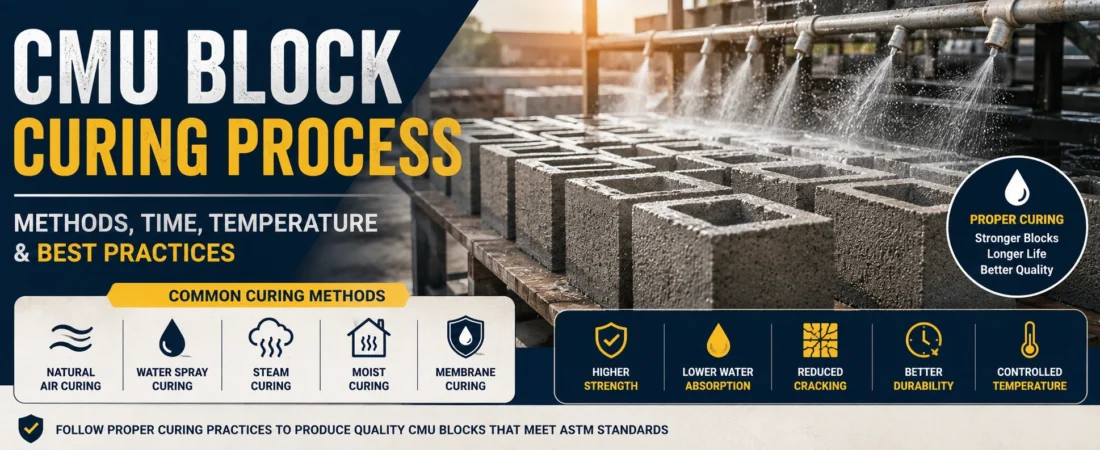
Concrete masonry units (CMU) are only as strong as the curing process that follows manufacturing. Even if a block is produced using high-quality cement, properly graded aggregates, and an optimized mix design, inadequate curing can significantly reduce its strength, durability, and long-term performance.
Curing is the process of maintaining adequate moisture and temperature so the cement can continue hydrating after the block is molded. This hydration reaction allows concrete to gain strength over time and develop the durability needed for structural applications.
In commercial block plants, curing is a carefully controlled production stage. Manufacturers monitor curing time, temperature, humidity, and handling procedures to produce concrete masonry units that meet project specifications and applicable ASTM standards.
This guide explains how CMU block curing works, common curing methods, recommended curing times, ideal environmental conditions, and best practices for producing high-quality concrete masonry units.
What Is CMU Block Curing?
CMU block curing is the controlled process of allowing freshly manufactured concrete masonry units to gain strength through cement hydration.
When water is mixed with Portland cement, a chemical reaction begins. During this reaction, cement particles bond with aggregates to form hardened concrete. This process continues for days and even weeks after the blocks leave the mold.
Without proper curing, hydration stops prematurely, resulting in weaker concrete with lower durability.
Unlike drying, curing is not about removing moisture from the block. Instead, it focuses on maintaining suitable moisture and temperature conditions so hydration can continue effectively.
Curing vs Drying
Many people mistakenly believe curing simply means allowing blocks to dry. In reality, curing and drying are completely different processes.
| Curing | Drying |
|---|---|
| Supports cement hydration | Removes moisture from concrete |
| Increases compressive strength | Does not increase strength |
| Improves durability | Can reduce strength if it occurs too early |
| Controlled process | Natural moisture loss |
| Essential for quality production | Occurs after curing progresses |
Fresh concrete should never be allowed to dry too quickly during the early stages of curing.
Why Proper Curing Is Important
Curing has a direct impact on nearly every performance characteristic of a concrete masonry unit.
Proper curing helps manufacturers achieve:
- Higher compressive strength
- Improved durability
- Better weather resistance
- Reduced shrinkage cracking
- Lower water absorption
- Greater dimensional stability
- Longer service life
- More consistent product quality
Blocks that are improperly cured may appear acceptable on the surface but often contain internal weaknesses that reduce long-term performance.
The Science Behind Concrete Curing
Concrete hardens because of a chemical reaction known as cement hydration.
When cement and water are combined, cement particles react with water molecules to form microscopic crystals. These crystals gradually interlock and bind the aggregates together into a strong, solid material.
Hydration continues as long as:
- Sufficient moisture is available.
- The temperature remains within an acceptable range.
- The concrete has not dried prematurely.
If moisture is lost too early, hydration slows dramatically or stops altogether, preventing the concrete from reaching its full design strength.
For this reason, curing is one of the most critical stages in concrete masonry production.
Before curing begins, manufacturers must first prepare a properly proportioned concrete mixture. Learn how material proportions affect block performance in our CMU Block Mix Design Guide.
Why Moisture Matters During Curing
Moisture is essential throughout the curing period because cement requires water to complete hydration.
Insufficient moisture can lead to:
- Lower compressive strength
- Surface dusting
- Early shrinkage cracks
- Reduced durability
- Poor freeze-thaw resistance
- Higher water absorption
Maintaining adequate moisture during the first several days has a much greater impact on strength than extending curing after the concrete has already dried.
How Temperature Affects Curing
Temperature has a major influence on the rate of cement hydration.
Higher temperatures generally speed up strength development but can also increase the risk of rapid moisture loss if not properly controlled.
Lower temperatures slow hydration, meaning blocks require more time to achieve the same strength.
Extremely cold conditions may even stop hydration until temperatures rise again.
Maintaining a stable curing temperature helps produce concrete masonry units with more consistent engineering properties.
How Long Should CMU Blocks Cure?
Concrete continues gaining strength for months, but most of the important strength development occurs during the first four weeks.
A typical curing schedule looks like this:
| Age | Typical Strength Development |
|---|---|
| 24 Hours | Initial hardening begins |
| 3 Days | Rapid strength gain |
| 7 Days | Significant strength achieved |
| 14 Days | Continued hydration |
| 28 Days | Design strength typically reached |
Although blocks can often be handled before 28 days, curing should continue long enough to achieve the required engineering performance.
Typical CMU Curing Timeline
| Time After Production | What Happens |
|---|---|
| 0–24 Hours | Initial set and early hydration |
| 1–3 Days | Rapid strength development |
| 3–7 Days | Continued hardening and durability improvement |
| 7–14 Days | Strength continues increasing |
| 14–28 Days | Concrete approaches its specified design strength |
The exact timeline varies depending on cement type, curing method, environmental conditions, and manufacturing practices.
Factors That Influence CMU Curing
Several variables affect how quickly concrete masonry units gain strength during curing.
Important factors include:
- Cement type
- Water-cement ratio
- Aggregate quality
- Ambient temperature
- Relative humidity
- Block density
- Manufacturing method
- Curing technique
- Air circulation
- Moisture retention
Manufacturers should monitor these factors to maintain consistent product quality.
Types of CMU Block Curing Methods
Concrete masonry manufacturers use different curing methods depending on production volume, climate, available equipment, and project requirements. Each method aims to provide the proper moisture and temperature conditions needed for cement hydration.
The most common curing methods are discussed below.
Natural Air Curing
Natural air curing is the simplest and most economical method used by many small and medium-sized block manufacturers.
Freshly molded blocks are placed in a protected curing area where they gradually gain strength under ambient environmental conditions.
This method is suitable when:
- Weather conditions are moderate.
- Production volumes are relatively low.
- Blocks can remain undisturbed during curing.
- Proper moisture loss control is maintained.
Although inexpensive, natural air curing may produce inconsistent results if temperature and humidity vary significantly.
Advantages
- Low operating cost
- No specialized equipment required
- Simple production process
- Suitable for small manufacturers
Disadvantages
- Slower strength development
- Weather-dependent
- Greater variation in block quality
- Difficult to maintain consistent curing conditions
Moist Curing
Moist curing keeps freshly manufactured blocks in an environment where sufficient moisture is available throughout the early hydration period.
Rather than allowing the concrete to dry immediately, manufacturers maintain a humid curing environment that supports continuous cement hydration.
Moist curing is widely recognized as one of the most effective methods for producing durable concrete masonry units.
Benefits
- Higher compressive strength
- Better durability
- Reduced shrinkage cracking
- Lower water absorption
- Improved long-term performance
Water Spray Curing
Water spray curing involves periodically applying a fine mist of water over newly manufactured concrete blocks to maintain surface moisture.
The spraying schedule depends on:
- Temperature
- Relative humidity
- Wind conditions
- Block age
Excessive spraying should be avoided because standing water may affect surface quality.
Steam Curing
Steam curing is commonly used in large commercial CMU manufacturing plants where rapid production is required.
Instead of waiting several days for natural curing, blocks are placed inside enclosed curing chambers where temperature and humidity are carefully controlled.
Warm steam accelerates cement hydration, allowing blocks to gain strength much faster than under normal curing conditions.
Steam curing is particularly useful for manufacturers operating multiple production shifts or high-capacity automated plants.
Steam curing is one step in the overall manufacturing workflow. Read our Complete CMU Block Production Guide to understand every stage of CMU block production.
Advantages
- Faster strength gain
- Shorter production cycles
- Earlier handling
- Improved productivity
- Consistent curing conditions
Disadvantages
- Higher equipment cost
- Increased energy consumption
- Requires skilled operation
- Careful temperature control is necessary
Accelerated Curing
Accelerated curing refers to any process that increases the rate of concrete strength development through controlled environmental conditions.
Methods may include:
- Heated curing rooms
- Controlled humidity chambers
- Steam curing systems
- Warm-air circulation
The objective is to reduce production time without compromising long-term concrete performance.
Membrane Curing
Some manufacturers use curing compounds that form a thin membrane over the concrete surface.
This membrane reduces moisture evaporation while hydration continues inside the block.
Although membrane curing is more common in cast-in-place concrete applications, it may also be used in specific masonry manufacturing situations where moisture retention is important.
Comparison of Common Curing Methods
| Curing Method | Cost | Speed | Quality Consistency | Typical Application |
|---|---|---|---|---|
| Natural Air Curing | Low | Slow | Moderate | Small manufacturers |
| Moist Curing | Low to Medium | Moderate | High | General CMU production |
| Water Spray Curing | Low | Moderate | High | Outdoor curing yards |
| Steam Curing | High | Very Fast | Excellent | Commercial block plants |
| Accelerated Curing | High | Fast | Excellent | High-volume production |
| Membrane Curing | Medium | Moderate | Good | Special applications |
Ideal Temperature for CMU Block Curing
Temperature has a direct influence on the rate of cement hydration and the final quality of concrete masonry units.
Very high temperatures can cause rapid moisture loss, while extremely low temperatures slow hydration and delay strength development.
Manufacturers should aim to maintain stable curing temperatures whenever possible.
| Temperature | Effect on Curing |
|---|---|
| Below 40°F (4°C) | Hydration slows significantly |
| 50–70°F (10–21°C) | Good curing conditions |
| 70–90°F (21–32°C) | Rapid and efficient hydration with proper moisture control |
| Above 90°F (32°C) | Increased evaporation; additional moisture control required |
Sudden temperature fluctuations should be minimized because they can affect both strength development and dimensional stability.
Ideal Humidity During Curing
Relative humidity is just as important as temperature.
Concrete that loses moisture too quickly cannot complete the hydration process efficiently.
Maintaining high humidity during early curing helps:
- Increase compressive strength
- Improve durability
- Reduce shrinkage
- Lower cracking risk
- Produce more uniform blocks
Large manufacturing plants often use enclosed curing chambers where humidity levels can be controlled throughout the curing cycle.
How Climate Affects CMU Curing
Environmental conditions play a significant role in curing performance.
Hot Weather
Hot weather increases evaporation, which can cause premature drying.
Manufacturers should:
- Protect fresh blocks from direct sunlight.
- Maintain adequate moisture.
- Reduce unnecessary air movement around curing areas.
Cold Weather
Low temperatures slow hydration and delay strength development.
During cold conditions, manufacturers may use heated curing rooms or steam curing to maintain production efficiency.
Rainy Weather
Rain can wash cement paste from freshly molded blocks or alter surface quality if blocks are exposed too early.
Fresh blocks should remain protected until sufficient initial strength has developed.
Dry and Windy Conditions
Dry air combined with strong winds can remove moisture rapidly from concrete surfaces.
Additional moisture-retention measures may be necessary to prevent early drying and shrinkage cracking.
When Can CMU Blocks Be Handled?
Freshly molded blocks should remain undisturbed until they have developed enough strength to resist damage during handling.
The exact handling time depends on:
- Curing method
- Cement type
- Temperature
- Humidity
- Production process
Steam-cured blocks generally become ready for handling much sooner than naturally cured blocks.
Improper handling during early curing can damage corners, edges, and internal structure, reducing overall product quality.
When Can CMU Blocks Be Shipped?
The shipping schedule depends on the curing method, block strength, and customer specifications.
Commercial manufacturers typically avoid shipping freshly molded blocks until they have developed sufficient strength to withstand transportation, loading, and unloading without damage.
Before shipment, blocks should:
- Meet the required compressive strength.
- Be free from visible cracks or defects.
- Have stable dimensions.
- Be properly cured according to the production process.
- Be carefully stacked and palletized.
Shipping blocks too early increases the risk of chipped corners, cracked webs, and customer complaints.
How Curing Affects Compressive Strength
Proper curing is one of the most important factors influencing the compressive strength of concrete masonry units.
When curing conditions are maintained correctly, cement hydration continues efficiently, allowing the concrete to develop a dense internal structure.
Poor curing interrupts hydration and reduces the final strength, even if the original mix design was correct.
| Curing Condition | Expected Effect on Strength |
|---|---|
| Proper moisture and temperature | Maximum strength development |
| Premature drying | Lower compressive strength |
| Low curing temperature | Slower strength gain |
| Excessively high temperature with rapid drying | Surface cracking and reduced durability |
| Controlled steam curing | Faster early strength development |
Manufacturers should remember that curing cannot compensate for poor mix design, but an excellent mix design can still fail if curing is neglected.
Proper curing is only one part of producing high-quality concrete masonry units. Follow our CMU Block Quality Control Guide to learn how manufacturers inspect and maintain consistent product quality.
How Curing Improves Durability
In addition to strength, curing significantly improves the long-term durability of concrete masonry units.
Well-cured blocks generally provide:
- Better freeze-thaw resistance
- Lower permeability
- Reduced water absorption
- Increased abrasion resistance
- Improved weather resistance
- Longer service life
These characteristics are especially important for structural masonry exposed to outdoor environments.
Common CMU Block Curing Problems
Several production defects can occur when curing conditions are not properly controlled.
Understanding these issues helps manufacturers identify problems early and improve production quality.
Rapid Drying
Concrete loses moisture before hydration is complete.
Possible causes:
- High temperature
- Strong wind
- Low humidity
- Direct sunlight
Effects include:
- Reduced strength
- Surface cracking
- Poor durability
Plastic Shrinkage Cracks
These small cracks develop shortly after molding when moisture evaporates faster than the concrete can hydrate.
Common causes include:
- Hot weather
- Low humidity
- Wind exposure
Proper moisture control greatly reduces the risk of plastic shrinkage.
Low Compressive Strength
Weak blocks are often the result of inadequate curing rather than poor raw materials.
Possible causes include:
- Insufficient curing time
- Early drying
- Low curing temperature
- Poor moisture control
Surface Dusting
Dusting occurs when the concrete surface becomes weak and powdery.
Possible causes include:
- Poor curing
- Excessive water
- Premature drying
Corner Damage
Corners may chip during handling if blocks are moved before sufficient strength has developed.
Proper curing and careful handling reduce this problem.
Uneven Strength
Blocks within the same production batch should develop similar engineering properties.
Uneven curing conditions may produce blocks with varying strengths, resulting in inconsistent product quality.
Efflorescence
Efflorescence appears as a white powdery deposit on the surface of concrete masonry units.
Although usually not a structural problem, it can affect appearance.
Proper curing, good drainage, and quality materials help minimize efflorescence.
Troubleshooting Guide
| Problem | Possible Cause | Recommended Solution |
|---|---|---|
| Low strength | Inadequate curing | Increase curing duration and improve moisture control |
| Surface cracks | Rapid drying | Maintain humidity and protect fresh blocks |
| Dusting | Early moisture loss | Improve curing environment |
| Corner damage | Early handling | Allow additional curing before moving blocks |
| Uneven strength | Inconsistent curing conditions | Maintain uniform temperature and humidity |
| Efflorescence | Moisture movement and soluble salts | Improve drainage, curing, and material quality |
Best Practices for CMU Block Curing
Manufacturers can consistently produce high-quality concrete masonry units by following these proven curing practices.
- Begin curing immediately after molding.
- Maintain adequate moisture throughout early hydration.
- Protect fresh blocks from direct sunlight.
- Avoid rapid drying caused by wind.
- Maintain stable curing temperatures.
- Monitor humidity regularly.
- Use steam curing only under controlled conditions.
- Avoid moving blocks too early.
- Test compressive strength regularly.
- Train production staff on proper curing procedures.
- Inspect curing chambers and equipment routinely.
- Keep curing records for quality assurance.
Consistent curing procedures improve product reliability, reduce production defects, and help ensure compliance with project specifications and applicable ASTM requirements.
Manufacturers should also ensure their blocks comply with recognized industry requirements. Read our CMU Block ASTM Standards Explained guide to understand the key standards for concrete masonry units.
Frequently Asked Questions (FAQs)
Why is curing important for CMU blocks?
Curing allows cement hydration to continue, helping concrete masonry units develop strength, durability, and long-term performance.
How long should CMU blocks cure?
While curing duration varies by production method, concrete continues gaining strength for several weeks, with most design strength typically achieved after about 28 days.
What happens if blocks dry too quickly?
Rapid drying interrupts cement hydration and may result in lower strength, shrinkage cracks, increased water absorption, and reduced durability.
Is curing the same as drying?
No. Curing maintains moisture to support hydration, while drying removes moisture from the concrete. Proper curing should occur before significant drying takes place.
Which curing method is best?
The best method depends on production requirements. Steam curing is common in large commercial plants, while moist curing and controlled air curing are widely used by smaller manufacturers.
Can blocks be moved immediately after manufacturing?
No. Fresh blocks should remain undisturbed until they have gained sufficient strength to prevent edge damage and deformation during handling.
Does cold weather affect curing?
Yes. Low temperatures slow cement hydration, meaning blocks require more time to achieve the desired strength.
Does hot weather improve curing?
Higher temperatures accelerate hydration but also increase evaporation. Without proper moisture control, excessive heat can reduce concrete quality.
How does humidity affect curing?
High humidity helps retain moisture within the concrete, allowing hydration to continue efficiently and improving both strength and durability.
Does curing affect ASTM compliance?
Yes. Proper curing helps manufacturers produce concrete masonry units capable of meeting the performance requirements specified in applicable ASTM standards.
Related Calculators
- CMU Block Calculator
- CMU Material Cost Calculator
- Concrete Calculator
- Mortar Calculator
- Foundation Calculator
Related Guides
- Complete CMU Block Production Guide
- CMU Block Mix Design Guide
- CMU Block Quality Control Guide
- CMU Block ASTM Standards Explained
- Standard Cinder Block Sizes
- CMU Wall Thickness Guide
- How Many CMU Blocks Per Pallet
- How to Start a CMU Block Business
Final Thoughts
The curing process is one of the most important stages in CMU block manufacturing. Even the best mix design cannot deliver its full potential without proper curing. By maintaining the right combination of moisture, temperature, and curing time, manufacturers can produce concrete masonry units with higher compressive strength, improved durability, reduced cracking, and more consistent quality.
Whether you operate a small block-making facility using natural air curing or a high-capacity manufacturing plant equipped with automated steam-curing chambers, following proven curing practices can reduce defects, improve production efficiency, and increase customer confidence. Combined with proper mix design, quality control, and routine testing, an effective curing process ensures that every CMU block is ready to meet the demands of structural and non-structural construction applications.