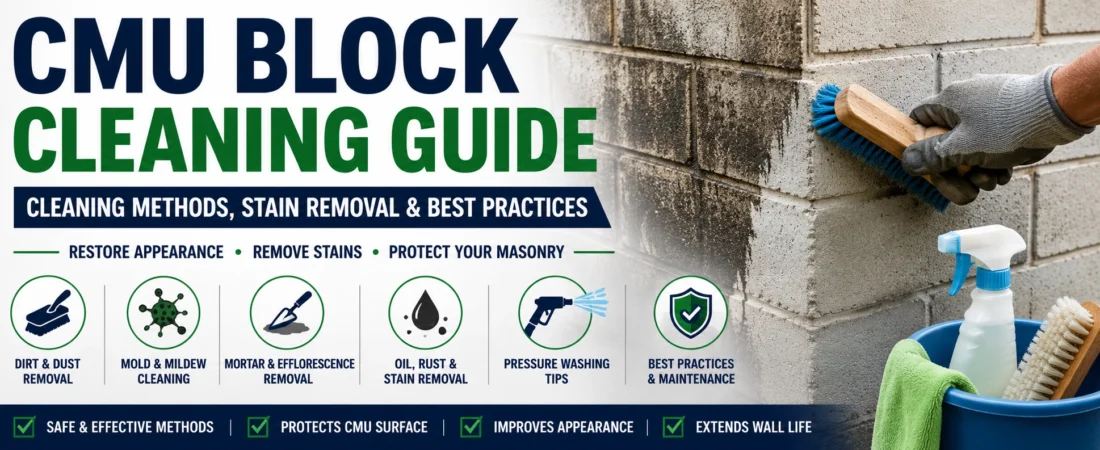
Concrete Masonry Units (CMU) are durable building materials, but their surfaces can accumulate dirt, dust, mortar residue, efflorescence, mold, mildew, stains, and other contaminants over time.
Proper cleaning can improve the appearance of a CMU wall and help maintain its surface condition. However, the wrong cleaning method can damage the block, change its texture, discolor the surface, or create additional moisture-related problems.
The best cleaning method depends on the type of CMU, surface finish, type of contamination, and condition of the masonry.
This CMU Block Cleaning Guide explains how to clean concrete masonry surfaces, how to deal with common stains, which cleaning methods to use, and which mistakes to avoid.
Why Should CMU Blocks Be Cleaned?
CMU walls can accumulate different types of contaminants during construction and normal use.
Common contaminants include:
- Dirt and dust
- Mortar residue
- Grout residue
- Efflorescence
- Mold and mildew
- Oil and grease
- Rust stains
- Atmospheric dirt
- Paint
- Organic growth
- Construction debris
Regular cleaning can improve the appearance of the masonry and help keep the surface looking consistent.
Cleaning should be considered part of normal masonry maintenance rather than something that is only performed when a wall becomes heavily stained.
Identify the CMU Surface Before Cleaning
Before selecting a cleaning method, identify the type of CMU surface.
Different finishes can respond differently to aggressive cleaning.
Smooth-Faced CMU
Smooth-faced CMU has a relatively uniform concrete surface.
Aggressive cleaning can potentially remove part of the surface or expose aggregate, which may change the appearance of the block.
For this reason, strong cleaning methods should be tested carefully before being applied to the entire wall.
Split-Faced CMU
Split-faced CMU has a rough, textured surface that gives the block a more natural stone-like appearance.
The irregular surface can make some contaminants more difficult to remove because dirt can collect in the textured areas.
Cleaning should therefore be performed carefully to avoid damaging the surface texture.
Ground-Faced CMU
Ground-faced CMU has a smoother, more refined appearance.
Because the finished surface is an important part of its appearance, abrasive cleaning should be used carefully.
Harsh cleaning can potentially alter the appearance of the finished surface.
Glazed CMU
Glazed CMU has a smooth, relatively non-porous facing.
Its surface is generally easier to clean than many unfinished concrete surfaces, but abrasive methods and unsuitable chemicals can still damage the finish.
Always consider the manufacturer’s recommendations when cleaning specialized CMU products.
Use the Least Aggressive Cleaning Method First
One of the most important CMU cleaning principles is to start with the least aggressive method that can effectively remove the contamination.
A practical progression is:
- Dry brushing
- Hand cleaning
- Water cleaning
- Mild detergent
- Low-pressure washing
- Appropriate masonry cleaning chemicals
- More aggressive methods only when necessary
There is no reason to use a strong chemical or high-pressure washer when a simple brush and water can solve the problem.
Dry Cleaning CMU Blocks
Loose dirt, dust, sand, and other dry contaminants should often be removed before using water.
A stiff nylon or fiber brush can be useful for this purpose.
Dry brushing can help remove:
- Loose dust
- Surface dirt
- Dry mortar particles
- Construction debris
- Loose efflorescence
Avoid unnecessarily aggressive brushing, particularly on decorative or finished CMU surfaces.
Can You Use a Wire Brush on CMU?
A metal wire brush should be used with caution.
Small metal particles can become embedded in the masonry surface and may later produce rust-colored staining.
A stiff nylon or fiber brush is generally a safer starting point for routine CMU cleaning.
Cleaning CMU With Water
Water is often one of the simplest cleaning methods for ordinary dirt and surface contamination.
Depending on the condition of the wall, water cleaning may involve:
- Hand scrubbing
- Garden-hose cleaning
- Mild detergent and water
- Low-pressure washing
- Controlled pressure washing
The amount of water should be controlled.
Excessive water can penetrate porous masonry and may contribute to moisture-related problems.
CMU Cleaning Step-by-Step
A basic CMU cleaning procedure can follow these steps.
Step 1: Inspect the Wall
Before cleaning, inspect the entire surface.
Look for:
- Cracks
- Damaged blocks
- Damaged mortar joints
- Efflorescence
- Mold
- Oil stains
- Rust stains
- Paint
- Existing coatings
- Sealers
- Other contaminants
Understanding the type of contamination helps determine the appropriate cleaning method.
Step 2: Protect Surrounding Areas
Protect nearby materials and surfaces before beginning.
Depending on the project, this may include:
- Windows
- Doors
- Metal components
- Landscaping
- Electrical equipment
- Adjacent finishes
- Ground surfaces
Cleaning chemicals and dirty runoff should also be controlled so they do not damage surrounding materials.
Step 3: Test a Small Area
Before cleaning the entire wall, test the selected method on a small area.
Check:
- Does the contamination come off?
- Does the CMU color change?
- Is the surface texture affected?
- Does the cleaning solution leave residue?
- Is the pressure damaging the surface?
If the test produces an undesirable result, change the cleaning method before proceeding.
Step 4: Remove Loose Dirt
Start with dry brushing where appropriate.
Remove loose dirt, dust, and debris before applying water or cleaning solutions.
This can reduce the amount of material that needs to be removed during wet cleaning.
Step 5: Apply the Appropriate Cleaning Method
Select the cleaning method based on the contamination.
For example:
Light dirt → water and brushing
General staining → mild detergent and water
Efflorescence → appropriate efflorescence cleaning method
Oil or grease → suitable degreasing cleaner
Mold or mildew → appropriate biological growth cleaner
Mortar residue → suitable masonry cleaning procedure
Do not use the same chemical or procedure for every type of stain.
Step 6: Rinse the CMU Surface
After cleaning, rinse the surface thoroughly.
The objective is to remove:
- Dirt
- Loosened contaminants
- Cleaning solution
- Chemical residue
Rinsing should be controlled so that excessive water does not unnecessarily enter the masonry.
When Should CMU Be Cleaned?
CMU can be cleaned when necessary based on its condition.
Common situations include:
- After construction
- Before applying a coating
- When dirt becomes noticeable
- After removing construction residue
- When mold or mildew appears
- When stains develop
- During scheduled maintenance
- Before inspection or renovation
New masonry should be handled carefully because recently constructed walls may still contain significant moisture.
Cleaning CMU After Construction
Construction can leave different types of residue on CMU walls.
These may include:
- Mortar smears
- Grout residue
- Dust
- Soil
- Construction debris
- Cutting residue
- Adhesive materials
Construction cleaning should be planned rather than performed with excessive pressure or harsh chemicals.
The earlier a suitable cleaning method is selected, the easier it may be to remove certain construction-related contaminants.
Why Cleaning Method Matters
Using the wrong cleaning method can cause problems such as:
- Surface discoloration
- Aggregate exposure
- Texture changes
- Chemical staining
- Damage to coatings
- Excessive water penetration
- Damage to surrounding materials
For this reason, stronger does not always mean better when cleaning CMU.
A controlled cleaning process is generally preferable to aggressive cleaning.
CMU Cleaning and Moisture
Water plays an important role in both cleaning and masonry performance.
Excessive moisture can move through porous CMU and may contribute to recurring moisture-related deposits.
If white deposits appear after cleaning, the cause may need to be investigated rather than simply cleaning the wall repeatedly.
For more information about white deposits specifically, see our:
White powdery deposits on CMU are often related to moisture movement and soluble salts. Learn more about identifying, preventing, and removing these deposits in our CMU Block Efflorescence Guide.
Cleaning CMU Without Damaging the Surface
To reduce the risk of damage:
- Start with a gentle method
- Test before full application
- Avoid unnecessary abrasive cleaning
- Control water pressure
- Use suitable cleaning products
- Protect surrounding materials
- Follow product instructions
- Rinse thoroughly
- Allow the wall to dry properly
- Inspect the result
Decorative CMU deserves additional care because aggressive cleaning can change its appearance.
Pressure Washing CMU Blocks
Pressure washing can be useful for removing dirt and some surface contaminants from CMU, but it should be used carefully.
Excessive pressure can:
- Damage the surface
- Remove weak surface material
- Expose aggregate
- Affect decorative finishes
- Force water into the masonry
- Damage mortar joints
If pressure washing is used, start with a lower pressure setting and increase it only when necessary.
Always test the equipment on a small area first.
How to Pressure Wash CMU Safely
A controlled process is more important than simply using high pressure.
Recommended approach:
- Inspect the wall.
- Protect nearby surfaces.
- Test a small area.
- Start with low pressure.
- Keep the nozzle at a suitable distance.
- Avoid concentrating the spray on one small area.
- Work systematically across the wall.
- Rinse away loosened dirt.
- Inspect the cleaned surface.
Do not assume that maximum pressure will produce the best result.
Cleaning Mold and Mildew From CMU
Mold and mildew can develop on CMU surfaces where moisture, shade, and organic material create favorable conditions.
Common locations include:
- Shaded walls
- Damp areas
- Areas near vegetation
- Poorly drained locations
- Walls exposed to persistent moisture
Before cleaning mold or mildew, identify why the area remains damp.
Cleaning the visible growth without addressing persistent moisture may allow it to return.
A suitable cleaner can be applied according to its manufacturer’s instructions, followed by appropriate rinsing.
Cleaning Mortar Stains From CMU
Mortar residue is a common problem after masonry construction.
Fresh mortar can often be easier to remove than hardened mortar.
When dealing with mortar stains:
- Remove loose material carefully.
- Avoid damaging the CMU surface.
- Use an appropriate masonry cleaning method.
- Test the cleaning solution first.
- Protect adjacent materials.
- Rinse thoroughly after cleaning.
Avoid aggressively scraping the surface because this can damage the face of the block.
Cleaning Oil and Grease Stains
Oil and grease require a different approach from ordinary dirt.
A suitable masonry-safe degreasing cleaner may be required.
The process generally involves:
- Remove loose surface contamination.
- Apply an appropriate cleaner.
- Allow the cleaner to work according to its instructions.
- Scrub the affected area.
- Rinse thoroughly.
- Repeat if necessary.
Deep oil stains may require more than one treatment.
Because CMU is porous, some oil can penetrate into the material rather than remaining only on the surface.
Cleaning Rust Stains From CMU
Rust-colored stains may come from:
- Metal components
- Reinforcement
- Nearby steel
- Fasteners
- Metal tools
- Contaminated runoff
Rust stains should be treated with a product specifically suitable for masonry and the particular type of stain.
Always test the product first because some chemical cleaners can discolor concrete masonry.
If the rust is coming from a continuing source, cleaning alone will not permanently solve the problem.
Removing Paint and Graffiti From CMU
Paint and graffiti can be difficult to remove because the coating may penetrate the pores of the CMU.
The appropriate method depends on:
- Paint type
- Age of the paint
- CMU surface
- Depth of penetration
- Size of the affected area
Possible approaches include:
- Suitable chemical paint removers
- Controlled pressure washing
- Mechanical cleaning
- Specialized masonry cleaning systems
Aggressive abrasive methods should be avoided unless they are genuinely necessary because they can permanently alter the appearance of the CMU.
Cleaning Efflorescence From CMU
Efflorescence produces white or light-colored deposits on masonry.
The visible deposit can often be removed, but recurring efflorescence usually requires attention to the underlying moisture source.
Do not repeatedly flood a wall with water simply to remove efflorescence.
For a complete explanation of causes, prevention, and cleaning methods, see our:
White powdery deposits on CMU are often related to moisture movement and soluble salts. Learn more about identifying, preventing, and removing these deposits in our CMU Block Efflorescence Guide.
Chemical Cleaning of CMU
Chemical cleaning can be effective for stubborn stains, but it should be used carefully.
Before using a chemical cleaner:
- Read the manufacturer’s instructions.
- Confirm that it is suitable for masonry.
- Test a small area.
- Protect nearby materials.
- Use the recommended dilution.
- Wear appropriate protective equipment.
- Prevent uncontrolled runoff.
- Rinse the surface properly.
Never assume that a strong acid or chemical cleaner is automatically better for CMU.
The wrong chemical can cause:
- Discoloration
- Surface damage
- Staining
- Damage to nearby materials
- Changes in texture
Cleaning Colored and Decorative CMU
Colored CMU requires additional care because aggressive cleaning can affect the appearance of the finished product.
Before cleaning:
- Identify the surface finish.
- Check whether a coating or sealer is present.
- Test the cleaning method.
- Compare the cleaned area with the surrounding surface.
For specialized surfaces, always follow the product manufacturer’s cleaning recommendations.
For more information about different CMU surface types and finishes, see our:
Different CMU finishes can respond differently to cleaning methods. Learn more about smooth, split-face, ground-face, and other masonry finishes in our CMU Block Surface Finishes Guide.
Cleaning CMU Wall Drainage Components
Cleaning should not focus only on the visible block surface.
Inspect and keep drainage components clear where applicable, including:
- Weep holes
- Flashing areas
- Drainage openings
- Wall base drainage paths
Blocked drainage components can contribute to moisture problems.
For more information about managing water within a masonry wall system, see our:
Proper drainage helps control moisture within a masonry wall system. Learn more about flashing, weep holes, drainage paths, and moisture management in our CMU Wall Drainage Guide.
Common CMU Cleaning Mistakes
Avoid these common mistakes when cleaning concrete masonry.
1. Using Too Much Pressure
High pressure can damage the surface instead of simply removing dirt.
2. Using Strong Chemicals Without Testing
A chemical that works on one masonry surface may damage another.
3. Using a Metal Wire Brush
Metal particles can remain on the masonry and potentially create rust-colored staining.
4. Cleaning Without Identifying the Stain
Different contaminants require different cleaning methods.
5. Ignoring the Moisture Source
Recurring mold, mildew, or efflorescence may indicate an ongoing moisture problem.
6. Skipping the Test Area
A small test area can reveal problems before the entire wall is affected.
7. Cleaning Only the Visible Area
Cleaning only one stain while ignoring nearby contamination can produce an inconsistent appearance.
8. Allowing Cleaning Chemicals to Dry on the Wall
Cleaning products should be used according to their instructions. Do not allow chemical residue to remain on the masonry unnecessarily.
How to Inspect CMU After Cleaning
After the cleaning process is complete, inspect the entire wall.
Look for:
- Remaining stains
- Discoloration
- Surface damage
- Exposed aggregate
- Texture changes
- Chemical residue
- Damaged mortar
- New white deposits
- Areas that were missed
Compare the cleaned surface with the original test area.
If the cleaning method has caused an undesirable change, stop and reassess before continuing.
Allow CMU to Dry After Cleaning
The wall should be allowed to dry after cleaning.
Drying helps you determine:
- Whether stains were completely removed
- Whether discoloration remains
- Whether efflorescence returns
- Whether moisture is trapped in the wall
- Whether additional cleaning is necessary
A wall can look clean while still being significantly wet.
CMU Cleaning Maintenance Schedule
There is no single cleaning interval that applies to every CMU wall.
Cleaning frequency depends on:
- Climate
- Location
- Exposure
- Building use
- Pollution
- Vegetation
- Moisture
- Surface finish
- Amount of staining
Instead of cleaning strictly according to a fixed schedule, inspect the masonry periodically and clean it when necessary.
For broader long-term care, see our:
Regular inspection and cleaning are important parts of maintaining a CMU wall. Learn more about routine inspections, repairs, moisture checks, and long-term masonry care in our CMU Wall Maintenance Guide.
CMU Cleaning Checklist
Before Cleaning
✓ Identify the type of CMU surface
✓ Identify the type of contamination
✓ Inspect the wall for damage
✓ Protect surrounding materials
✓ Select the least aggressive suitable method
✓ Test a small area
During Cleaning
✓ Follow the cleaning product instructions
✓ Control water pressure
✓ Avoid unnecessary abrasion
✓ Work systematically
✓ Prevent excessive water penetration
✓ Protect nearby surfaces
After Cleaning
✓ Rinse the surface properly
✓ Check for chemical residue
✓ Inspect for surface damage
✓ Allow the wall to dry
✓ Check for remaining stains
✓ Investigate recurring moisture problems
When Should You Hire a Professional?
Professional cleaning may be appropriate when:
- The wall has extensive staining.
- The CMU is highly decorative.
- The contamination is difficult to identify.
- Strong chemicals may be required.
- Paint or graffiti covers a large area.
- The masonry has significant damage.
- Previous cleaning attempts have failed.
- Moisture problems are present.
- The building has sensitive adjacent materials.
A professional can help select a cleaning method that balances stain removal with protection of the masonry surface.
Frequently Asked Questions
Can you pressure wash CMU blocks?
Yes, pressure washing can be used for some CMU surfaces, but excessive pressure can damage the masonry. Start with a controlled, lower-pressure approach and test a small area first.
What is the best cleaner for CMU blocks?
There is no single cleaner that is best for every CMU surface. The appropriate cleaner depends on the type of contamination and the finish of the block.
How do you remove dirt from CMU walls?
Loose dirt can often be removed with dry brushing, followed by water cleaning if necessary. More stubborn contamination may require an appropriate masonry cleaner.
How do you remove mold from CMU?
Identify and control the moisture source first, then clean the affected surface using a suitable cleaner and appropriate rinsing method.
Can bleach be used to clean CMU?
A cleaning product should only be used when it is appropriate for the specific masonry surface and contamination. Always follow the product manufacturer’s instructions and test a small area first.
How do you remove mortar stains from CMU?
Mortar stains should be addressed using a masonry-appropriate cleaning method. Hardened residue may require more specialized treatment than fresh mortar.
Why do white stains appear after cleaning CMU?
White deposits may be efflorescence caused by moisture movement through the masonry. If the deposits repeatedly return, investigate the underlying moisture source.
How often should CMU walls be cleaned?
Cleaning frequency depends on the wall’s environment, exposure, surface finish, and contamination. Periodic inspection is more useful than applying one fixed cleaning interval to every project.
Final Thoughts
Cleaning CMU blocks is not simply a matter of applying the strongest available cleaner or using the highest pressure.
The best results usually come from identifying the contamination first, selecting an appropriate cleaning method, testing it on a small area, and using the least aggressive method capable of producing the desired result.
For routine maintenance, dry brushing, water, mild cleaning solutions, and controlled washing may be sufficient. More difficult contamination such as oil, rust, paint, or hardened mortar may require specialized treatment.
Most importantly, recurring stains should not always be treated as a cleaning problem. Mold, mildew, and efflorescence can indicate moisture-related conditions that need to be corrected at their source.