
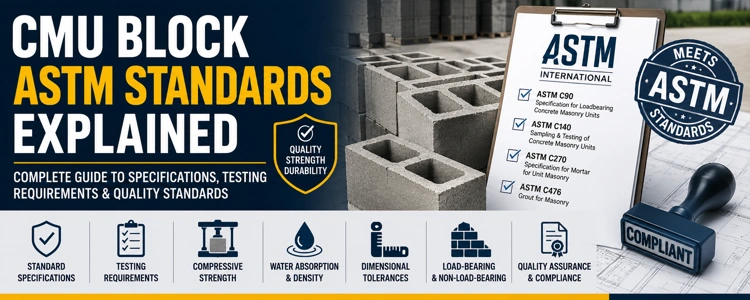
Concrete Masonry Units (CMUs) are used in residential, commercial, industrial, and infrastructure construction throughout the United States. To ensure these concrete blocks meet consistent quality, strength, durability, and dimensional requirements, manufacturers follow recognized industry standards.
One of the most widely referenced organizations in the construction industry is ASTM International, which develops technical standards for building materials, testing procedures, and manufacturing practices. ASTM standards help engineers, architects, contractors, inspectors, and manufacturers work with materials that meet established performance requirements.
If you manufacture CMU blocks, purchase concrete masonry units, or specify masonry products for construction projects, understanding ASTM standards is essential. These standards provide a common framework for evaluating block quality and ensuring products are suitable for their intended applications.
This guide explains the purpose of ASTM standards for CMU blocks, the most commonly referenced standards, and how they influence manufacturing, quality control, testing, and construction.
What Is ASTM International?
ASTM International is a globally recognized standards organization that develops voluntary technical standards for a wide range of industries, including construction, manufacturing, transportation, energy, and engineering.
Rather than manufacturing products, ASTM develops standards that describe:
- Testing methods
- Material specifications
- Quality requirements
- Performance criteria
- Inspection procedures
These standards help improve consistency, reliability, and safety across the construction industry.
Why ASTM Standards Matter for CMU Blocks
Concrete masonry units are structural building materials. Poor-quality blocks may affect wall strength, durability, fire performance, and long-term structural integrity.
Following recognized standards helps manufacturers:
- Produce consistent products
- Improve quality control
- Reduce production defects
- Increase customer confidence
- Meet project specifications
- Support compliance with building codes
For contractors and designers, ASTM standards provide confidence that the selected blocks have been manufactured and tested according to accepted industry practices.
Are ASTM Standards Required?
Many construction projects reference ASTM standards through:
- Building codes
- Engineering specifications
- Architectural drawings
- Government contracts
- Commercial project requirements
Whether a specific ASTM standard is required depends on the applicable building code, project specifications, and local regulations.
Manufacturers should always review the requirements for the projects they supply.
Common ASTM Standards Used for CMU Blocks
Several ASTM standards are frequently associated with concrete masonry units and masonry construction.
Some of the most commonly referenced include:
- ASTM C90
- ASTM C140
- ASTM C270
- ASTM C476
Each standard serves a different purpose within the manufacturing and construction process.
Understanding ASTM C90
ASTM C90 is one of the most widely recognized standards associated with load-bearing concrete masonry units.
Rather than prescribing how blocks must be manufactured, this standard establishes performance requirements that qualifying CMU products are expected to meet.
The standard addresses topics such as:
- Product classification
- Dimensional requirements
- Manufacturing tolerances
- Physical properties
- Performance criteria
Manufacturers often design their production processes and quality control systems to consistently produce blocks that satisfy these requirements.
Why ASTM C90 Is Important
ASTM C90 is frequently referenced because it helps create consistency across the industry.
Benefits include:
- More reliable construction materials
- Improved product quality
- Better compatibility between manufacturers
- Greater confidence for engineers and contractors
Instead of relying only on visual appearance, products are evaluated according to measurable performance criteria.
Understanding ASTM C140
While ASTM C90 focuses on product specifications, ASTM C140 primarily relates to testing procedures for concrete masonry units.
Manufacturers use standardized testing methods to evaluate products consistently.
Typical evaluations may include:
- Dimensional measurements
- Moisture content
- Density
- Compressive strength
- Water absorption
Using consistent testing procedures allows manufacturers to compare production batches and maintain quality control.
Why Standardized Testing Matters
Without standardized testing, two manufacturers might evaluate identical blocks using completely different methods.
Standardized procedures help ensure:
- Fair product comparison
- Reliable laboratory results
- Consistent quality evaluation
- Better manufacturing control
This improves confidence for everyone involved in the construction process.
ASTM C270 and Mortar
Concrete blocks alone do not create a masonry wall.
Mortar is equally important.
ASTM C270 provides requirements related to masonry mortar used during block construction.
Different mortar types are selected depending on:
- Structural requirements
- Weather exposure
- Project specifications
- Construction conditions
Understanding mortar selection helps improve overall wall performance.
You can also read:
CMU Mortar Mix Ratio GuideASTM C476 and Grout
Many reinforced masonry walls require grout.
ASTM C476 is commonly referenced when discussing grout used in reinforced masonry construction.
Proper grout contributes to:
- Structural reinforcement
- Load transfer
- Improved wall performance
Grout quality becomes especially important in reinforced masonry systems.
Related calculator:
CMU Grout CalculatorHow ASTM Standards Support Quality Control
Manufacturers typically incorporate ASTM requirements into their quality control systems.
This may include:
- Raw material inspection
- Production monitoring
- Laboratory testing
- Product inspection
- Documentation
- Continuous quality improvement
Following structured quality procedures helps reduce manufacturing defects.
Related guide:
CMU Block Quality Control GuideUnderstanding Compressive Strength
Compressive strength is one of the most important performance characteristics of a concrete masonry unit. It represents the ability of a CMU block to resist compressive loads without failure and plays a significant role in determining whether a block is suitable for structural applications.
During manufacturing, producers regularly monitor compressive strength to verify that their production process is operating consistently. Laboratory testing allows manufacturers to compare different production batches, evaluate changes in raw materials, and identify manufacturing issues before products reach construction sites.
Several factors influence compressive strength, including:
- Cement quality
- Aggregate grading
- Water content
- Concrete consistency
- Compaction efficiency
- Curing conditions
- Production equipment
- Quality control procedures
Rather than relying on appearance alone, manufacturers use standardized testing methods to confirm that their products achieve the desired level of structural performance.
Water Absorption and Durability
Another important characteristic evaluated during quality testing is water absorption.
Concrete masonry units naturally absorb some moisture because concrete contains microscopic pores. However, excessive absorption may reduce long-term durability in certain service conditions.
Water absorption can be influenced by:
- Mix design
- Aggregate properties
- Density
- Curing process
- Production consistency
Manufacturers carefully monitor these factors to produce blocks with predictable performance.
Proper curing, accurate batching, and consistent compaction generally improve the long-term durability of concrete masonry units.
Dimensional Tolerances
Concrete blocks must maintain consistent dimensions throughout the manufacturing process.
Even small dimensional variations may affect:
- Wall alignment
- Mortar joint thickness
- Construction speed
- Material consumption
- Overall appearance
For this reason, manufacturers regularly inspect:
- Block length
- Width
- Height
- Face shell thickness
- Web thickness
- Squareness
- Corner alignment
Routine inspections also help identify worn molds before they begin affecting production quality.
Load-Bearing and Non-Load-Bearing CMU Blocks
Not every concrete block is designed for the same application.
Some units are intended for structural walls that support building loads, while others are manufactured for partitions, architectural walls, or other non-structural purposes.
Selecting the correct type of CMU depends on:
- Structural design
- Engineering calculations
- Building code requirements
- Project specifications
Manufacturers should clearly identify product classifications so contractors can select the appropriate masonry units for each application.
Factory Quality Documentation
Successful manufacturers maintain detailed quality records throughout the production process.
Typical documentation includes:
- Raw material inspection reports
- Batch records
- Moisture measurements
- Production logs
- Machine inspection reports
- Laboratory testing results
- Maintenance records
- Corrective action reports
Maintaining organized documentation improves traceability and helps identify recurring production issues.
Production Traceability
Every production batch should be traceable.
Traceability allows manufacturers to determine:
- When a product was manufactured
- Which raw materials were used
- Which production line produced the blocks
- Which machine settings were applied
- Which quality inspections were completed
If a customer reports a problem, traceability helps identify the affected batch and investigate the root cause more efficiently.
Common Misunderstandings About ASTM Standards
Many people misunderstand the purpose of ASTM standards.
Some believe ASTM standards tell manufacturers exactly how to make concrete blocks.
In reality, ASTM standards generally establish performance requirements and standardized testing procedures rather than prescribing every manufacturing step.
Manufacturers remain responsible for developing suitable production methods that consistently produce products meeting the required performance criteria.
Why ASTM Compliance Benefits Everyone
Following recognized industry standards benefits every participant in the construction process.
Manufacturers
- More consistent production
- Improved quality control
- Better customer confidence
- Reduced production defects
Contractors
- Reliable products
- Easier installation
- More predictable performance
Engineers
- Greater confidence during structural design
- Standardized product expectations
Building Owners
- Durable masonry construction
- Long-term structural reliability
- Reduced maintenance concerns
Relationship Between ASTM Standards and Quality Control
ASTM standards and quality control work together.
Standards establish the performance expectations, while quality control ensures those expectations are achieved consistently during manufacturing.
An effective quality system normally includes:
- Incoming material inspection
- Production monitoring
- Equipment maintenance
- Laboratory testing
- Finished product inspection
- Documentation
- Continuous improvement
This systematic approach helps manufacturers produce reliable concrete masonry units over the long term.
Practical ASTM Compliance Checklist for CMU Manufacturers
Meeting ASTM requirements is not achieved through a single inspection or laboratory test. It requires a consistent quality management process that begins before production and continues until finished blocks are delivered to customers.
Manufacturers can improve consistency by following a structured inspection checklist during every production shift.
A typical compliance checklist includes:
- Approved raw materials received
- Cement stored in dry conditions
- Aggregates free from contamination
- Moisture content verified
- Mix design confirmed
- Batching equipment calibrated
- Mixing time monitored
- Machine inspection completed
- Mold condition verified
- Vibration system operating correctly
- Hydraulic pressure checked
- Fresh blocks inspected
- Curing process monitored
- Finished products tested
- Production records updated
Using the same checklist every day helps reduce production variability and improves overall manufacturing quality.
Best Practices for Maintaining Consistent Quality
Successful CMU manufacturers understand that consistency is more valuable than occasional high-quality production.
Some of the most effective quality management practices include:
Train Production Staff
Every machine operator should understand:
- Material handling
- Proper batching
- Concrete consistency
- Machine settings
- Daily inspections
Well-trained employees reduce production errors.
Inspect Equipment Regularly
Production equipment should never be repaired only after failure.
Preventive maintenance helps maintain:
- Consistent vibration
- Hydraulic pressure
- Mold alignment
- Production speed
Reliable equipment produces reliable blocks.
Monitor Every Production Batch
Instead of inspecting only finished products, quality should be monitored throughout production.
Regular monitoring helps identify small problems before they become expensive defects.
Review Customer Feedback
Customer complaints often identify production issues that may not appear during factory inspections.
Manufacturers should document feedback and investigate recurring problems.
Continuous improvement is one of the most valuable quality management tools.
Common Quality Mistakes Manufacturers Should Avoid
Even experienced manufacturers occasionally experience production problems.
Some of the most common mistakes include:
Using Low-Quality Raw Materials
Poor aggregates, contaminated sand, or old cement may reduce product quality before production even begins.
Incorrect Moisture Content
Concrete that is too wet or too dry affects:
- Block strength
- Surface finish
- Dimensional accuracy
- Compaction quality
Moisture should be adjusted according to aggregate conditions.
Poor Mold Maintenance
Worn molds can produce:
- Uneven dimensions
- Rough edges
- Surface defects
Regular mold inspection improves consistency.
Skipping Quality Documentation
Without production records, identifying recurring problems becomes much more difficult.
Documentation supports long-term process improvement.
Ignoring Preventive Maintenance
Waiting until equipment fails often results in:
- Production downtime
- Increased repair costs
- Product inconsistency
Routine maintenance is usually less expensive than emergency repairs.
How ASTM Standards Improve Customer Confidence
Construction projects depend on reliable building materials.
When manufacturers follow recognized industry standards and maintain strong quality control systems, contractors and engineers gain greater confidence in the products they purchase.
Reliable production benefits everyone involved in the project by reducing delays, minimizing defects, and supporting long-term structural performance.
Although no manufacturing process is completely free from variation, a disciplined quality management system helps produce more consistent concrete masonry units over time.
Related Calculators
- CMU Block Calculator
- CMU Material Cost Calculator
- CMU Labor Cost Calculator
- CMU Grout Calculator
- CMU Wall Area Calculator
- CMU Construction Cost Per Square Foot
Related Articles
- Complete CMU Block Production Guide
- CMU Block Quality Control Guide
- How to Start a CMU Block Business in USA
- CMU Block Business Profit Margin
- How to Price CMU Wall Jobs
- CMU Construction Cost Per Square Foot
Frequently Asked Questions
What is the purpose of ASTM standards for CMU blocks?
ASTM standards provide recognized specifications and standardized testing methods that help manufacturers produce consistent, reliable concrete masonry units and allow engineers, contractors, and inspectors to evaluate product performance using common criteria.
Do ASTM standards explain how to manufacture CMU blocks?
Not necessarily. ASTM standards generally establish performance requirements and testing procedures rather than prescribing a specific manufacturing process. Manufacturers are responsible for developing production methods that consistently achieve the required performance.
Why is ASTM C90 commonly referenced?
ASTM C90 is widely referenced because it provides performance requirements for load-bearing concrete masonry units and is commonly specified in construction projects throughout the United States.
How does quality control support ASTM compliance?
Quality control includes inspecting raw materials, monitoring production, testing finished products, maintaining equipment, and documenting results. These practices help manufacturers consistently produce blocks that meet project requirements.
Are ASTM standards only important for manufacturers?
No. Architects, engineers, contractors, inspectors, and project owners also benefit from understanding ASTM standards because they support better material selection, quality assurance, and construction performance.
Final Thoughts
ASTM standards play an important role in the concrete masonry industry by providing a common framework for evaluating the quality and performance of CMU blocks. Combined with an effective quality control program, these standards help manufacturers produce reliable products while giving contractors, engineers, and project owners greater confidence in the materials used on their projects.
Rather than viewing ASTM standards as a regulatory obstacle, manufacturers can use them as a practical tool for improving production consistency, reducing defects, strengthening customer relationships, and supporting long-term business growth.