
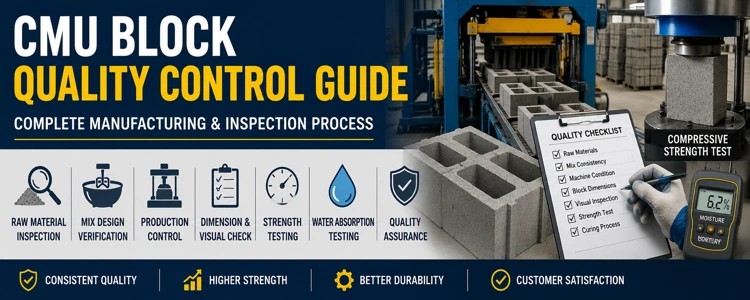
Quality control is one of the most important aspects of CMU (Concrete Masonry Unit) manufacturing. Even with modern machinery and experienced operators, poor quality control can result in weak concrete blocks, customer complaints, project delays, and increased production costs.
Successful CMU manufacturers understand that quality is not something inspected only after production—it begins before the first batch of concrete is mixed. Every stage, from selecting raw materials to curing finished blocks, affects the strength, durability, appearance, and dimensional accuracy of the final product.
Whether you operate a small block plant or a fully automated manufacturing facility, implementing a structured quality control process helps improve product consistency, reduce waste, and meet customer expectations.
This guide explains the complete quality control system used during CMU block production and highlights the inspections that should be performed throughout the manufacturing process.
What Is Quality Control in CMU Manufacturing?
Quality control is the process of monitoring, inspecting, and testing materials and production activities to ensure that every concrete masonry unit meets the required quality standards.
A quality control system helps manufacturers:
- Produce consistent blocks
- Reduce defective products
- Improve compressive strength
- Minimize production waste
- Increase customer satisfaction
- Maintain manufacturing efficiency
Quality control is a continuous process rather than a single inspection at the end of production.
Why Quality Control Is Important
Poor quality blocks can create serious problems during construction.
Common issues include:
- Cracked blocks
- Broken corners
- Uneven dimensions
- Poor wall alignment
- Low compressive strength
- High water absorption
- Customer complaints
- Increased warranty costs
Maintaining strict quality control protects both the manufacturer and the customer.
Establish Quality Standards Before Production
Every factory should develop written quality standards before production begins.
These standards normally define:
- Raw material specifications
- Mix design
- Production procedures
- Inspection methods
- Acceptance criteria
- Testing frequency
Having documented procedures improves consistency between production shifts.
Raw Material Inspection
Quality control begins with incoming raw materials.
Every delivery should be inspected before entering production.
Portland Cement Inspection
Inspect:
- Manufacturing date
- Storage condition
- Moisture damage
- Bag condition
- Supplier certification
Old or moisture-damaged cement may reduce block strength.
Sand Inspection
Quality sand should be:
- Clean
- Well graded
- Free from clay
- Free from organic materials
Dirty sand affects both strength and appearance.
Aggregate Inspection
Aggregates should be checked for:
- Particle size
- Cleanliness
- Moisture
- Contamination
- Consistent grading
Well-graded aggregates improve block density and reduce voids.
Water Quality Inspection
Only clean water should be used during production.
Avoid water contaminated with:
- Oil
- Chemicals
- Salt
- Organic materials
Poor water quality may affect cement hydration.
Material Storage Inspection
Even good materials become poor materials when stored incorrectly.
Inspect storage areas for:
- Moisture exposure
- Dirt contamination
- Water leakage
- Stock rotation
- Proper labeling
Good storage practices help maintain consistent production quality.
Mix Design Verification
Before production begins, verify that the approved mix design is being used.
Check:
- Cement quantity
- Aggregate ratio
- Water content
- Admixture dosage
- Pigment quantity
Unauthorized changes in mix design often create inconsistent blocks.
Moisture Control
Moisture content should be monitored continuously.
Aggregate moisture changes because of:
- Rain
- Humidity
- Storage conditions
Manufacturers often adjust added water according to aggregate moisture.
Proper moisture control improves:
- Density
- Surface finish
- Strength
- Dimensional stability
Batching Accuracy
Batching errors are one of the most common causes of inconsistent block quality.
Inspect:
- Batch weights
- Scale calibration
- Material sequence
- Automatic batching system
Even small batching errors may reduce block performance.
Mixing Inspection
Concrete should be mixed until all ingredients become uniform.
Inspect:
- Mixing time
- Concrete consistency
- Color uniformity
- Moisture distribution
Poor mixing creates weak zones inside concrete blocks.
Concrete Consistency Inspection
CMU blocks require low-slump concrete.
Inspect:
- Workability
- Moisture
- Cohesion
- Uniform appearance
Concrete should not be:
- Too dry
- Too wet
- Segregated
Proper consistency improves molding quality.
Machine Inspection Before Production
Production equipment should be inspected every day.
Check:
- Hydraulic pressure
- Vibrators
- Mold alignment
- Oil leakage
- Conveyor operation
- Safety systems
Machine problems often appear before quality problems.
Mold Inspection
The mold determines the final shape of every block.
Inspect molds for:
- Wear
- Cracks
- Damage
- Alignment
- Cleanliness
Worn molds may produce blocks with incorrect dimensions.
Vibration System Inspection
Proper vibration removes trapped air and improves density.
Inspect:
- Vibration frequency
- Duration
- Machine performance
Insufficient vibration may produce weak blocks.
Excessive vibration may cause segregation.
Compaction Inspection
Hydraulic compaction should be checked regularly.
Inspect:
- Pressure settings
- Block density
- Surface finish
- Edge quality
Proper compaction creates stronger, more durable blocks.
Fresh Block Inspection
Immediately after demolding, inspect fresh blocks for:
- Shape
- Corner condition
- Surface defects
- Honeycombing
- Collapse
- Cracks
Problems found at this stage often indicate issues with moisture or machine settings.
Pallet Inspection
Production pallets should remain clean and level.
Inspect for:
- Warping
- Damage
- Surface cleanliness
Damaged pallets may deform freshly produced blocks.
as we discussed above, quality planning, raw material inspection, batching, mixing, machine inspection, mold condition, vibration, compaction, and fresh block inspection.
Once a block has been successfully manufactured, quality control does not stop. The next stages—curing, testing, dimensional inspection, documentation, and continuous improvement—are equally important. Even blocks that appear visually perfect may fail strength or durability tests if proper quality procedures are not followed.
This section explains the inspections and quality assurance practices used after block production.
Curing Inspection
Curing is one of the most important stages in CMU manufacturing.
During curing, cement continues to hydrate, allowing the block to develop strength and durability.
Quality inspectors should monitor:
- Temperature
- Humidity
- Curing time
- Moisture retention
- Block handling
Improper curing may result in:
- Surface cracking
- Reduced strength
- Higher water absorption
- Uneven color
- Poor long-term durability
Every production batch should follow a consistent curing schedule.
Dimensional Accuracy Inspection
Concrete masonry units must maintain consistent dimensions throughout production.
Inspectors should verify:
- Length
- Width
- Height
- Face shell thickness
- Web thickness
- Squareness
- Corner alignment
Even small dimensional variations can create problems during wall construction.
Incorrect dimensions may cause:
- Uneven mortar joints
- Poor wall alignment
- Slower installation
- Increased material consumption
Routine dimensional inspections help identify mold wear before it becomes a larger production issue.
Surface Appearance Inspection
Visual inspection helps detect manufacturing problems before products reach customers.
Inspect every production batch for:
- Surface cracks
- Honeycombing
- Air voids
- Broken corners
- Chips
- Rough edges
- Color inconsistency
- Surface contamination
Products with visible defects should be separated for further evaluation.
Density Inspection
Density plays an important role in block strength and durability.
Manufacturers commonly compare block weight with production specifications to ensure consistency.
Unexpected density changes may indicate:
- Incorrect batching
- Moisture variation
- Poor compaction
- Aggregate inconsistency
Maintaining consistent density improves product performance.
Compressive Strength Testing
One of the most important quality tests for CMU blocks is compressive strength testing.
This test measures how much load a concrete masonry unit can withstand before failure.
Manufacturers perform compressive strength testing to:
- Verify production quality
- Monitor consistency
- Meet customer specifications
- Improve process control
Testing is normally performed using laboratory compression testing equipment under controlled conditions.
If results fall below expected values, manufacturers should investigate:
- Mix design
- Cement quality
- Moisture control
- Compaction pressure
- Curing conditions
Water Absorption Testing
Water absorption affects long-term durability.
Blocks with excessive absorption may experience reduced performance in certain environments.
Quality inspections typically evaluate:
- Moisture absorption
- Drying characteristics
- Surface quality
Proper curing and a well-designed concrete mix generally improve durability.
Block Weight Verification
Random blocks should be weighed throughout production.
Unexpected weight differences may indicate:
- Material variation
- Inconsistent batching
- Moisture changes
- Density problems
Tracking block weight helps identify production issues early.
Batch Identification System
Every production batch should receive a unique identification number.
Typical production records include:
- Date
- Time
- Machine number
- Operator
- Mix design
- Raw material source
- Batch number
Traceability allows manufacturers to investigate quality issues quickly if problems occur later.
Production Documentation
Successful factories maintain detailed production records.
Documentation may include:
- Material delivery reports
- Batch reports
- Machine inspection logs
- Quality inspection reports
- Laboratory test results
- Maintenance records
- Customer complaints
- Corrective actions
Accurate documentation supports continuous quality improvement.
Quality Audit Checklist
Many manufacturers perform routine internal quality audits.
Typical inspection checklist:
✅ Raw materials approved
✅ Mix design verified
✅ Moisture checked
✅ Batch weights confirmed
✅ Machine inspected
✅ Mold cleaned
✅ Vibration verified
✅ Hydraulic pressure checked
✅ Fresh blocks inspected
✅ Curing monitored
✅ Finished blocks inspected
✅ Documentation completed
Using a standardized checklist reduces the risk of missing important inspections.
Root Cause Analysis
When quality problems occur, manufacturers should investigate the underlying cause instead of only correcting the defective blocks.
Typical root causes include:
- Incorrect batching
- Poor moisture control
- Worn molds
- Machine malfunction
- Low-quality materials
- Inadequate curing
- Operator error
Finding the true cause helps prevent future defects.
Continuous Quality Improvement
Quality control should be viewed as an ongoing process.
Manufacturers can improve quality by:
- Reviewing production data
- Training employees
- Updating procedures
- Improving machine maintenance
- Monitoring customer feedback
- Testing materials regularly
Small improvements implemented consistently often produce significant long-term benefits.
Common Quality Problems and Possible Causes
| Quality Issue | Possible Cause |
|---|---|
| Surface cracks | Improper curing or excess moisture loss |
| Honeycombing | Poor vibration or insufficient compaction |
| Broken corners | Rough handling or damaged pallets |
| Low strength | Incorrect mix design or inadequate curing |
| Uneven dimensions | Mold wear or machine misalignment |
| Color variation | Inconsistent pigment or moisture content |
| Rough surface | Poor concrete consistency |
| Excessive absorption | Weak mix design or poor curing |
This type of troubleshooting guide helps production teams respond quickly to quality issues.
Building a Quality Culture
The most successful CMU manufacturers understand that quality is everyone’s responsibility.
Management, supervisors, machine operators, maintenance staff, and quality inspectors all contribute to the final product.
Creating a quality-focused workplace encourages:
- Better communication
- Fewer production errors
- Improved customer satisfaction
- Reduced waste
- Higher productivity
Quality should become part of the factory culture rather than simply a department.
Related Calculators
- CMU Block Calculator
- CMU Material Cost Calculator
- CMU Labor Cost Calculator
- CMU Grout Calculator
- CMU Construction Cost Per Square Foot
- How to Price CMU Wall Jobs
Related Articles
- Complete CMU Block Production Guide
- How to Start a CMU Block Business in USA
- CMU Block Business Profit Margin
- CMU Construction Cost Per Square Foot
- CMU Mortar Mix Ratio Guide
- How to Price CMU Wall Jobs
Frequently Asked Questions
Why is quality control important in CMU manufacturing?
Quality control helps ensure that every block meets the required standards for strength, durability, dimensions, and appearance while reducing waste and customer complaints.
What is the most critical stage of quality control?
Quality control starts before production with raw material inspection and continues through batching, mixing, molding, curing, testing, and final inspection.
How often should quality inspections be performed?
Routine inspections should be carried out throughout every production shift, with additional laboratory testing performed according to the manufacturer’s quality program and applicable project requirements.
What should manufacturers do when defects are found?
Defective products should be isolated, the root cause investigated, and corrective actions implemented before production continues.
Final Thoughts
A strong quality control system is essential for producing reliable CMU blocks. Consistent inspections, proper documentation, regular testing, preventive maintenance, and continuous process improvement help manufacturers deliver products that meet customer expectations and support long-term business success.
Quality should never be treated as the final step in production. It begins with selecting the right raw materials and continues through every stage of manufacturing until the finished blocks are delivered to the customer.