
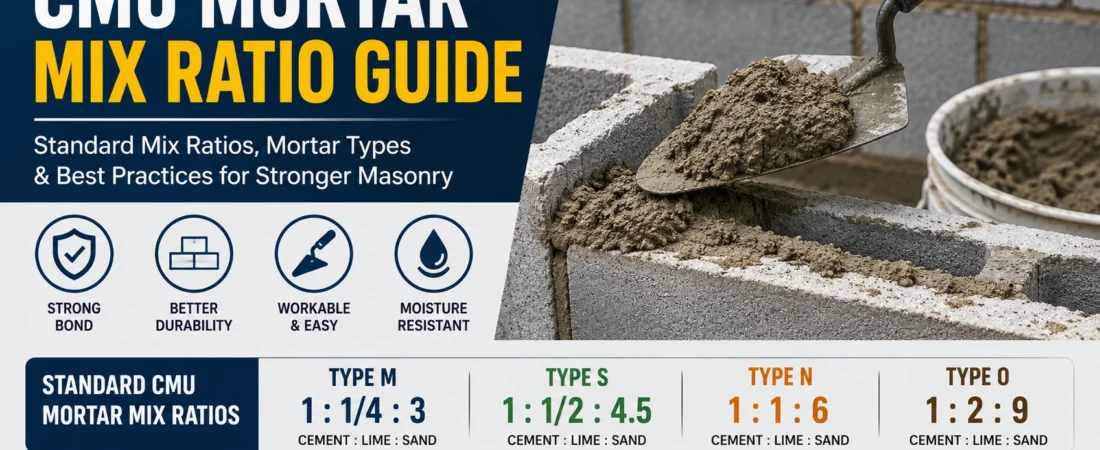
Concrete masonry unit (CMU) walls depend heavily on proper mortar selection and mixing quality. Even when high-quality blocks are used, poor mortar ratios may reduce wall strength, increase cracking, and affect long-term durability.
Choosing the correct CMU mortar mix ratio helps improve bonding, workability, moisture resistance, and overall construction performance.
In this guide, you will learn standard CMU mortar ratios, mortar types, how mortar differs from grout, common mistakes, mixing recommendations, and practical construction considerations.
What Is CMU Mortar?
CMU mortar is a construction material used to bond concrete masonry units together.
Mortar typically consists of:
- Portland cement
- Hydrated lime
- Sand
- Water
Its purpose is to create strong joints between concrete blocks and transfer loads throughout the wall.
Mortar does not fill internal block cavities. Instead, it creates bonding between masonry units.
Mortar performance affects:
- Structural stability
- Crack resistance
- Moisture control
- Construction quality
Why Mortar Mix Ratio Matters in CMU Construction
Many people focus only on block quality, but mortar quality also plays an important role.
Using the correct ratio helps improve:
Better Bond Strength
Proper mortar improves adhesion between blocks.
Improved Workability
Workers can install blocks faster and more accurately.
Better Durability
Correct mortar may reduce premature deterioration.
Improved Water Resistance
Balanced mortar reduces excessive moisture movement.
More Consistent Construction Quality
Consistent mixing improves overall wall performance.
Standard CMU Mortar Mix Ratios
Different projects require different mortar strengths.
Common mortar ratios include:
| Mortar Type | Cement | Lime | Sand |
|---|---|---|---|
| Type M | 1 | ¼ | 3 |
| Type S | 1 | ½ | 4.5 |
| Type N | 1 | 1 | 6 |
| Type O | 1 | 2 | 9 |
Ratio order:
Cement : Lime : Sand
Actual project requirements should always follow engineering specifications.
Type M Mortar for CMU Walls
Type M mortar is generally considered one of the strongest traditional mortar options.
Common uses:
- Foundation walls
- Retaining walls
- Heavy-load applications
- Below-grade masonry
Advantages:
- Higher compressive strength
- Good load support
Limitations:
- Lower flexibility
- Less workability
Type S Mortar for CMU Construction
Type S mortar is one of the most commonly selected mortar types for concrete masonry construction.
Common applications:
- Exterior walls
- Structural walls
- Commercial masonry
- Retaining walls
Advantages:
- Good bond performance
- Better durability
- Suitable for many climates
For many CMU projects, Type S becomes a practical choice.
Type N Mortar for Residential Masonry
Type N mortar is commonly used where extreme strength is not required.
Typical applications:
- Residential walls
- Above-grade construction
- Decorative masonry
Advantages:
- Easier installation
- Balanced performance
Type O Mortar for Repair Applications
Type O mortar is typically used where lower strength is acceptable.
Common uses:
- Interior walls
- Repair work
- Restoration projects
It generally provides lower structural capacity.
Mortar vs Grout for CMU Walls
These materials are often confused.
Mortar
Used:
- Between block joints
Purpose:
- Bonding
Grout
Used:
- Inside block cavities
Purpose:
- Reinforcement support
Many reinforced masonry systems use both.
You can also use:
CMU Grout CalculatorHow to Mix Mortar for CMU Walls
Although exact procedures vary, a common process includes:
Step 1 — Prepare Dry Materials
Measure cement, lime, and sand.
Step 2 — Blend Materials
Mix until color becomes consistent.
Step 3 — Add Water Gradually
Avoid adding excessive water.
Step 4 — Continue Mixing
Stop once workable consistency develops.
Consistency matters more than speed.
Factors That Affect Mortar Performance
Several variables influence final mortar quality.
Sand Quality
Poor sand may reduce bond performance.
Water Content
Too much water may weaken mortar.
Weather Conditions
Temperature affects curing behavior.
Mixing Time
Uneven mixing may create weak areas.
Material Storage
Moisture exposure may affect performance.
Common Mortar Mixing Mistakes
Many masonry issues happen because of mixing errors.
Avoid:
- Excess water
- Incorrect proportions
- Dirty materials
- Reusing hardened mortar
- Poor consistency
These mistakes may reduce wall performance.
How Mortar Strength Affects CMU Walls
Mortar selection impacts:
- Wall durability
- Joint performance
- Structural behavior
- Moisture resistance
Stronger mortar is not always the best choice.
The selected mortar should match project requirements.
Mortar and Construction Cost
Mortar selection also influences project budgeting.
Costs may vary depending on:
- Material quantities
- Labor requirements
- Wall dimensions
You can also use:
CMU Material Cost Calculatorand
CMU Labor Cost CalculatorTips for Better CMU Mortar Results
Contractors commonly recommend:
- Measure materials accurately
- Use clean water
- Maintain consistent mixing
- Follow specifications
- Estimate quantities before starting
Proper preparation improves final quality.
Common Applications of CMU Mortar
Mortar is commonly used in:
- Foundation walls
- Basement walls
- Structural walls
- Commercial construction
- Residential masonry
You can also read:
CMU Foundation Wall GuideRelated Calculators
- Mortar Calculator
- CMU Block Calculator
- CMU Material Cost Calculator
- CMU Labor Cost Calculator
- CMU Wall Area Calculator
Related Articles
- What Is a CMU Block?
- CMU Wall Thickness Guide
- CMU Wall Waterproofing Guide
- CMU Grout Calculator
- CMU Wall Weight Calculator
Frequently Asked Questions
What is the most common mortar for CMU?
Type S mortar is commonly selected for many masonry projects.
Is mortar stronger than grout?
They serve different purposes and are not direct replacements.
Does water affect mortar performance?
Water quantity influences consistency and final quality.
Can incorrect ratios weaken walls?
Improper mixing may reduce durability and bonding.
Final Thoughts
Selecting the correct CMU mortar mix ratio improves bonding, durability, and construction efficiency. Understanding mortar types and mixing methods supports better planning and long-term masonry performance.