
When working with concrete masonry units (CMU blocks), one of the most confusing topics for beginners is:
nominal vs actual dimensions
Many people notice that a:
“8x8x16 CMU block”
does not actually measure exactly:
8 inches × 8 inches × 16 inches
Understanding this difference is important for:
- Wall layout
- Construction planning
- Material estimation
- Mortar joint spacing
- Architectural drawings
- Structural accuracy
In this guide, you will learn the difference between nominal and actual CMU dimensions, why the sizes differ, and how concrete block measurements work in construction.
What Are Nominal Dimensions?
Nominal dimensions
refer to:
the rounded block size including mortar joints
Nominal dimensions are commonly used for:
- Construction drawings
- Estimation
- Wall layout
- Architectural plans
For example:
A:
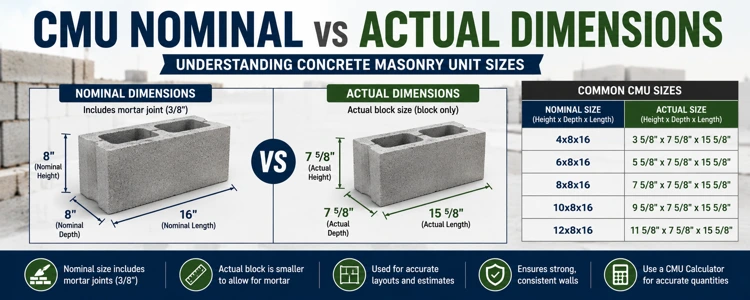
nominal 8x8x16 CMU block
is designed to fit within a wall system measuring:
- 8 inches high
- 8 inches deep
- 16 inches long
INCLUDING the mortar joint thickness.
What Are Actual Dimensions?
Actual dimensions
refer to:
the real physical size of the concrete block itself
Actual dimensions are slightly smaller to allow room for:
- Mortar joints
- Proper alignment
- Construction tolerances
For example:
An:
8x8x16 CMU block
usually has actual dimensions close to:
7 5/8″ × 7 5/8″ × 15 5/8″
Why CMU Blocks Are Smaller Than Nominal Size
Concrete blocks are intentionally manufactured smaller so that:
mortar joints complete the nominal size
Standard mortar joints are typically:
3/8 inch thick
When mortar is added:
- The block + mortar joint
= nominal dimensions
This helps create:
- Uniform wall dimensions
- Easier layout planning
- Consistent construction spacing
Nominal vs Actual CMU Dimensions Chart
| Nominal CMU Size | Actual CMU Size |
|---|---|
| 4x8x16 | 3 5/8″ × 7 5/8″ × 15 5/8″ |
| 6x8x16 | 5 5/8″ × 7 5/8″ × 15 5/8″ |
| 8x8x16 | 7 5/8″ × 7 5/8″ × 15 5/8″ |
| 10x8x16 | 9 5/8″ × 7 5/8″ × 15 5/8″ |
| 12x8x16 | 11 5/8″ × 7 5/8″ × 15 5/8″ |
These measurements may vary slightly by manufacturer.
Why Understanding CMU Dimensions Matters
Knowing the difference between nominal and actual sizes helps with:
- Accurate wall layouts
- Material estimation
- Structural planning
- Reinforcement spacing
- Construction accuracy
Incorrect measurements can cause:
- Alignment problems
- Estimation errors
- Construction delays
Mortar Joint Thickness
Standard mortar joints are usually:
3/8 inch
This joint thickness allows:
- Proper bonding
- Structural stability
- Dimensional consistency
Mortar joints help CMU walls maintain:
- Uniform spacing
- Correct wall dimensions
- Better structural performance
You can estimate mortar quantities using the:
Mortar CalculatorMost Common CMU Block Size
The:
8x8x16 CMU block
is one of the most commonly used concrete masonry units.
It is widely used for:
- Residential walls
- Commercial buildings
- Foundations
- Structural masonry
You can also read:
8x8x16 CMU Block DimensionsNominal Dimensions in Construction Drawings
Architects and engineers usually use:
nominal dimensions
on:
- Blueprints
- Structural drawings
- Construction documents
This simplifies:
- Layout calculations
- Modular wall design
- Masonry coordination
Builders understand that:
actual block sizes will be slightly smaller.
CMU Modular Construction
CMU blocks are manufactured using:
modular sizing principles
This helps:
- Simplify construction
- Improve wall alignment
- Reduce cutting requirements
- Increase installation efficiency
Modular sizing is one reason concrete masonry remains popular in modern construction.
CMU Wall Thickness and Dimensions
Wall thickness is usually based on:
nominal block width
For example:
- 8-inch CMU wall
- 12-inch CMU wall
- 6-inch CMU wall
Actual wall thickness is slightly smaller before mortar application.
You can also read:
CMU Wall Thickness GuideCMU Weight and Dimensions
Larger blocks generally:
- Weigh more
- Require more mortar
- Increase structural load
You can also read:
CMU Block Weight GuideCommon Mistakes With CMU Dimensions
Many beginners mistakenly assume:
nominal dimensions equal actual dimensions
This can create problems with:
- Wall spacing
- Openings
- Material estimation
- Reinforcement layout
Always verify:
- Manufacturer specifications
- Actual block measurements
- Mortar joint thickness
before construction begins.
Use a CMU Block Calculator
Before starting masonry construction, it is important to estimate:
- Block quantities
- Mortar requirements
- Material costs
- Wall dimensions
Our:
CMU Block Calculatorhelps estimate:
- Concrete block quantities
- Mortar requirements
- Material costs
- Wall coverage
You can also use:
for additional construction estimation.
Related Articles
- 8x8x16 CMU Block Dimensions
- CMU Wall Thickness Guide
- CMU Block Weight Guide
- CMU Compressive Strength Guide
- CMU Block Density Guide
- What Is a CMU Block?
Final Thoughts
Understanding CMU nominal vs actual dimensions is essential for accurate masonry construction and material estimation. Concrete blocks are intentionally manufactured smaller than their nominal size to allow room for mortar joints and modular wall alignment.
Knowing the difference helps builders, contractors, and homeowners improve construction accuracy, wall layout planning, and project efficiency.