
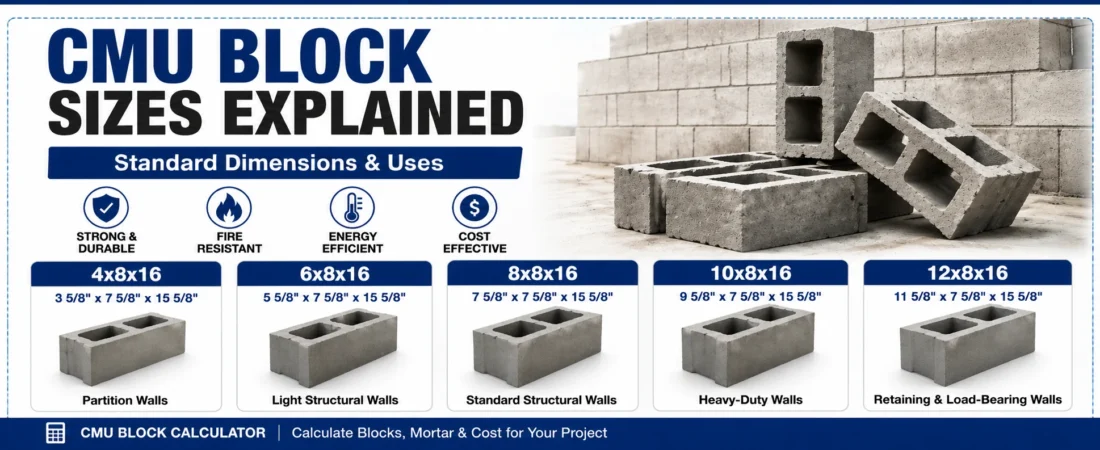
Concrete Masonry Units (CMU blocks) are one of the most commonly used building materials in residential, commercial, and industrial construction projects across the United States. Choosing the correct CMU block size is important because it affects wall strength, construction cost, material quantity, and structural performance.
In this guide, we will explain the most common CMU block sizes, their dimensions, uses, and how to choose the right block for your project.
What Is a CMU Block?
A CMU block, also called a concrete masonry unit, is a rectangular concrete block used for constructing walls, foundations, partitions, retaining walls, and structural masonry systems.
CMU blocks are durable, fire-resistant, and cost-effective, making them a popular choice for builders and contractors.
Standard CMU Block Dimensions
In the United States, the most common standard CMU block dimensions are based on nominal sizes.
The actual block dimensions are usually slightly smaller to allow room for mortar joints.
Common CMU Block Sizes
| Nominal Size | Actual Size | Common Uses |
|---|---|---|
| 4x8x16 | 3 5/8″ x 7 5/8″ x 15 5/8″ | Partition walls |
| 6x8x16 | 5 5/8″ x 7 5/8″ x 15 5/8″ | Light structural walls |
| 8x8x16 | 7 5/8″ x 7 5/8″ x 15 5/8″ | Standard structural walls |
| 10x8x16 | 9 5/8″ x 7 5/8″ x 15 5/8″ | Heavy-duty walls |
| 12x8x16 | 11 5/8″ x 7 5/8″ x 15 5/8″ | Retaining and load-bearing walls |
Most Common CMU Block Size
The most widely used CMU block size is:
8x8x16 CMU Block
This block is commonly used for:
- Exterior walls
- Foundations
- Commercial buildings
- Structural masonry walls
- Garage walls
- Load-bearing construction
Builders prefer this size because it provides a strong balance between strength, durability, and cost efficiency.
4-Inch CMU Blocks
4-inch blocks are thinner and lighter than standard blocks.
These blocks are mainly used for:
- Interior partitions
- Non-load-bearing walls
- Fence walls
- Decorative structures
Because they are lightweight, installation is faster and easier.
6-Inch CMU Blocks
6-inch concrete blocks provide more strength than 4-inch blocks while remaining relatively lightweight.
These blocks are commonly used in:
- Residential walls
- Small commercial projects
- Exterior partitions
- Reinforced masonry walls
8-Inch CMU Blocks
8-inch CMU blocks are the industry standard for structural masonry.
Advantages include:
- High durability
- Better load-bearing capacity
- Improved fire resistance
- Long lifespan
- Excellent structural stability
These blocks are commonly used in schools, warehouses, commercial buildings, and residential foundations.
12-Inch CMU Blocks
12-inch concrete blocks are larger and heavier.
They are commonly used for:
- Retaining walls
- Industrial structures
- High-load walls
- Reinforced concrete masonry systems
These blocks provide greater strength and insulation compared to smaller block sizes.
Hollow vs Solid CMU Blocks
CMU blocks may be:
- Hollow
- Solid
Hollow CMU Blocks
These blocks contain voids or cores that reduce weight and improve insulation.
Benefits include:
- Easier handling
- Reduced material usage
- Better reinforcement options
Solid CMU Blocks
Solid blocks are heavier and stronger.
They are often used for:
- Retaining structures
- High-strength applications
- Foundations
How to Choose the Right CMU Block Size
Selecting the correct CMU block size depends on several factors:
1. Wall Purpose
Load-bearing walls require larger and stronger blocks.
2. Structural Requirements
Commercial and industrial projects often require thicker blocks.
3. Insulation Needs
Larger blocks may provide better thermal performance.
4. Budget
Smaller blocks are usually cheaper and easier to install.
5. Local Building Codes
Always check local construction regulations before selecting masonry units.
CMU Block Weight
The weight of a CMU block depends on:
- Size
- Density
- Material type
- Hollow or solid construction
An 8x8x16 hollow CMU block typically weighs between:
30–35 pounds
Solid blocks can weigh significantly more.
Benefits of CMU Blocks
CMU blocks offer several advantages in construction:
- Fire resistance
- Long-term durability
- Low maintenance
- Structural strength
- Energy efficiency
- Pest resistance
- Cost-effectiveness
Because of these benefits, concrete masonry remains one of the most reliable construction materials in modern building projects.
CMU Block Applications
Concrete masonry units are used in:
- Residential homes
- Commercial buildings
- Schools
- Warehouses
- Retaining walls
- Foundations
- Boundary walls
- Industrial facilities
Their versatility makes them suitable for both small and large-scale construction projects.
Final Thoughts
Understanding standard CMU block sizes is essential for accurate construction planning, material estimation, and structural performance.
The 8x8x16 CMU block remains the most common choice for structural walls, while smaller and larger sizes are selected based on project requirements.
Choosing the correct concrete block size can improve durability, reduce construction costs, and simplify installation.
For accurate material estimation, use our online CMU Block Calculator to quickly calculate concrete blocks, mortar requirements, and masonry project costs.