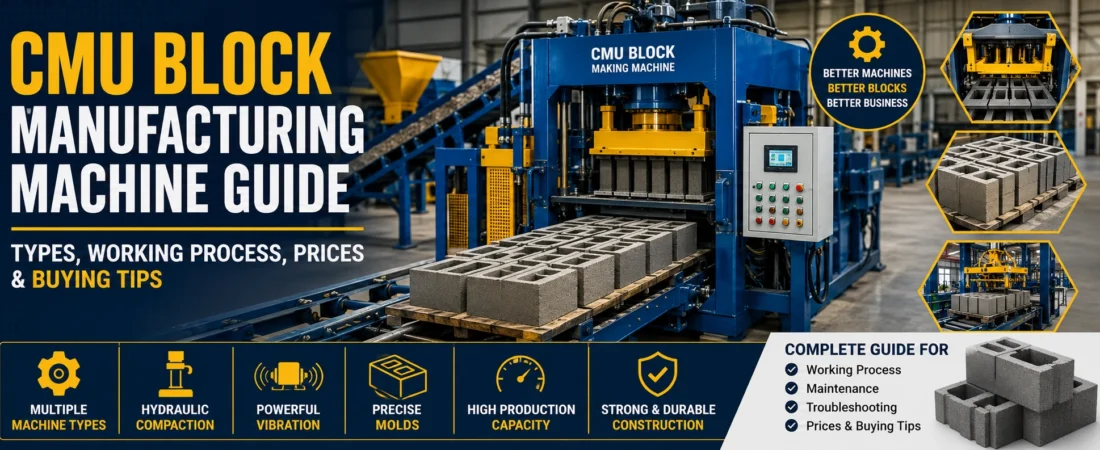
Manufacturing high-quality Concrete Masonry Units (CMUs) requires meore than a good mix design. The machine used to produce the blocks plays a critical role in determining their strength, dimensional accuracy, production speed, and overall quality. Whether you operate a small startup or a large-scale manufacturing plant, choosing the right CMU block manufacturing machine can significantly improve efficiency, reduce labor costs, and ensure consistent production.
Modern block-making machines use hydraulic pressure, vibration, and precision molds to produce thousands of concrete blocks every day. These machines are capable of manufacturing a wide range of products, including hollow blocks, solid blocks, partition blocks, interlocking pavers, retaining wall units, and decorative concrete products.
In this comprehensive guide, you’ll learn how CMU block manufacturing machines work, the different machine types available, their key components, production capacity, maintenance requirements, buying considerations, and best practices for maximizing productivity.
What Is a CMU Block Manufacturing Machine?
A CMU block manufacturing machine is specialized equipment designed to compress and mold a concrete mixture into uniform concrete masonry units (CMUs). These machines automate much of the block production process, improving accuracy, production speed, and product consistency compared to manual manufacturing methods.
Most modern machines combine controlled vibration and hydraulic compression to remove air pockets and compact the concrete mix inside steel molds. This process produces dense, durable blocks with consistent dimensions that meet construction industry standards.
The type of machine you choose depends on several factors, including:
- Production volume
- Factory size
- Available budget
- Labor availability
- Desired level of automation
- Types of concrete blocks being manufactured
Why Machine Quality Matters
A block manufacturing machine is one of the largest investments for any concrete masonry business. While raw materials influence concrete strength, the machine determines how consistently those materials are compressed into finished blocks.
High-quality machines provide:
- Uniform block dimensions
- Better edge and corner definition
- Higher compressive strength
- Lower rejection rates
- Faster production cycles
- Reduced material waste
- Longer equipment life
- Lower maintenance costs
Poor-quality equipment, on the other hand, may produce blocks with inconsistent sizes, weak corners, uneven density, or visible surface defects. These issues often lead to customer complaints, increased waste, and higher operating costs.
For manufacturers aiming to produce ASTM-compliant concrete masonry units, machine precision is just as important as raw material quality.
Main Components of a CMU Block Manufacturing Machine
Although machine designs vary by manufacturer, most modern CMU block machines consist of several essential systems that work together throughout the production process.
Raw Material Hopper
The hopper stores the prepared concrete mix before it enters the molding section.
Its primary functions include:
- Temporary material storage
- Controlled material feeding
- Uniform distribution
- Continuous production support
A properly designed hopper prevents material segregation and ensures a consistent supply of concrete throughout the production cycle.
Concrete Mixer
Before entering the machine, cement, sand, aggregates, water, and admixtures must be thoroughly mixed.
The mixer ensures every batch has consistent proportions and moisture content.
Proper mixing directly affects:
- Block strength
- Surface appearance
- Density
- Durability
- Production consistency
Material Conveyor
Many automatic plants use belt conveyors to transport freshly mixed concrete from the mixer to the machine hopper.
Advantages include:
- Reduced manual labor
- Faster production
- Continuous material flow
- Less material spillage
Large production facilities often automate this entire process using conveyor belts and storage bins.
Mold Box
The mold box is one of the most important components of the machine.
It determines:
- Block dimensions
- Shape
- Hollow core design
- Surface finish
Manufacturers can replace molds to produce different products, including:
- Standard CMU blocks
- Solid blocks
- Partition blocks
- Corner blocks
- Pavers
- Retaining wall blocks
- Specialty masonry units
High-quality steel molds provide better dimensional accuracy and longer service life.
Hydraulic System
Most commercial CMU machines use hydraulic cylinders to compress the concrete mix inside the mold.
The hydraulic system provides:
- High compaction pressure
- Uniform block density
- Better edge quality
- Consistent strength
Hydraulic pressure is carefully controlled throughout every production cycle to maintain consistent product quality.
Vibration System
The vibration system removes trapped air from the concrete while helping the material flow into every corner of the mold.
Proper vibration offers several benefits:
- Increased density
- Reduced air voids
- Higher compressive strength
- Better surface finish
- Improved dimensional accuracy
The vibration frequency and duration vary depending on the concrete mix and the type of block being produced.
Control Panel
Modern block-making machines are equipped with electronic control panels that manage the production process.
Depending on the machine, the control system may regulate:
- Hydraulic pressure
- Vibration timing
- Cycle duration
- Material feeding
- Machine diagnostics
- Safety systems
Fully automatic machines often use PLC (Programmable Logic Controller) systems that allow operators to store multiple production settings for different block sizes.
Pallet Feeder
Freshly molded concrete blocks require support during transportation to the curing area.
The pallet feeder automatically positions empty pallets beneath the mold before each production cycle.
Common pallet materials include:
- Hardwood
- Steel
- Composite materials
- Heavy-duty plastic
Durable pallets improve production efficiency and reduce replacement costs.
Block Stacker
Once blocks leave the molding machine, many production lines automatically stack pallets for transport to the curing area.
Automatic stacking systems help:
- Reduce labor costs
- Minimize product damage
- Improve workplace safety
- Increase production speed
- Organize curing operations more efficiently
How a CMU Block Manufacturing Machine Works (Step-by-Step)
Although machine designs vary by manufacturer, the production cycle follows a similar sequence in most modern CMU block manufacturing plants. Each step must be completed accurately to produce blocks with consistent dimensions, density, and strength.
Step 1: Raw Material Feeding
The production process begins by loading the raw materials into the batching and mixing system.
Typical materials include:
- Portland cement
- Sand
- Coarse aggregates
- Water
- Chemical admixtures (if required)
Accurate batching is essential because incorrect proportions can reduce block strength and increase production defects.
For recommended material proportions, refer to our CMU Block Mix Design Guide.Step 2: Mixing the Concrete
The measured ingredients are transferred into a concrete mixer, where they are blended until a uniform mixture is achieved.
Unlike conventional concrete used for slabs, CMU manufacturing typically uses a low-moisture (zero-slump) concrete mix that holds its shape immediately after demolding.
A properly mixed batch provides:
- Uniform moisture distribution
- Consistent color
- Better compaction
- Higher compressive strength
- Improved surface finish
Step 3: Transporting the Mix
After mixing, the concrete is transported to the machine hopper.
Depending on the factory layout, this may be done using:
- Belt conveyors
- Bucket elevators
- Skip hoists
- Manual carts (small plants)
Automatic feeding systems maintain a continuous production cycle while reducing labor requirements.
Step 4: Filling the Mold
The machine distributes the concrete evenly into the mold box.
The feed drawer or filling system ensures every mold cavity receives approximately the same amount of material.
Proper filling helps prevent:
- Uneven block height
- Density variation
- Weak corners
- Honeycombing
Sensors on advanced machines automatically monitor the filling process for improved consistency.
Step 5: Vibration and Compression
Once the mold is filled, vibration and hydraulic pressure are applied simultaneously.
This is one of the most critical stages of the manufacturing process.
The vibration:
- Removes trapped air
- Improves material flow
- Increases density
The hydraulic press:
- Compresses the concrete
- Produces sharp block edges
- Improves dimensional accuracy
- Enhances compressive strength
The exact pressure and vibration settings depend on:
- Block size
- Aggregate type
- Moisture content
- Machine design
Step 6: Demolding
After compaction, the mold is lifted while the freshly formed block remains on the production pallet.
Because the concrete mixture contains very little water, the block can retain its shape immediately after demolding.
Careful mold design helps produce:
- Smooth faces
- Sharp edges
- Accurate dimensions
- Uniform hollow cores
Step 7: Pallet Transfer
The pallet carrying the newly molded blocks moves to the next stage using:
- Roller conveyors
- Chain conveyors
- Automatic transfer systems
Large manufacturing plants often use robotic handling equipment to minimize manual labor and reduce the risk of damaging fresh blocks.
Step 8: Curing
Fresh blocks are carefully transported to the curing area.
Depending on the production facility, curing may involve:
- Moist curing
- Steam curing
- Controlled humidity rooms
- Natural air curing
Proper curing allows the cement to hydrate fully, resulting in stronger and more durable concrete masonry units.
To understand this process in detail, read our <a href=”https://cmublockcalculator.com/cmu-block-curing-process/”>CMU Block Curing Process Guide</a>.
Types of CMU Block Manufacturing Machines
Manufacturers can choose from several machine types depending on production capacity, available investment, and desired automation level.
Each type offers different advantages and limitations.
Manual Block Making Machines
Manual machines require operators to perform most production tasks by hand.
Workers typically:
- Fill the mold manually
- Compact the concrete
- Remove finished blocks
- Transfer pallets
These machines are commonly used by:
- Small businesses
- Rural manufacturers
- Startup block plants
- Low-volume production facilities
Advantages
- Low purchase cost
- Easy operation
- Minimal maintenance
- No complex electronics
Disadvantages
- Low production capacity
- High labor requirements
- Greater variation in block quality
- Slower manufacturing speed
Semi-Automatic Block Machines
Semi-automatic machines combine manual labor with automated production systems.
Certain operations—such as vibration, hydraulic pressing, and demolding—are automated, while material feeding and pallet handling may still require workers.
These machines are popular among growing manufacturers because they offer a good balance between cost and productivity.
Advantages
- Moderate investment
- Better product consistency
- Faster production
- Reduced labor costs
- Easier maintenance
Disadvantages
- Some manual handling remains
- Lower productivity than fully automatic systems
Fully Automatic Block Machines
Fully automatic machines perform nearly every production step without manual intervention.
Typical automated operations include:
- Material feeding
- Mold filling
- Hydraulic pressing
- Vibration
- Demolding
- Pallet transfer
- Stacking
Operators mainly supervise the production line, monitor the control panel, and perform routine maintenance.
These machines are ideal for commercial manufacturers producing thousands of concrete blocks every day.
Advantages
- Highest production capacity
- Excellent dimensional accuracy
- Reduced labor costs
- Consistent product quality
- Lower rejection rates
- Continuous operation
Disadvantages
- Higher purchase price
- Greater installation requirements
- Requires skilled technicians
- More complex maintenance
Mobile Block Machines
Mobile block-making machines manufacture blocks directly on a flat concrete floor instead of using production pallets.
After forming one batch, the machine moves forward and produces the next set of blocks.
These machines are often selected for:
- Small construction projects
- Remote locations
- Developing markets
- Budget-conscious manufacturers
Although simple to operate, they generally offer lower production capacity than stationary manufacturing plants.
Stationary Block Machines
Stationary machines remain fixed in one location while conveyors, pallets, and transfer systems move materials throughout the production line.
Most modern commercial factories use stationary systems because they provide:
- Higher productivity
- Better automation
- Improved quality control
- Greater flexibility
- Higher daily output
Large plants often integrate stationary machines with automated batching, curing chambers, pallet return systems, and robotic stackers to create a continuous manufacturing process.
Hydraulic vs Mechanical Block Machines
One of the most important decisions when purchasing a CMU block manufacturing machine is choosing between a hydraulic system and a mechanical system. Although both machines produce concrete masonry units, they differ significantly in performance, maintenance, production quality, and long-term operating costs.
Modern commercial plants overwhelmingly prefer hydraulic machines because they provide greater precision, higher productivity, and more consistent block quality.
Hydraulic Block Machines
Hydraulic machines use pressurized hydraulic cylinders to compress the concrete mixture inside the mold.
The hydraulic pressure is carefully controlled during every production cycle, allowing manufacturers to produce blocks with uniform density and accurate dimensions.
Advantages
- Higher compressive strength
- Better dimensional accuracy
- Consistent block density
- Lower rejection rates
- Quieter operation
- Suitable for high-volume production
- Compatible with automatic production lines
Disadvantages
- Higher initial investment
- Hydraulic oil maintenance required
- More complex repair procedures
- Skilled technicians may be needed
Hydraulic systems are commonly found in medium and large commercial block plants because they offer the best balance of productivity and quality.
Mechanical Block Machines
Mechanical machines use gears, cams, flywheels, and mechanical linkages to generate compression force instead of hydraulic cylinders.
These machines are generally simpler in design and less expensive to purchase.
Advantages
- Lower purchase cost
- Simple construction
- Easy maintenance
- Suitable for small manufacturers
Disadvantages
- Less consistent compaction
- Greater machine vibration
- Faster wear on moving parts
- Lower production efficiency
- Reduced dimensional accuracy
Mechanical machines are gradually becoming less common as manufacturers adopt hydraulic technology.
Hydraulic vs Mechanical Machine Comparison
| Feature | Hydraulic Machine | Mechanical Machine |
|---|---|---|
| Initial Cost | Higher | Lower |
| Production Speed | High | Moderate |
| Block Quality | Excellent | Good |
| Dimensional Accuracy | Excellent | Moderate |
| Compaction Force | Highly Consistent | Less Consistent |
| Maintenance | Moderate | Moderate |
| Automation | Excellent | Limited |
| Suitable For | Commercial Plants | Small Factories |
Understanding the Vibration System
Vibration is one of the most important processes in concrete block manufacturing.
Without proper vibration, trapped air remains inside the concrete, resulting in weak, porous blocks with poor surface quality.
The vibration system works together with hydraulic compression to compact the concrete evenly throughout the mold.
Its primary functions include:
- Eliminating air pockets
- Increasing concrete density
- Improving mold filling
- Producing smooth block surfaces
- Enhancing compressive strength
- Improving dimensional consistency
A properly adjusted vibration system can significantly improve the quality of finished concrete masonry units.
Types of Vibration Systems
Different manufacturers use different vibration technologies depending on machine size and production capacity.
Table Vibration
The entire production table vibrates while the mold remains stationary.
This design is commonly found on smaller and semi-automatic machines.
Mold Vibration
The mold itself vibrates during compaction.
This provides more direct energy transfer into the concrete mixture.
Combined Vibration
High-capacity commercial machines often use both table and mold vibration simultaneously.
This approach provides:
- Better compaction
- Faster production
- Higher density
- Improved block strength
Why Proper Vibration Matters
Too little vibration may cause:
- Air voids
- Honeycombing
- Weak blocks
- Rough surfaces
- Poor edge definition
Too much vibration may result in:
- Material segregation
- Cement paste migration
- Uneven density
- Surface defects
- Dimensional inconsistencies
Manufacturers should adjust vibration settings according to the concrete mix, moisture content, and block type being produced.
Maintaining proper vibration settings is also an essential part of quality assurance. Learn more in our CMU Block Quality Control Guide.Mold Types Used in CMU Manufacturing
The mold determines the final shape, dimensions, and internal configuration of the concrete masonry unit.
Modern machines allow molds to be replaced quickly, enabling manufacturers to produce multiple concrete products using the same machine.
Common mold types include:
- Hollow block molds
- Solid block molds
- Partition block molds
- Corner block molds
- Lintel block molds
- U-shaped bond beam block molds
- Interlocking block molds
- Retaining wall block molds
- Concrete paver molds
- Decorative masonry molds
Changing molds is usually much less expensive than purchasing an entirely new machine.
Choosing the Right Mold Material
Molds are subjected to continuous vibration, abrasion, and hydraulic pressure.
For long service life, manufacturers typically use:
- Hardened steel
- Alloy steel
- Heat-treated steel
High-quality molds provide:
- Better dimensional accuracy
- Longer service life
- Reduced maintenance
- Lower production costs
- Cleaner block edges
Regular inspection helps identify worn molds before they begin affecting product quality.
Block Sizes Produced by Manufacturing Machines
Most modern CMU block machines are capable of producing multiple block sizes by simply replacing the mold.
Common products include:
- 4-inch CMU blocks
- 6-inch CMU blocks
- 8-inch CMU blocks
- 10-inch CMU blocks
- 12-inch CMU blocks
- Solid concrete blocks
- Hollow concrete blocks
- Partition blocks
- Pavers
- Curbstones
- Retaining wall units
- Landscape blocks
Machine versatility allows manufacturers to respond quickly to changing market demand without investing in additional production equipment.
Production Capacity
Production capacity is one of the primary factors when selecting a CMU block manufacturing machine.
Actual output depends on:
- Machine type
- Automation level
- Block size
- Number of molds
- Operator experience
- Production cycle time
- Curing space
- Material supply efficiency
A fully automatic hydraulic machine can produce many times more blocks per shift than a manual machine while maintaining better quality and consistency.
When planning production capacity, manufacturers should ensure the curing area can accommodate daily output. Our CMU Block Curing Process Guide explains why sufficient curing space is essential for maintaining block quality.Power Requirements
Every CMU block manufacturing machine requires a reliable power supply to operate efficiently. The required power depends on the machine’s production capacity, hydraulic system, mixer size, conveyor equipment, and level of automation.
Before purchasing a machine, manufacturers should confirm that their facility can provide sufficient electrical capacity for continuous operation.
Power is commonly required for:
- Hydraulic pumps
- Electric motors
- Concrete mixers
- Conveyor belts
- Vibration motors
- PLC control systems
- Automatic stackers
- Lighting and auxiliary equipment
Large production plants often install backup generators to prevent production losses during power outages.
Labor Requirements
The number of workers needed depends largely on the automation level of the production line.
Manual Machines
Manual plants usually require workers for:
- Material batching
- Mixing
- Mold filling
- Demolding
- Block transportation
- Stacking
These operations are labor-intensive and generally result in lower daily production.
Semi-Automatic Machines
Semi-automatic production lines reduce manual work while still requiring operators for:
- Material loading
- Pallet movement
- Quality inspection
- Finished block handling
These systems offer a good balance between productivity and operating cost.
Fully Automatic Machines
Fully automated plants require significantly fewer workers because most production stages are machine-controlled.
Operators mainly supervise:
- Machine settings
- Production monitoring
- Quality inspection
- Routine maintenance
- Equipment cleaning
Automation not only reduces labor costs but also improves consistency by minimizing human error.
Machine Installation Requirements
Proper installation is essential for safe operation and long-term reliability.
Before installation, manufacturers should prepare:
- A level reinforced concrete foundation
- Adequate electrical connections
- Water supply
- Drainage system
- Material storage area
- Finished block storage area
- Safe operator access
- Maintenance space around the machine
Improper installation can cause excessive vibration, premature wear, and inaccurate block dimensions.
Factory Layout Planning
An efficient factory layout minimizes unnecessary material handling and improves production flow.
A typical CMU manufacturing plant follows this sequence:
- Raw material storage
- Batching area
- Concrete mixer
- Material conveyor
- Block manufacturing machine
- Pallet transfer
- Curing area
- Quality inspection
- Finished goods storage
- Shipping area
A well-designed layout reduces travel time, improves worker safety, and increases daily production capacity.
For a complete overview of the manufacturing workflow, see our CMU Block Production Guide.Machine Maintenance
Routine maintenance is one of the most effective ways to maximize machine life and prevent unexpected downtime.
A preventive maintenance schedule should include:
- Daily cleaning
- Hydraulic oil inspection
- Lubrication of moving parts
- Tightening loose bolts
- Checking vibration motors
- Inspecting molds
- Cleaning sensors
- Inspecting electrical connections
- Monitoring conveyor alignment
- Checking hydraulic hoses for leaks
Well-maintained machines produce more consistent blocks while reducing repair costs.
Daily Maintenance Checklist
Operators should perform these inspections before each production shift:
- Inspect hydraulic oil level
- Remove hardened concrete from molds
- Clean hopper and conveyors
- Check vibration motor operation
- Inspect safety guards
- Verify emergency stop switches
- Check electrical cables
- Test machine controls
Daily inspections often prevent expensive breakdowns later.
Weekly Maintenance
A weekly inspection should include:
- Lubricating bearings
- Inspecting hydraulic cylinders
- Cleaning cooling fans
- Checking chain tension
- Inspecting pallet feeders
- Examining mold wear
- Testing vibration frequency
- Inspecting conveyor rollers
Monthly Maintenance
Monthly servicing may include:
- Replacing hydraulic filters
- Inspecting electrical panels
- Checking pump performance
- Measuring hydraulic pressure
- Inspecting structural welds
- Calibrating sensors
- Reviewing PLC settings
- Performing a complete safety inspection
Preventive maintenance is far less expensive than emergency repairs.
Common Machine Problems
Even high-quality machines occasionally experience production issues.
Recognizing common problems early helps minimize downtime and maintain product quality.
Uneven Block Height
Possible causes:
- Uneven mold filling
- Worn molds
- Incorrect vibration settings
- Improper hydraulic pressure
Possible solutions:
- Adjust feed system
- Inspect molds
- Calibrate hydraulic pressure
- Verify vibration timing
Weak Concrete Blocks
Possible causes:
- Poor concrete mix
- Low compaction pressure
- Insufficient vibration
- Incorrect curing
Hydraulic Oil Leaks
Common causes include:
- Damaged seals
- Loose fittings
- Worn hydraulic hoses
- High operating pressure
Leaks should be repaired immediately to avoid pressure loss and equipment damage.
Excessive Machine Vibration
Possible causes:
- Loose bolts
- Damaged bearings
- Unbalanced vibration motors
- Foundation problems
Ignoring excessive vibration may shorten machine life and affect block quality.
Mold Wear
Over time, molds gradually lose dimensional accuracy.
Signs of mold wear include:
- Rounded block corners
- Size variations
- Rough surfaces
- Increased rejection rates
Replacing worn molds restores production quality.
Troubleshooting Guide
| Problem | Possible Cause | Recommended Solution |
|---|---|---|
| Uneven block size | Incorrect mold filling | Adjust feed drawer and inspect molds |
| Low compressive strength | Poor compaction or curing | Verify hydraulic pressure and curing process |
| Rough block surface | Worn mold or insufficient vibration | Replace mold and adjust vibration settings |
| Hydraulic pressure loss | Oil leak or worn pump | Repair leaks and inspect hydraulic system |
| Conveyor stoppage | Misalignment or worn rollers | Realign conveyor and replace damaged components |
| Machine overheating | Poor ventilation or excessive workload | Clean cooling system and reduce overload |
| Frequent downtime | Lack of preventive maintenance | Follow a regular maintenance schedule |
How to Choose the Right CMU Block Manufacturing Machine
Selecting the right machine involves more than comparing prices. Manufacturers should evaluate both current production needs and future business growth.
Consider the following factors before purchasing:
- Required daily production capacity
- Available budget
- Factory space
- Labor availability
- Local power supply
- Types of blocks to be manufactured
- Automation level
- Spare parts availability
- Technical support
- Warranty coverage
- Ease of maintenance
- Long-term operating costs
New vs. Used CMU Block Manufacturing Machines
One of the biggest decisions for a new manufacturer is whether to invest in a brand-new machine or purchase a used one. Both options have advantages, but the right choice depends on your budget, production goals, and long-term business plans.
A new machine offers the latest technology, higher efficiency, and manufacturer support, while a used machine may reduce initial investment but often requires more maintenance and careful inspection.
New CMU Block Machines
New machines are built with the latest hydraulic systems, automation technology, and safety features. They are ideal for businesses planning long-term growth and consistent production.
Advantages
- Latest manufacturing technology
- Manufacturer warranty
- Higher production efficiency
- Better energy efficiency
- Lower maintenance costs during the first years
- Easy availability of spare parts
- Better resale value
- Improved automation features
Disadvantages
- Higher purchase cost
- Longer delivery time for custom machines
- Larger initial investment
Used CMU Block Machines
Used machines are often selected by startups with limited budgets. However, buyers should carefully inspect the machine before purchasing.
Advantages
- Lower purchase price
- Faster availability
- Lower depreciation
Disadvantages
- Unknown maintenance history
- Worn molds
- Older control systems
- Reduced production efficiency
- Higher repair costs
- Limited or no warranty
- Spare parts may be difficult to find
If purchasing a used machine, inspect the hydraulic system, vibration motors, mold condition, electrical controls, and structural frame before making a decision.
Typical CMU Block Machine Price Range
The cost of a CMU block manufacturing machine varies depending on several factors, including production capacity, automation level, mold size, hydraulic system, and country of manufacture.
Rather than focusing on exact prices—which change frequently—it is more useful to understand the general investment levels.
| Machine Type | Typical Investment Level | Best For |
|---|---|---|
| Manual Machine | Low | Small startups |
| Semi-Automatic Machine | Moderate | Growing manufacturers |
| Fully Automatic Machine | High | Commercial production plants |
| High-Capacity Production Line | Very High | Large industrial factories |
Besides the machine itself, manufacturers should also budget for:
- Concrete mixer
- Material conveyors
- Cement silos
- Aggregate storage bins
- Pallets
- Forklifts
- Curing racks or chambers
- Electrical installation
- Factory building
- Foundation work
- Operator training
Considering these additional costs helps create a more realistic business budget.
Safety Tips for Operating CMU Block Machines
Concrete block manufacturing involves heavy machinery, hydraulic pressure, electrical systems, and moving components. Following proper safety practices helps prevent accidents and equipment damage.
Personal Protective Equipment (PPE)
Operators should wear:
- Safety helmets
- Steel-toe boots
- Safety glasses
- Hearing protection
- Dust masks or respirators
- Protective gloves
- High-visibility clothing
Machine Safety Practices
Before starting the machine:
- Inspect all guards and safety covers.
- Ensure emergency stop buttons are working.
- Remove loose tools from the machine.
- Check hydraulic hoses for leaks.
- Verify electrical connections.
- Clean any spilled concrete around the machine.
During operation:
- Never place hands inside the mold area.
- Do not bypass safety switches.
- Keep unauthorized personnel away.
- Avoid wearing loose clothing near moving parts.
- Stop the machine before performing adjustments.
Following these practices improves workplace safety and reduces costly downtime.
Frequently Asked Questions (FAQs)
What is the best type of CMU block manufacturing machine?
The best machine depends on your production requirements. Fully automatic hydraulic machines are ideal for large-scale commercial manufacturing, while semi-automatic machines are often the best choice for small and medium-sized businesses due to their balance of cost and productivity.
How many blocks can a machine produce in one day?
Daily production varies based on machine size, automation level, mold configuration, shift length, and operator efficiency. Larger automatic production lines can manufacture significantly more blocks than manual or semi-automatic systems.
Can one machine produce different block sizes?
Yes. Most modern CMU machines can produce various block sizes and shapes by replacing the mold. This allows manufacturers to expand their product range without purchasing another machine.
How often should molds be replaced?
There is no fixed replacement schedule. Mold life depends on production volume, concrete mix abrasiveness, maintenance, and steel quality. Regular inspections help determine when replacement is necessary.
Which is better: hydraulic or mechanical machines?
Hydraulic machines generally provide better compaction, improved dimensional accuracy, higher production efficiency, and more consistent block quality, making them the preferred choice for most commercial manufacturers.
Does automation improve block quality?
Yes. Automation reduces human error, maintains consistent production settings, and improves repeatability, resulting in more uniform blocks and lower rejection rates.
Final Thoughts
A CMU block manufacturing machine is the heart of any concrete masonry production facility. From material feeding and vibration to hydraulic compaction and curing, every stage of the manufacturing process depends on reliable equipment and proper operation.
When selecting a machine, manufacturers should evaluate more than just the purchase price. Production capacity, automation level, maintenance requirements, energy consumption, spare parts availability, and long-term operating costs all play an important role in determining the best investment.
Equally important is integrating the machine into a well-designed production system. A quality machine paired with a properly engineered mix design, effective curing practices, and a strong quality control program will consistently produce durable, high-strength CMU blocks that meet industry standards.
Whether you are starting a new block manufacturing business or upgrading an existing production line, choosing the right equipment and following best practices will improve productivity, reduce waste, and support long-term business growth.
Related Calculators
- CMU Block Calculator
- Concrete Calculator
- Cement Calculator
- Gravel Calculator
- Sand Calculator
- Mortar Calculator