When planning a foundation, retaining wall, basement, or structural wall system, one of the most common questions is:
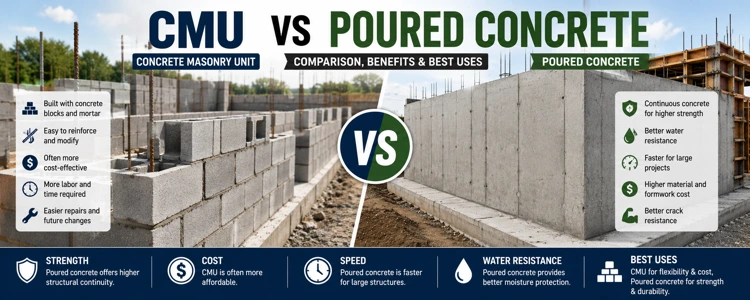
CMU vs poured concrete
Both construction methods are widely used in residential and commercial projects, but they differ in:
- Strength
- Cost
- Installation
- Durability
- Labor requirements
- Waterproofing
- Construction speed
In this guide, you will learn the key differences between CMU block walls and poured concrete walls, including advantages, disadvantages, costs, and best construction applications.
What Is CMU Construction?
CMU
stands for:
Concrete Masonry Unit
CMU construction uses:
- Concrete blocks
- Mortar joints
- Reinforcement steel
- Grouted cells
CMU walls are commonly used for:
- Foundations
- Retaining walls
- Commercial structures
- Residential walls
- Basements
You can also read:
What Is a CMU Block?What Is Poured Concrete?
Poured concrete
construction uses:
- Wet concrete
- Formwork systems
- Reinforcement steel
- Continuous concrete placement
Concrete is poured into forms and allowed to cure into a solid wall system.
Poured concrete is commonly used for:
- Foundations
- Basement walls
- Commercial buildings
- Structural walls
CMU vs Poured Concrete Comparison
| Feature | CMU Block Walls | Poured Concrete Walls |
|---|---|---|
| Installation | Block-by-block | Continuous concrete pour |
| Construction Speed | Moderate | Faster for large projects |
| Labor Requirements | Higher masonry labor | Requires formwork |
| Structural Strength | High | Very high |
| Waterproofing | Requires additional protection | Better moisture resistance |
| Crack Resistance | Moderate | Better overall |
| Flexibility | Easier modifications | Harder modifications |
| Cost | Often lower | Usually higher |
| Reinforcement | Easy to reinforce | Reinforcement embedded inside |
Both systems can provide excellent structural performance when properly designed.
Strength Differences
Poured concrete walls generally provide:
higher structural continuity
because they form a single solid concrete structure.
Advantages include:
- Better lateral resistance
- Reduced joint separation
- Improved crack control
However, reinforced CMU walls can also provide excellent:
- Structural stability
- Load-bearing capacity
- Durability
You can also read:
CMU Compressive Strength GuideCost Comparison
CMU walls
often cost less because:
- Materials may be cheaper
- Equipment requirements are lower
- Smaller crews can install blocks
Poured concrete walls
may cost more because of:
- Formwork systems
- Pumping equipment
- Large concrete pours
- Higher labor specialization
Actual costs depend on:
- Region
- Project size
- Labor rates
- Material prices
Construction Speed
Poured concrete walls are often:
faster for large projects
because entire wall sections can be poured at once.
CMU block walls:
- Require individual block placement
- Need mortar curing
- Take more installation time
However, CMU construction may simplify:
- Future modifications
- Repairs
- Wall adjustments
Waterproofing and Moisture Resistance
Poured concrete walls generally provide:
better natural water resistance
because they contain:
- Fewer joints
- Continuous concrete surfaces
CMU walls contain:
- Mortar joints
- Hollow cores
- More moisture pathways
Proper waterproofing is important for both systems.
You can also read:
CMU Moisture Resistance GuideCrack Resistance
Poured concrete walls often provide:
- Better structural continuity
- Reduced movement between sections
However, poured walls can still crack because of:
- Shrinkage
- Settlement
- Temperature changes
CMU walls may experience:
- Mortar joint cracking
- Differential movement
Proper reinforcement improves crack resistance in both systems.
Reinforcement and Seismic Performance
Both systems commonly use:
- Rebar reinforcement
- Structural engineering
- Concrete strengthening methods
Reinforced CMU walls provide excellent:
- Earthquake resistance
- Structural flexibility
- Load distribution
You can also read:
CMU Seismic Design GuideThermal Performance
CMU walls provide:
excellent thermal mass
which helps:
- Stabilize indoor temperatures
- Improve energy efficiency
- Reduce heat transfer
Poured concrete also provides strong thermal mass but may require:
- Additional insulation
- Exterior thermal systems
You can also read:
CMU Thermal Insulation GuideWhich System Is Better for Foundations?
CMU foundations
are commonly preferred for:
- Residential projects
- Cost efficiency
- Easier repairs
- Reinforced masonry systems
Poured concrete foundations
are commonly preferred for:
- High water table areas
- Large commercial buildings
- Heavy structural loads
- Faster construction schedules
The best option depends on:
- Soil conditions
- Climate
- Budget
- Structural requirements
Common Applications for CMU Walls
CMU construction is commonly used for:
- Residential foundations
- Retaining walls
- Commercial buildings
- Partition walls
- Reinforced masonry systems
Common Applications for Poured Concrete Walls
Poured concrete is commonly used for:
- Basement walls
- Parking structures
- Commercial foundations
- Structural cores
- High-rise construction
Use a CMU Block Calculator
Before starting masonry construction, it is important to estimate:
- Block quantities
- Mortar requirements
- Material costs
- Wall dimensions
Our:
CMU Block Calculatorhelps estimate:
- Concrete block quantities
- Mortar requirements
- Material costs
- Wall coverage
You can also use:
for additional construction estimation.
Related Articles
- CMU Compressive Strength Guide
- CMU Moisture Resistance Guide
- CMU Seismic Design Guide
- CMU Thermal Insulation Guide
- Hollow vs Solid Concrete Blocks
- CMU Block Density Guide
Final Thoughts
CMU vs poured concrete walls each offer unique advantages depending on the construction project. CMU walls provide flexibility, cost efficiency, and reinforced masonry benefits, while poured concrete walls offer excellent structural continuity and moisture resistance.
Choosing the right wall system depends on project size, climate, budget, structural requirements, and construction goals.