Concrete masonry units (CMU blocks) are widely used in residential and commercial construction because they provide:
- Structural strength
- Fire resistance
- Durability
- Weather resistance
One of the most important advantages of concrete block construction is:
moisture resistance
Properly designed CMU walls can help resist:
- Rain penetration
- Ground moisture
- Water damage
- Mold growth
- Structural deterioration
In this guide, you will learn about CMU moisture resistance, waterproofing methods, drainage systems, sealers, wall performance, and moisture control in masonry construction.
Why Moisture Resistance Matters
Moisture is one of the biggest threats to building durability.
Excessive water penetration can cause:
- Mold growth
- Wall cracking
- Surface damage
- Structural weakening
- Insulation problems
Concrete masonry walls are commonly designed with:
- Drainage systems
- Waterproof coatings
- Reinforcement
- Proper flashing
to improve long-term moisture performance.
Are CMU Blocks Waterproof?
CMU blocks are not naturally waterproof.
Concrete masonry is:
- Porous
- Absorbent
- Capable of retaining moisture
However, properly designed CMU wall systems can become highly:
- Water resistant
- Weather resistant
- Durable
Moisture protection depends on:
- Wall design
- Sealers
- Drainage systems
- Construction quality
How Water Enters CMU Walls
Moisture can enter concrete block walls through:
- Rain penetration
- Groundwater
- Cracks
- Improper flashing
- Poor drainage
- Capillary action
Controlling water movement is essential for long-term masonry performance.
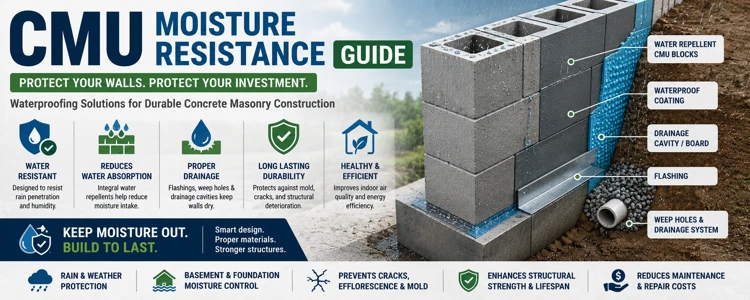
Common CMU Waterproofing Methods
Several methods are commonly used to improve moisture resistance in masonry construction.
1. Waterproof Coatings
Special masonry coatings help reduce water penetration.
Common options include:
- Elastomeric coatings
- Acrylic sealers
- Cementitious waterproofing
Advantages:
- Reduced moisture absorption
- Improved weather protection
- Longer wall lifespan
2. Integral Water Repellents
Some CMU blocks are manufactured with:
integral water repellents
These additives help reduce:
- Water absorption
- Moisture penetration
- Surface saturation
This improves overall wall performance.
3. Proper Drainage Systems
Drainage systems are extremely important for masonry construction.
Common drainage components:
- Flashing
- Weep holes
- Drainage cavities
- Waterproof membranes
These systems help remove water from wall assemblies.
4. Grouting and Reinforcement
Proper grouting can help:
- Reduce void spaces
- Improve wall strength
- Minimize water pathways
Reinforced CMU walls often provide:
- Better durability
- Improved crack resistance
- Greater weather performance
You can estimate reinforcement using the:
Rebar CalculatorCMU Wall Thickness and Moisture Performance
Wall thickness can influence:
- Water resistance
- Thermal performance
- Structural durability
Thicker walls generally provide:
- Better moisture resistance
- Improved structural stability
- Greater thermal mass
You can also read:
CMU Wall Thickness GuideCMU Density and Water Absorption
Block density affects:
- Water absorption
- Drying speed
- Moisture retention
Lightweight blocks may absorb more moisture compared to:
- Medium-weight blocks
- Normal-weight blocks
You can also read:
CMU Block Density GuideBasement and Foundation Moisture Protection
Basement CMU walls are especially vulnerable to:
- Soil moisture
- Hydrostatic pressure
- Groundwater infiltration
Common protection methods include:
- Exterior waterproof membranes
- Drainage tile systems
- Gravel backfill
- Proper grading
You can estimate foundation materials using the:
Foundation CalculatorSigns of Moisture Problems in CMU Walls
Common signs include:
- Efflorescence
- Damp spots
- Mold growth
- Cracking
- Paint peeling
- Water stains
Early moisture control helps prevent major structural damage.
CMU Moisture Resistance and Climate
Climate conditions greatly affect masonry wall performance.
Wet climates may require:
- Enhanced waterproofing
- Drainage cavities
- Exterior sealers
Dry climates often place less stress on moisture protection systems.
Local building codes may require specific waterproofing methods.
Benefits of Proper Moisture Protection
Proper moisture-resistant CMU wall systems help improve:
- Building durability
- Indoor air quality
- Structural stability
- Energy efficiency
- Long-term maintenance costs
Well-designed masonry walls can last for decades with minimal problems.
Use a CMU Block Calculator
Before starting masonry construction, it is important to estimate:
- Block quantities
- Mortar requirements
- Material costs
- Wall dimensions
Our:
CMU Block Calculatorhelps estimate:
- Concrete block quantities
- Mortar requirements
- Material costs
- Wall coverage
You can also use:
- Gravel Calculator
- Concrete Volume Calculator
- Mortar Calculator
- Foundation Calculator
for additional construction estimation.
Related Articles
- CMU Wall Thickness Guide
- CMU Block Density Guide
- CMU Thermal Insulation Guide
- CMU Fire Rating Guide
- CMU Compressive Strength Guide
- 8x8x16 CMU Block Dimensions
Final Thoughts
CMU moisture resistance is an important part of long-term masonry wall performance and building durability. Proper waterproofing systems, drainage design, reinforcement, and moisture control methods help protect concrete masonry walls from water damage and structural deterioration.
Well-designed CMU wall systems can provide strong, durable, and weather-resistant construction for residential and commercial buildings.