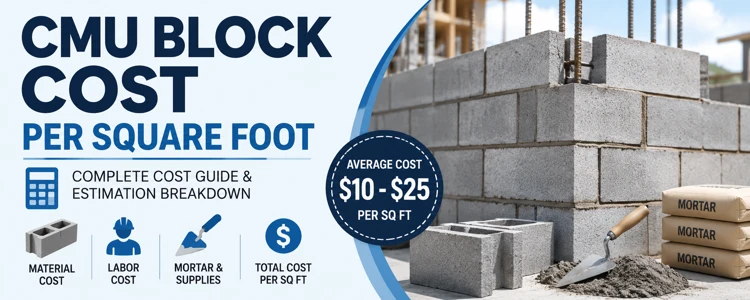
Quick answer: CMU block wall cost per square foot has no single national price. Current U.S. cost guides report roughly $15–$30 per square foot for a typical installed concrete block wall in one estimate, while another reports $45–$110 per square foot of wall face. Angi reports a typical total project range of $1,600–$8,000, with a $3,200 national average. These are different publishers’ planning estimates with different methods and scopes, so they do not form one dependable price for every CMU wall. Use them as context, then compare written bids for the same wall area and included work.
| 2026 U.S. estimate checked Oct. 31 | Published figure | How to read it |
|---|---|---|
| HomeGuide | $15–$30 per sq. ft. installed | General freestanding wall estimate; its stated scope includes foundation and reinforcement. |
| RemodelingExpense | $45–$110 per sq. ft. of wall face installed | Its 100-sq.-ft. example is $4,500–$11,000, with material and labor in the estimate. |
| Angi | $1,600–$8,000 per project; $3,200 average | Total project figures; the page does not present this as a per-square-foot rate. |
These guides cover different wall types, locations, quote assumptions, and cost methods. A broad range across publishers is useful as a warning to check scope; it is not a quote for your address. Your plan, soil, access, footing, reinforcement, grout, delivery, and finish determine the actual bid. The price comparison below shows how to calculate and compare estimates on the same basis.
How to calculate CMU wall cost per square foot
First agree on the wall-face area and the work included in each quote. For a rectangular wall:
Quoted cost per square foot = comparable quote total ÷ agreed wall-face area
Wall-face area is length × height. Ask whether the contractor measures gross area or subtracts door and window openings. Confirm whether the price covers one wall face or finish on both sides. An installed-wall quote and a materials-only quote use different scopes.
100-square-foot CMU wall quote example
Suppose a written proposal totals $4,800 for an agreed 100-square-foot wall face. The calculation is $4,800 ÷ 100 = $48 per square foot. This invented example demonstrates the math; it is not a market average or a forecast. If the proposal excludes any required work, request a separate allowance before comparing it with another bid.
| Illustrative quote item | Example amount | Details to confirm |
|---|---|---|
| Specified CMU, mortar, and delivery | $1,650 | Unit type, count, waste, delivery distance, and unloading |
| Masonry labor and equipment | $2,100 | Wall height, access, layout, openings, and cleanup |
| Footing and site preparation | $750 | Excavation, soil or site conditions, concrete, and disposal |
| Specified grout, reinforcement, and finish allowance | $300 | Plan requirements and exactly which finish is included |
| Illustrative total for 100 sq. ft. | $4,800 | Divide by agreed area: $48 per sq. ft. |
The figures in this worksheet are made up for explanation. Local contractors should price the actual drawings, site, materials, and requested finish.
What a CMU wall price may include
- CMU materials: Block type and count, mortar, delivery, unloading, and cutting waste. This is a material takeoff cost.
- Installed masonry: The stated wall area, block and mortar, masonry labor, equipment, and the listed reinforcement or finish.
- Complete project: Installed masonry plus any quoted excavation, footing, drainage, engineering, permits, demolition, access, or cleanup.
Ask the estimator to name each included item and each exclusion. The CMU block cost guide covers individual-unit pricing; material price and installed wall price describe different scopes.
What changes installed CMU wall cost?
- Wall purpose and design: A partition, fence, foundation, or retaining wall has different plans and structural requirements. Price the approved design for the specific wall.
- Dimensions and layout: Height, length, thickness, corners, openings, steps, curves, and number of finished faces affect material and labor quantities.
- Footing and site: Excavation, soil, slope, access, existing surfaces, drainage, and disposal change the quoted scope.
- Reinforcement and grout: Plans determine where steel, bond beams, grout, and lintels are required. Ask the estimator to identify the scheduled items.
- Unit selection and finish: Block width, density, specialty shapes, color, and architectural finish affect product price and handling. See our standard CMU sizes guide and CMU wall thickness guide.
- Labor, delivery, and location: Crew rates, material availability, delivery distance, equipment, schedule, and site access vary by market.
- Items outside the wall quote: Permits, engineering, waterproofing, insulation, caps, demolition, taxes, and landscaping may be separate. Confirm them in writing.
Compare contractor quotes on the same scope
- Give each mason the same wall dimensions, drawings, finish, and site details.
- Confirm the area calculation, opening deductions, wall-face basis, and price unit.
- List the specified CMU size, shape, product class, finish, and estimated quantity.
- Confirm whether mortar, delivery, unloading, equipment, and waste are included.
- Ask whether excavation, footing, drainage, reinforcement, grout, lintels, and bond beams follow the plans and appear in the bid.
- Compare finishes, both-side treatments, permits, engineering, cleanup, taxes, and exclusions.
- Ask how changes in soil, access, dimensions, or site conditions affect the proposal.
When bids use the same area and scope, the per-square-foot calculation becomes a useful comparison. Have the project designer review proposed structural changes before construction.
Estimate CMU material quantities separately
For a material takeoff, calculate wall area and block count from the specified modular size, then estimate mortar, reinforcement, grout, and other items separately. Our CMU block quantity guide explains the basic count, and the CMU material cost calculator helps organize selected quantities and prices.
Footings and fill are separate quantities. The foundation calculator, rebar calculator, and CMU grout calculator can help with early material estimates when used with the applicable project details. A calculator does not replace a complete installation quote.
CMU wall cost FAQs
How much does a 100-square-foot CMU wall cost?
Published guides give different estimates because they assume different work and wall conditions. Divide a written quote for the specified work by the agreed 100-square-foot area. The $4,800 example above shows the arithmetic only; it is not a typical U.S. price.
Does cost per square foot include a footing?
Some estimates include a footing and others separate it. Confirm excavation, footing concrete, reinforcement, drainage, and disposal in the written scope.
Is the price for materials or for a finished wall?
Both conventions appear in estimates. The proposal should say whether it covers CMU materials, installed masonry, or the full project with site and foundation work.
Are CMU retaining walls priced like ordinary walls?
Retained soil, wall height, drainage, footing, reinforcement, access, and engineering affect the design and scope. Price the actual approved retaining-wall plan.
Why do online CMU wall cost estimates disagree?
Guides may use different wall types, areas, dates, locations, labor rates, and inclusions. One may include a footing and reinforcement; another may use a different wall-face estimate. Compare like-for-like written bids for a project-specific budget.
Price research note: HomeGuide, RemodelingExpense, and Angi estimates reviewed October 31, 2026. Their published figures use different assumptions and are planning references, not contractor bids.