How Many CMU Blocks Do I Need? A most Common Question, Here we are going to answer in detail. Estimating the correct number of CMU blocks is one of the most important steps in any masonry or concrete block construction project. Whether you are building a retaining wall, garage, foundation, partition wall, or commercial structure, accurate block estimation helps reduce waste, save money, and improve project planning.
In this guide, you will learn how to calculate the number of CMU blocks needed for your wall, what factors affect block quantity, and how contractors estimate masonry materials professionally.
What Is a CMU Block?
CMU stands for Concrete Masonry Unit. These concrete blocks are commonly used in residential, commercial, and industrial construction because they are durable, fire-resistant, and cost-effective.
The most common CMU block size used in the United States is:
8x8x16 CMU Block
This block is widely used for:
- Exterior walls
- Foundations
- Structural masonry
- Garage walls
- Commercial construction
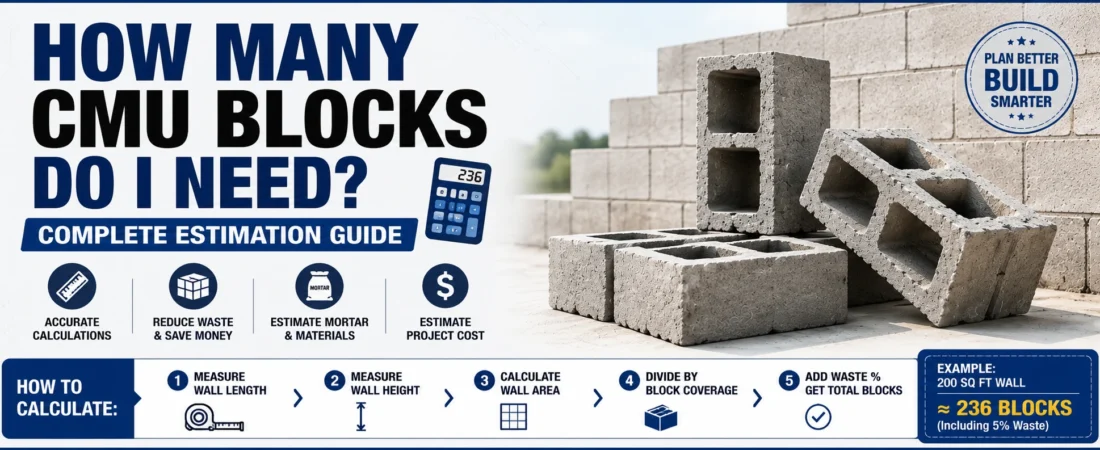
How to Calculate CMU Blocks Needed
The basic formula for estimating CMU blocks is:
Wall Area ÷ Block Coverage Area = Number of Blocks
To estimate blocks correctly, you must first calculate the total wall area.
Step 1: Measure Wall Length
Measure the total wall length in:
- Feet
- Inches
- Meters
- Centimeters
Example:
20 feetStep 2: Measure Wall Height
Next, measure the wall height.
Example:
10 feetStep 3: Calculate Wall Area
Multiply:
Length × Height
Example:
20 × 10 = 200 square feetSo the wall area is:
200 sq ft
Step 4: Determine Block Coverage
A standard 8x8x16 CMU block covers approximately:
0.89 square feet
Step 5: Calculate Blocks Needed
Divide wall area by block coverage.
Example:
200 ÷ 0.89 = 224.7Rounded up:
225 CMU blocks
Add Waste Percentage
Construction projects always require extra blocks because of:
- Cutting
- Breakage
- Damage
- Waste
- Future repairs
Most contractors add:
5%–10% waste
Example:
225 × 5% = 11 extra blocksFinal estimate:
236 CMU blocks
Standard CMU Block Sizes
| Block Size | Common Uses |
|---|---|
| 4x8x16 | Partition walls |
| 6x8x16 | Light structural walls |
| 8x8x16 | Standard masonry walls |
| 10x8x16 | Heavy-duty walls |
| 12x8x16 | Retaining and load-bearing walls |
Different block sizes cover different wall areas, so the total number of blocks may vary.
Factors That Affect CMU Block Quantity
Several factors influence the number of blocks required for a project.
Wall Openings
Doors and windows reduce the number of blocks needed.
Always subtract:
- Door area
- Window area
- Vent openings
from the total wall area.
Mortar Joints
Mortar thickness affects final block count.
Standard mortar joints are usually:
3/8 inch
Block Pattern
Some masonry layouts require additional cutting and waste.
Decorative walls may require extra blocks.
Reinforced Walls
Walls containing:
- Rebar
- Filled cores
- Structural reinforcement
may require different masonry planning.
How Many Blocks Per Square Foot?
For standard 8x8x16 CMU blocks:
Approximately 1.125 blocks per square foot
Example:
- 100 sq ft wall ≈ 113 blocks
- 200 sq ft wall ≈ 225 blocks
- 500 sq ft wall ≈ 563 blocks
How Much Mortar Do I Need?
Mortar requirements depend on:
- Block size
- Joint thickness
- Wall design
Typically:
One 80 lb mortar bag covers about 35 CMU blocks
Example:
225 ÷ 35 = 6.4 bagsRounded up:
7 mortar bags
CMU Block Cost Estimation
CMU block prices vary depending on:
- Region
- Block type
- Material density
- Supplier
- Quantity purchased
Typical prices range between:
$1.50–$4.00 per block
Example:
236 blocks × $2.50 = $590Estimated block cost:
$590
Why Accurate Block Estimation Matters
Proper block estimation helps:
- Reduce construction waste
- Save money
- Improve budgeting
- Avoid project delays
- Prevent material shortages
Professional contractors always calculate masonry materials carefully before starting construction.
Use a CMU Block Calculator
Manual calculations can take time and may cause mistakes.
Our online CMU Block Calculator helps you:
- Calculate blocks instantly
- Estimate mortar bags
- Add waste percentage
- Estimate material costs
- Support multiple block sizes
Using an online calculator improves speed and accuracy for construction planning.
Final Thoughts
Calculating the correct number of CMU blocks is essential for efficient masonry construction. By measuring wall dimensions, selecting the proper block size, and including waste allowance, you can estimate materials more accurately and avoid unnecessary expenses.
For faster and more accurate results, use our online CMU Block Calculator to estimate blocks, mortar, and masonry project costs in seconds.