
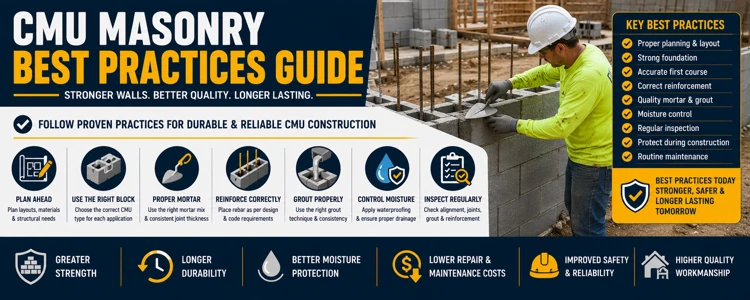
Concrete masonry unit (CMU) construction is known for its strength, durability, and cost-effectiveness. However, achieving high-quality masonry work requires proper planning, installation techniques, reinforcement practices, and maintenance procedures.
Following masonry best practices helps improve structural performance, reduce repairs, and extend the lifespan of concrete block structures.
This guide covers the most important CMU masonry best practices used in residential and commercial construction.
What Are CMU Masonry Best Practices?
CMU masonry best practices are recommended construction methods that help ensure:
- Stronger walls
- Better durability
- Improved safety
- Reduced maintenance
- Higher construction quality
These practices apply to:
- Foundation walls
- Basement walls
- Retaining walls
- Structural walls
- Commercial masonry systems
You can also read:
What Is a CMU Block?Start With Proper Planning
Every successful masonry project begins with proper planning.
Before construction:
- Verify wall dimensions
- Review structural requirements
- Confirm block sizes
- Estimate materials accurately
- Prepare the job site
Good planning reduces delays and construction mistakes.
Use the Correct CMU Block Type
Different masonry applications require different block types.
Common CMU types include:
- Standard blocks
- Bond beam blocks
- Lintel blocks
- Jamb blocks
- Pilaster blocks
Selecting the correct block improves structural performance.
You can also read:
Types of CMU BlocksBuild on a Proper Foundation
A masonry wall is only as strong as its foundation.
Best practices include:
- Proper footing design
- Adequate reinforcement
- Correct concrete placement
- Proper drainage
You can also read:
CMU Foundation Wall GuideEnsure Accurate Layout
Proper layout helps prevent alignment problems.
Always verify:
- Wall dimensions
- Corner locations
- Door openings
- Window openings
- Wall elevations
Accurate layout improves construction quality.
Install the First Course Carefully
The first course determines the alignment of the entire wall.
Check for:
- Level installation
- Proper spacing
- Straight wall lines
- Correct elevation
Mistakes in the first course often create problems throughout the project.
Follow Proper Mortar Practices
Mortar plays an important role in masonry performance.
Best practices include:
- Using the correct mortar type
- Maintaining consistent joint thickness
- Mixing mortar properly
- Protecting mortar from extreme weather
Proper mortar application improves wall strength and durability.
Reinforce Walls Correctly
Many structural masonry walls require reinforcement.
Best practices include:
- Proper rebar placement
- Correct spacing
- Secure reinforcement
- Following engineering requirements
You can also read:
CMU Rebar Spacing Guideand
How to Reinforce a CMU WallUse Proper Grouting Techniques
Grout helps strengthen reinforced masonry systems.
Best practices include:
- Correct grout consistency
- Proper consolidation
- Complete cell filling
- Following lift limitations
You can also read:
CMU Grouting Methods Guideand
CMU Grout CalculatorControl Moisture
Moisture management is one of the most important masonry practices.
Use:
- Waterproof membranes
- Drainage systems
- Flashing
- Sealants
Proper moisture control improves durability.
You can also read:
CMU Wall Waterproofing GuideInspect Work Regularly
Quality control inspections help identify problems early.
Inspect:
- Alignment
- Reinforcement
- Mortar joints
- Grout placement
- Waterproofing
You can also read:
CMU Wall Inspection GuideProtect Walls During Construction
Fresh masonry should be protected from:
- Heavy rain
- Freezing temperatures
- Excessive heat
- Physical damage
Protection helps improve curing and long-term performance.
Maintain Completed Walls
After construction, regular maintenance helps extend wall lifespan.
Maintenance tasks include:
- Crack repair
- Cleaning
- Waterproofing inspections
- Mortar joint maintenance
You can also read:
CMU Wall Maintenance GuideCommon Masonry Mistakes
Avoid these common mistakes:
- Poor foundation preparation
- Improper reinforcement
- Incorrect grouting
- Weak mortar joints
- Ignoring moisture control
- Delayed repairs
Advantages of Following Best Practices
Improved Structural Performance
Proper construction methods improve wall strength.
Better Durability
Quality workmanship increases wall lifespan.
Reduced Repair Costs
Fewer construction mistakes lead to fewer repairs.
Better Moisture Protection
Proper waterproofing reduces water damage.
Improved Safety
Following best practices helps create safer structures.
Use a CMU Block Calculator
Before starting construction, accurate material estimation is important.
Our CMU Block Calculator helps estimate:
- Block quantities
- Mortar requirements
- Material costs
- Wall dimensions
Related Calculators
- CMU Block Calculator
- CMU Grout Calculator
- Mortar Calculator
- Foundation Calculator
- Rebar Calculator
- Concrete Calculator
Frequently Asked Questions
Why are masonry best practices important?
They improve wall strength, durability, safety, and construction quality.
Is reinforcement necessary for CMU walls?
Many structural walls require reinforcement and grout.
Why is moisture control important?
Moisture can cause deterioration, staining, and structural issues.
How often should masonry walls be inspected?
Regular inspections are recommended during and after construction.
Related Articles
- What Is a CMU Block?
- Types of CMU Blocks
- CMU Construction Process Guide
- CMU Foundation Wall Guide
- CMU Rebar Spacing Guide
- How to Reinforce a CMU Wall
- CMU Grouting Methods Guide
- CMU Wall Waterproofing Guide
- CMU Wall Inspection Guide
- CMU Wall Maintenance Guide
Final Thoughts
Following CMU masonry best practices helps builders, contractors, and property owners create stronger, safer, and longer-lasting masonry structures. Proper planning, reinforcement, grouting, moisture control, inspection, and maintenance are key to achieving high-quality concrete masonry construction.