Concrete masonry units (CMU blocks) are available in different types depending on their structure, weight, strength, and construction applications. Two of the most common options are:
hollow concrete blocks
and
solid concrete blocks
Understanding the difference between hollow and solid blocks is important for:
- Structural design
- Wall strength
- Construction cost
- Weight considerations
- Thermal performance
- Material selection
In this guide, you will learn the differences between hollow vs solid concrete blocks, including strength, weight, insulation, cost, and common construction applications.
What Are Hollow Concrete Blocks?
Hollow concrete blocks
contain hollow cores or voids inside the block structure.
These hollow spaces help:
- Reduce block weight
- Improve insulation
- Lower transportation costs
- Simplify handling
Hollow blocks are commonly used in:
- Residential construction
- Commercial walls
- Partition walls
- Reinforced masonry systems
What Are Solid Concrete Blocks?
Solid concrete blocks
contain very little hollow space and are much denser than hollow blocks.
Advantages include:
- Higher compressive strength
- Greater durability
- Better sound resistance
- Improved structural performance
Solid blocks are commonly used for:
- Retaining walls
- Foundations
- Load-bearing structures
- Heavy-duty construction
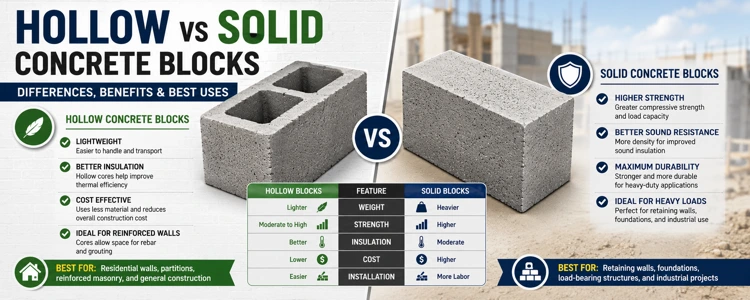
Hollow vs Solid Concrete Blocks Comparison
| Feature | Hollow Concrete Blocks | Solid Concrete Blocks |
|---|---|---|
| Weight | Lighter | Heavier |
| Strength | Moderate to High | Higher |
| Insulation | Better | Moderate |
| Sound Resistance | Moderate | Better |
| Transportation Cost | Lower | Higher |
| Installation | Easier | More difficult |
| Material Usage | Less concrete | More concrete |
Both block types are widely used depending on project requirements.
Strength Differences
Solid concrete blocks generally provide:
higher compressive strength
because they contain:
- More concrete material
- Greater density
- Fewer voids
Hollow blocks can still provide excellent structural performance when:
- Reinforced with rebar
- Properly grouted
- Designed according to code
You can also read:
CMU Compressive Strength GuideWeight Differences
Hollow blocks are significantly lighter because of their internal cavities.
Advantages:
- Easier lifting
- Faster installation
- Reduced transportation costs
- Lower structural dead load
Solid blocks are heavier and may require:
- More labor
- Additional equipment
- Stronger structural support
You can also read:
CMU Block Weight GuideThermal Insulation Performance
Hollow concrete blocks usually provide:
better thermal insulation
because air spaces inside the blocks help reduce heat transfer.
This can improve:
- Energy efficiency
- Indoor comfort
- Temperature control
You can also read:
CMU Thermal Insulation GuideSound Insulation Differences
Solid concrete blocks often provide:
better sound insulation
because of their:
- Higher density
- Greater mass
- Improved sound absorption
Solid blocks are commonly used in:
- Schools
- Industrial buildings
- Noise-sensitive areas
You can also read:
CMU Sound Transmission GuideFire Resistance
Both hollow and solid concrete blocks provide excellent:
fire resistance
Concrete masonry is naturally:
- Non-combustible
- Durable
- Heat resistant
Solid blocks may provide slightly higher fire endurance because of:
- Increased density
- Greater mass
You can also read:
CMU Fire Rating GuideReinforcement and Structural Design
Hollow blocks are commonly used in:
reinforced masonry systems
because hollow cores allow space for:
- Vertical rebar
- Horizontal reinforcement
- Grouting
This improves:
- Structural strength
- Earthquake resistance
- Load-bearing performance
You can estimate reinforcement using the:
Rebar CalculatorCost Comparison
Hollow blocks often cost less because they:
- Use less concrete
- Weigh less
- Reduce shipping costs
Solid blocks generally:
- Require more material
- Increase transportation costs
- Increase labor effort
However, solid blocks may reduce long-term maintenance in heavy-duty applications.
Common Applications for Hollow Blocks
Hollow blocks are commonly used for:
- Residential walls
- Commercial masonry
- Structural walls
- Reinforced CMU systems
- Partition walls
These blocks balance:
- Strength
- Weight
- Cost efficiency
Common Applications for Solid Blocks
Solid blocks are commonly used for:
- Retaining walls
- Foundations
- Heavy-load structures
- Security walls
- Industrial applications
They are preferred where:
- Maximum durability
- High compressive strength
- Greater structural stability
are required.
Which Block Type Is Better?
The best option depends on:
- Structural requirements
- Budget
- Climate
- Wall purpose
- Reinforcement needs
General recommendations:
Hollow Blocks
Best for:
- Residential projects
- Reinforced walls
- Energy efficiency
- Faster construction
Solid Blocks
Best for:
- Heavy-load structures
- Retaining walls
- Maximum durability
- High-impact applications
Use a CMU Block Calculator
Before starting masonry construction, it is important to estimate:
- Block quantities
- Mortar requirements
- Material costs
- Wall dimensions
Our:
CMU Block Calculatorhelps estimate:
- Concrete block quantities
- Mortar requirements
- Material costs
- Wall coverage
You can also use:
- Foundation Calculator
- Gravel Calculator
- Concrete Volume Calculator
- Mortar Calculator
for additional construction estimation.
Related Articles
- CMU Compressive Strength Guide
- CMU Block Weight Guide
- CMU Thermal Insulation Guide
- CMU Sound Transmission Guide
- CMU Fire Rating Guide
- CMU Seismic Design Guide
Final Thoughts
Hollow vs solid concrete blocks each provide different advantages depending on the construction application. Hollow blocks are lighter, easier to install, and better for reinforced masonry systems, while solid blocks provide greater strength, durability, and sound resistance.
Choosing the correct concrete block type helps improve structural performance, energy efficiency, and long-term construction durability.