Concrete masonry units (CMU blocks) are widely used in residential and commercial construction because they provide:
- Structural strength
- Fire resistance
- Durability
- Long-term performance
In earthquake-prone regions, one of the most important aspects of masonry construction is:
seismic design
Properly reinforced CMU walls can help buildings resist:
- Earthquake forces
- Structural movement
- Lateral loads
- Wall cracking
- Structural collapse
In this guide, you will learn about CMU seismic design, reinforcement methods, structural stability, building code requirements, and earthquake-resistant masonry construction.
What Is Seismic Design?
Seismic design
refers to:
designing structures to resist earthquake forces safely
Earthquakes create:
- Horizontal movement
- Vertical vibration
- Structural stress
- Lateral pressure
Buildings must be designed to absorb and resist these forces without major failure.
Why Seismic Design Matters for CMU Walls
Concrete masonry walls are heavy structural systems.
Without proper reinforcement, earthquakes can cause:
- Cracking
- Wall separation
- Structural instability
- Partial collapse
Proper seismic reinforcement helps:
- Improve wall strength
- Increase flexibility
- Distribute earthquake loads
- Reduce structural damage
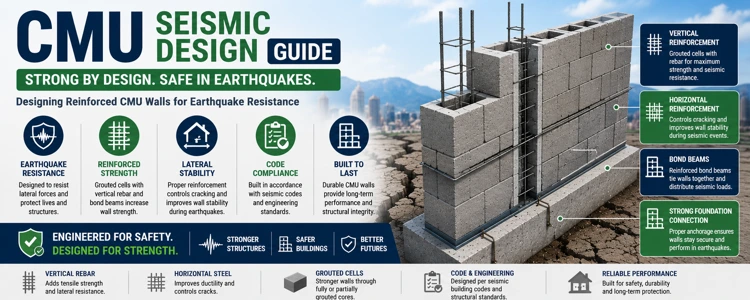
How Reinforced CMU Walls Resist Earthquakes
Reinforced CMU walls commonly use:
- Vertical rebar
- Horizontal reinforcement
- Grouted cells
- Bond beams
These systems improve:
- Structural stability
- Lateral resistance
- Crack control
- Load distribution
You can estimate reinforcement using the:
Rebar CalculatorVertical Reinforcement in CMU Walls
Vertical steel reinforcement is commonly placed inside:
grouted CMU cells
Advantages:
- Improves wall strength
- Increases lateral resistance
- Reduces earthquake damage
Vertical reinforcement is especially important for:
- Tall walls
- Load-bearing structures
- Seismic zones
Horizontal Reinforcement
Horizontal reinforcement helps:
- Control cracking
- Improve wall stability
- Increase structural continuity
Common methods include:
- Bond beams
- Joint reinforcement
- Horizontal steel bars
Combining vertical and horizontal reinforcement creates stronger seismic wall systems.
Bond Beams in Seismic Masonry
Bond beams
are reinforced horizontal concrete masonry sections that help:
- Tie walls together
- Distribute earthquake loads
- Improve wall stiffness
Bond beams are commonly installed:
- At floor levels
- Roof levels
- Wall openings
- Structural transitions
Fully Grouted vs Partially Grouted Walls
Fully Grouted CMU Walls
Fully grouted walls provide:
- Maximum structural strength
- Better seismic performance
- Higher lateral resistance
These are commonly used in:
- Commercial buildings
- Schools
- High seismic zones
Partially Grouted CMU Walls
Partially grouted walls may reduce:
- Material costs
- Wall weight
However, they generally provide:
- Lower seismic resistance
- Reduced structural performance
CMU Wall Thickness and Seismic Stability
Wall thickness affects:
- Structural strength
- Lateral stability
- Earthquake resistance
Thicker walls generally provide:
- Better structural performance
- Increased durability
- Improved load resistance
You can also read:
CMU Wall Thickness GuideCMU Compressive Strength and Earthquake Resistance
Higher compressive strength improves:
- Structural reliability
- Load-bearing performance
- Crack resistance
You can also read:
CMU Compressive Strength GuideBuilding Codes for Seismic Masonry
Seismic masonry construction must follow:
- Local building codes
- Structural engineering standards
- Reinforcement requirements
Codes commonly regulate:
- Rebar spacing
- Wall thickness
- Grouting requirements
- Anchorage systems
Structural engineers typically design reinforced masonry systems in earthquake-prone regions.
Common Applications for Seismic CMU Walls
Seismic-resistant concrete masonry walls are commonly used for:
- Schools
- Commercial buildings
- Apartment complexes
- Warehouses
- Retaining walls
- Industrial structures
Reinforced masonry systems provide:
- Durability
- Structural stability
- Long-term safety
Foundation Stability in Seismic Design
Strong foundations are critical for earthquake-resistant construction.
Foundations help:
- Transfer structural loads
- Reduce settlement
- Improve seismic stability
You can estimate materials using the:
Foundation CalculatorAdvantages of Reinforced CMU Seismic Systems
Properly reinforced CMU walls provide:
- High structural strength
- Fire resistance
- Long-term durability
- Earthquake resistance
- Cost-effective construction
Concrete masonry remains one of the most reliable structural systems for seismic construction.
Use a CMU Block Calculator
Before starting masonry construction, it is important to estimate:
- Block quantities
- Mortar requirements
- Material costs
- Wall dimensions
Our:
CMU Block Calculatorhelps estimate:
- Concrete block quantities
- Mortar requirements
- Material costs
- Wall coverage
You can also use:
- Rebar Calculator
- Gravel Calculator
- Concrete Volume Calculator
- Mortar Calculator
for additional construction estimation.
Related Articles
- CMU Compressive Strength Guide
- CMU Wall Thickness Guide
- CMU Fire Rating Guide
- CMU Moisture Resistance Guide
- CMU Freeze-Thaw Resistance Guide
- CMU Block Density Guide
Final Thoughts
CMU seismic design is essential for safe and durable construction in earthquake-prone regions. Proper reinforcement, grouting, wall thickness, and structural detailing help concrete masonry walls resist seismic forces and improve long-term building safety.
Well-designed reinforced CMU systems provide strong structural performance, durability, and earthquake resistance for residential and commercial construction projects.