
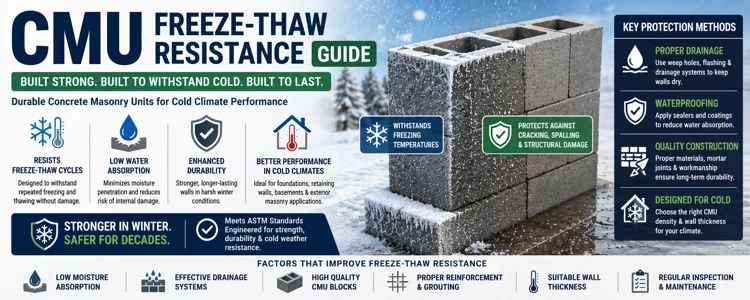
Concrete masonry units (CMU blocks) are widely used in residential and commercial construction because they provide:
- Structural strength
- Fire resistance
- Durability
- Long service life
In cold climates, one of the most important properties of concrete masonry is:
Freeze-thaw resistance
Concrete block walls exposed to freezing temperatures must resist repeated:
- Freezing
- Expansion
- Moisture penetration
- Ice formation
In this guide, you will learn about CMU freeze-thaw resistance, durability factors, moisture control, ASTM standards, block density, and cold-weather masonry performance.
What Is Freeze-Thaw Damage?
Freeze-thaw damage
occurs when water enters concrete masonry and freezes during cold temperatures.
As water freezes:
- It expands
- Creates internal pressure
- Causes cracking
- Weakens masonry
Repeated freeze-thaw cycles can lead to:
- Surface scaling
- Structural deterioration
- Cracking
- Moisture problems
This is especially important in:
- Cold climates
- Snow regions
- Wet environments
Why CMU Freeze-Thaw Resistance Matters
Concrete masonry walls exposed to weather must withstand:
- Rain
- Snow
- Ice
- Temperature fluctuations
Poor freeze-thaw performance can reduce:
- Structural durability
- Wall lifespan
- Moisture resistance
- Appearance
Properly designed CMU walls can provide decades of reliable performance in harsh climates.
Factors Affecting Freeze-Thaw Resistance
Several factors influence CMU durability during freeze-thaw exposure.
1. Moisture Absorption
Water absorption is one of the biggest causes of freeze-thaw damage.
Concrete blocks with:
- Lower absorption
- Better drainage
- Proper waterproofing
generally perform better in cold climates.
You can also read:
CMU Moisture Resistance Guide2. Block Density
Concrete block density significantly affects durability.
Normal-weight blocks often provide:
- Better freeze-thaw resistance
- Lower water absorption
- Improved structural performance
You can also read:
CMU Block Density Guide3. Wall Drainage Systems
Proper drainage systems help remove moisture from masonry walls.
Important components include:
- Flashing
- Weep holes
- Drainage cavities
- Waterproof membranes
These systems reduce water accumulation and improve freeze-thaw durability.
4. Construction Quality
Proper masonry installation is extremely important.
Good construction practices include:
- Proper mortar joints
- Correct flashing installation
- Reinforcement
- Moisture control
Poor workmanship can increase moisture penetration and freeze-thaw damage.
CMU Freeze-Thaw ASTM Standards
Concrete masonry durability is commonly evaluated using:
ASTM standards
These standards help determine:
- Water absorption
- Structural performance
- Freeze-thaw durability
- Material quality
Manufacturers often test blocks for cold-weather performance before commercial use.
Lightweight vs Normal-Weight CMU Performance
Lightweight CMU Blocks
Lightweight blocks may provide:
- Better thermal insulation
- Reduced wall weight
However, some lightweight blocks may absorb more moisture depending on:
- Aggregate type
- Manufacturing process
- Surface protection
Normal-Weight CMU Blocks
Normal-weight blocks often provide:
- Higher durability
- Better freeze-thaw resistance
- Lower water absorption
These are commonly used in:
- Foundations
- Retaining walls
- Commercial structures
- Severe climate regions
CMU Wall Thickness and Cold Weather Performance
Wall thickness affects:
- Moisture resistance
- Thermal performance
- Structural stability
Thicker masonry walls often provide:
- Better freeze-thaw durability
- Greater thermal mass
- Improved structural strength
You can also read:
CMU Wall Thickness GuideFreeze-Thaw Protection Methods
Several methods help improve cold-weather masonry durability.
Waterproof Coatings
Protective sealers help reduce:
- Water absorption
- Surface saturation
- Freeze-related cracking
Proper Drainage
Drainage systems help remove trapped moisture before freezing occurs.
Air Entrained Concrete
Some masonry products use:
air entrainment
to improve freeze-thaw performance by creating tiny air pockets inside concrete.
Proper Maintenance
Routine maintenance helps prevent:
- Cracks
- Water intrusion
- Surface damage
Early repairs improve long-term wall durability.
Common Applications Requiring Freeze-Thaw Resistance
Freeze-thaw resistant CMU walls are commonly used for:
- Foundations
- Retaining walls
- Exterior walls
- Commercial buildings
- Parking structures
Cold-weather masonry design is especially important in northern climates.
Thermal Insulation and Freeze-Thaw Protection
Thermal insulation can help reduce:
- Temperature fluctuations
- Freeze cycles
- Moisture condensation
You can also read:
CMU Thermal Insulation GuideUse a CMU Block Calculator
Before starting masonry construction, it is important to estimate:
- Block quantities
- Mortar requirements
- Material costs
- Wall dimensions
Our:
CMU Block Calculatorhelps estimate:
- Concrete block quantities
- Mortar requirements
- Material costs
- Wall coverage
You can also use:
- Foundation Calculator
- Gravel Calculator
- Concrete Volume Calculator
- Mortar Calculator
for additional construction estimation.
Related Articles
- CMU Moisture Resistance Guide
- CMU Block Density Guide
- CMU Thermal Insulation Guide
- CMU Wall Thickness Guide
- CMU Compressive Strength Guide
- CMU Fire Rating Guide
Final Thoughts
CMU freeze-thaw resistance is essential for long-term masonry durability in cold and wet climates. Proper drainage systems, moisture control, block density selection, and construction quality all help improve freeze-thaw performance and reduce structural deterioration.
Well-designed concrete masonry walls can provide strong, durable, and weather-resistant performance for decades in severe environmental conditions.