
Concrete masonry units (CMU blocks) are widely used in residential, commercial, and industrial construction because of their:
- Structural strength
- Durability
- Fire resistance
- Long service life
One of the most important properties of concrete blocks is:
compressive strength
Compressive strength determines how much load a CMU block can safely support before failure occurs.
In this guide, you will learn about CMU compressive strength, PSI ratings, ASTM standards, block density, wall performance, and common structural applications.
What Is CMU Compressive Strength?
CMU compressive strength
refers to:
the maximum load a concrete block can withstand under compression
before cracking or failing.
Compressive strength is commonly measured in:
PSI (pounds per square inch)
Higher PSI values generally indicate:
- Stronger blocks
- Better structural performance
- Higher load-bearing capacity
Standard CMU Strength Requirements
In the United States, concrete masonry units are commonly manufactured according to:
ASTM C90
This standard establishes minimum strength and quality requirements for load-bearing concrete blocks.
Typical minimum requirements:
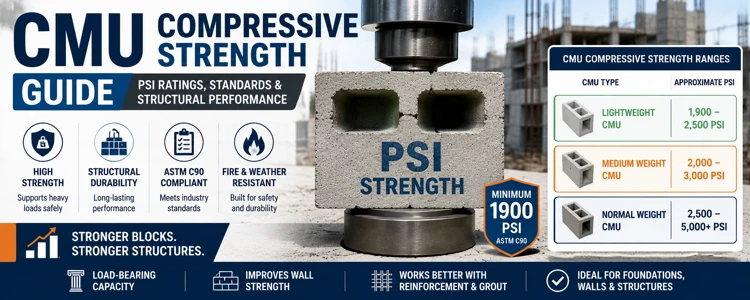
- Minimum net compressive strength → 1,900 PSI
Many commercial CMU blocks exceed these minimum values depending on:
- Aggregate type
- Density
- Manufacturing quality
- Curing process
Common CMU Strength Ranges
Approximate compressive strength ranges:
| CMU Type | Approximate PSI |
|---|---|
| Lightweight CMU | 1,900–2,500 PSI |
| Medium Weight CMU | 2,000–3,000 PSI |
| Normal Weight CMU | 2,500–5,000+ PSI |
Actual block strength depends on:
- Manufacturer specifications
- Concrete mix design
- Moisture content
- Block density
Why Compressive Strength Matters
Concrete block compressive strength directly affects:
- Structural safety
- Load-bearing capacity
- Building durability
- Foundation performance
Higher-strength CMU blocks are commonly used for:
- Foundations
- Retaining walls
- Commercial buildings
- Structural walls
- Industrial construction
Load-Bearing vs Non-Load-Bearing Walls
Load-Bearing CMU Walls
Load-bearing walls support:
- Roof loads
- Floor systems
- Structural framing
These walls generally require:
- Higher compressive strength
- Reinforcement steel
- Grouted cells
Non-Load-Bearing Walls
Non-load-bearing walls are primarily used for:
- Space division
- Interior partitions
- Decorative masonry
These walls may use lower-strength blocks depending on local codes.
CMU Density and Strength
Concrete block density strongly affects compressive strength.
Normal-weight blocks often provide:
- Higher structural strength
- Better durability
- Increased load capacity
You can also read:
CMU Block Density Guide8x8x16 CMU Strength
The:
8x8x16 CMU block
is one of the most commonly used structural concrete blocks.
Advantages:
- Strong load-bearing performance
- Excellent durability
- Good fire resistance
- Wide commercial use
These blocks are commonly used in:
- Foundations
- Commercial walls
- Residential structures
- Retaining walls
You can also learn more in:
8x8x16 CMU Block DimensionsCMU Reinforcement and Structural Performance
Concrete block walls often include:
- Vertical rebar
- Horizontal reinforcement
- Grout filling
Reinforcement significantly improves:
- Structural stability
- Crack resistance
- Wind resistance
- Seismic performance
You can estimate reinforcement using the:
Rebar CalculatorFire Resistance and Strength
Concrete masonry walls often provide both:
- High compressive strength
- Excellent fire resistance
This makes CMU construction highly suitable for:
- Schools
- Warehouses
- Industrial buildings
- Apartment complexes
You can also read:
CMU Fire Rating GuideCommon Applications of High-Strength CMU Blocks
High-strength concrete blocks are commonly used for:
- Retaining walls
- Foundations
- Commercial buildings
- Industrial structures
- Structural masonry systems
These applications require:
- Reliable structural performance
- Long-term durability
- High load resistance
How to Choose the Right CMU Strength
Choosing the correct CMU strength depends on:
- Structural loads
- Wall height
- Building type
- Local codes
- Environmental conditions
General recommendations:
- Residential walls → standard load-bearing CMU
- Commercial projects → higher-strength CMU
- Heavy-load applications → reinforced structural blocks
Consulting a structural engineer is recommended for major structural projects.
Use a CMU Block Calculator
Before starting masonry construction, it is important to estimate:
- Block quantities
- Mortar requirements
- Material costs
- Wall dimensions
Our:
CMU Block Calculatorhelps estimate:
- Concrete block quantities
- Mortar requirements
- Material costs
- Wall coverage
You can also use:
- Foundation Calculator
- Gravel Calculator
- Concrete Volume Calculator
- Mortar Calculator
for additional construction estimation.
Related Articles
- CMU Block Density Guide
- CMU Fire Rating Guide
- CMU Wall Thickness Guide
- CMU Sound Transmission Guide
- 8x8x16 CMU Block Dimensions
- CMU Block Weight Guide
Final Thoughts
CMU compressive strength is one of the most important factors in structural masonry construction. Concrete blocks with higher PSI ratings provide better load-bearing capacity, durability, and long-term structural performance.
Understanding CMU strength ratings helps contractors, builders, and homeowners choose the correct concrete blocks for safe and reliable construction projects.