
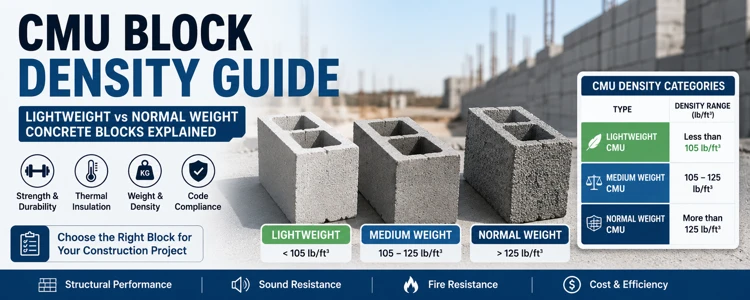
Concrete masonry units (CMU blocks) are manufactured in different densities depending on their materials, strength, and construction applications. Understanding:
CMU block density
is important for:
- Structural performance
- Wall strength
- Fire resistance
- Insulation
- Transportation weight
- Material selection
In this guide, you will learn about lightweight, medium-weight, and normal-weight CMU blocks, including density ranges, applications, advantages, and construction considerations.
What Is CMU Block Density?
CMU block density refers to:
the weight of concrete masonry units per cubic foot
Density affects:
- Block weight
- Structural strength
- Thermal insulation
- Sound resistance
- Transportation costs
Concrete blocks are generally classified into:
- Lightweight CMU blocks
- Medium-weight CMU blocks
- Normal-weight CMU blocks
CMU Density Categories
| CMU Type | Density Range |
|---|---|
| Lightweight CMU | Less than 105 lb/ft³ |
| Medium Weight CMU | 105–125 lb/ft³ |
| Normal Weight CMU | More than 125 lb/ft³ |
Different projects require different block densities depending on:
- Structural loads
- Climate conditions
- Building type
- Fire rating requirements
Lightweight CMU Blocks
Lightweight concrete blocks are manufactured using lightweight aggregates such as:
- Expanded shale
- Clay
- Pumice
- Volcanic materials
Advantages:
- Lower block weight
- Easier installation
- Better thermal insulation
- Reduced transportation costs
Common applications:
- Residential walls
- Partition walls
- Non-load-bearing structures
Medium-Weight CMU Blocks
Medium-weight concrete blocks provide a balance between:
- Strength
- Weight
- Insulation
- Durability
These blocks are commonly used for:
- Residential construction
- Commercial walls
- Structural masonry
They are one of the most versatile CMU categories used in modern construction.
Normal-Weight CMU Blocks
Normal-weight concrete blocks use dense aggregates such as:
- Crushed stone
- Gravel
- Sand
Advantages:
- Higher compressive strength
- Greater durability
- Improved structural performance
Common applications:
- Foundations
- Retaining walls
- Commercial buildings
- Structural walls
These blocks are heavier and typically increase pallet weight and transportation costs.
How CMU Density Affects Wall Performance
Concrete block density directly affects wall performance in several ways.
1. Structural Strength
Higher-density blocks generally provide:
- Better load-bearing capacity
- Improved structural stability
- Higher compressive strength
Structural masonry projects often use medium-weight or normal-weight CMU blocks.
2. Thermal Insulation
Lightweight CMU blocks often provide:
- Better thermal insulation
- Improved energy efficiency
- Reduced heat transfer
This can improve indoor comfort and reduce energy costs.
3. Sound Resistance
Dense concrete blocks typically provide:
- Better sound insulation
- Improved acoustic performance
These are commonly used in:
- Commercial buildings
- Schools
- Industrial facilities
4. Transportation and Handling
Higher-density blocks:
- Increase pallet weight
- Require more handling equipment
- Increase delivery costs
You can also read:
Cinder Block Pallet Weightfor pallet weight information.
Lightweight vs Normal-Weight CMU Blocks
| Feature | Lightweight CMU | Normal Weight CMU |
|---|---|---|
| Weight | Lower | Higher |
| Insulation | Better | Moderate |
| Structural Strength | Moderate | Higher |
| Transportation Cost | Lower | Higher |
| Installation | Easier | Heavier |
Choosing the correct block type depends on project requirements and local building codes.
CMU Block Weight and Density
Concrete block density significantly affects block weight.
For example:
- Lightweight 8x8x16 blocks → lower weight
- Normal-weight 8x8x16 blocks → higher weight
You can learn more in:
CMU Block Weight GuideCommon CMU Block Sizes
Concrete blocks are available in multiple standard sizes including:
- 4x8x16
- 6x8x16
- 8x8x16
- 12x8x16
The:
8x8x16 CMU block
is one of the most widely used concrete blocks in residential and commercial masonry construction.
You can also view:
CMU Block Sizes ChartHow to Choose the Right CMU Density
Choosing the correct CMU density depends on:
- Structural requirements
- Insulation needs
- Fire resistance
- Budget
- Transportation logistics
General recommendations:
- Lightweight → insulation-focused projects
- Medium weight → balanced construction
- Normal weight → heavy structural walls
Consulting a structural engineer is recommended for major commercial projects.
Use a CMU Block Calculator
Before starting masonry construction, it is important to estimate:
- Block quantity
- Material costs
- Mortar requirements
- Wall dimensions
Our:
CMU Block Calculatorhelps estimate:
- Concrete block quantities
- Mortar requirements
- Material costs
- Wall coverage
You can also use:
- Foundation Calculator
- Gravel Calculator
- Rebar Calculator
- Concrete Volume Calculator
for additional construction estimation.
Related Articles
- CMU Block Weight Guide
- CMU Block Sizes Chart
- Cinder Block Pallet Weight
- CMU Wall Thickness Guide
- 8x8x16 CMU Block Dimensions
- How Many CMU Blocks Per Pallet?
Final Thoughts
CMU block density plays an important role in masonry construction performance, structural strength, insulation, and transportation weight. Lightweight, medium-weight, and normal-weight concrete blocks each offer different advantages depending on the construction application.
Choosing the correct CMU density helps improve wall performance, energy efficiency, and long-term construction durability.