
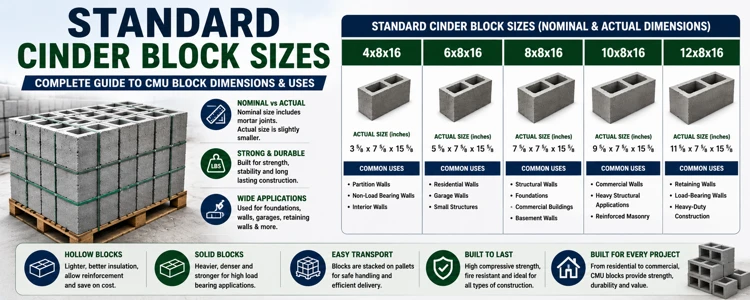
Standard cinder block sizes in the United States commonly include an 8 × 8 × 16-inch nominal concrete masonry unit (CMU). Its typical specified dimensions are 7 5/8 × 7 5/8 × 15 5/8 inches. Other common full-size units have 4-, 6-, 10-, and 12-inch nominal widths. Use the chart below to compare them before planning a wall or ordering blocks.
Standard concrete block sizes (quick chart)
Dimensions below are listed as width × height × length. The chart shows typical standard units; a manufacturer may offer different lengths, heights, textures, or special shapes. Millimeter values are rounded conversions of the typical specified dimensions.
| Nominal size (in.) | Typical specified size (in.) | Typical specified size (mm) | Nominal face coverage |
|---|---|---|---|
| 4 × 8 × 16 | 3 5/8 × 7 5/8 × 15 5/8 | 92 × 194 × 397 | About 0.89 sq. ft. |
| 6 × 8 × 16 | 5 5/8 × 7 5/8 × 15 5/8 | 143 × 194 × 397 | About 0.89 sq. ft. |
| 8 × 8 × 16 | 7 5/8 × 7 5/8 × 15 5/8 | 194 × 194 × 397 | About 0.89 sq. ft. |
| 10 × 8 × 16 | 9 5/8 × 7 5/8 × 15 5/8 | 244 × 194 × 397 | About 0.89 sq. ft. |
| 12 × 8 × 16 | 11 5/8 × 7 5/8 × 15 5/8 | 295 × 194 × 397 | About 0.89 sq. ft. |
All five sizes use a common nominal face of 8 inches high by 16 inches long, so each covers about 0.89 square feet of wall face when laid with typical joints. That is approximately 1.125 full units per square foot. The first number changes the unit width and nominal thickness of a single-wythe wall. Nominal 14- and 16-inch units are also made for some markets, but availability varies by producer. For details on the most common unit, see our 8 × 8 × 16 CMU dimensions guide.
Nominal, specified, and actual block dimensions
These three terms describe different measurements:
- Nominal size is the whole-number module used for wall layout. It includes room for a typical mortar joint.
- Specified size is the dimension used to specify the manufactured unit. A common 8 × 8 × 16-inch nominal CMU is typically specified at 7 5/8 × 7 5/8 × 15 5/8 inches.
- Actual size is what you measure on the delivered block. It can vary slightly from the specified dimension within the applicable product tolerance.
The usual 3/8-inch difference lets a block and its mortar joint fit the nominal module. For example, a 15 5/8-inch specified length plus a 3/8-inch joint occupies a 16-inch planning space. “Actual” and “specified” are sometimes used loosely in product listings, so check the manufacturer’s data sheet when a precise fit matters. Decorative split-face or slump units can have different dimensions on their textured faces.
What are common concrete block sizes used for?
The width in a size such as 8 × 8 × 16 refers to the unit’s nominal thickness. Common uses vary by design and local availability:
- 4-inch units: thinner walls, partitions, and applications where the plans specify a narrow masonry unit.
- 6-inch units: walls requiring a nominal thickness between common 4- and 8-inch units.
- 8-inch units: a widely used general-purpose CMU size for residential and commercial masonry.
- 10- and 12-inch units: thicker wall sections where the project plans call for those dimensions.
These are size examples, not structural recommendations. A wider block does not by itself establish a wall’s strength or suitability. Loads, wall height, reinforcement, grout, connections, soil, fire requirements, and local codes all matter. Follow the project drawings and have a qualified professional determine structural requirements. For the difference between nominal block width and finished wall thickness, read the CMU wall thickness guide.
How to estimate concrete blocks for a wall
A standard 8 × 16-inch nominal face covers 128 square inches, or about 0.89 square feet. A quick area estimate is:
Blocks needed ≈ net wall area in square feet × 1.125
Example: a 10-foot-high by 20-foot-long wall has 200 square feet of gross face area. At 1.125 blocks per square foot, that is about 225 full-size blocks before deductions or waste. If the wall has a 3 × 7-foot door and a 3 × 4-foot window, subtract their combined 33 square feet first: 167 × 1.125 is about 188 blocks before cuts or waste.
This is a surface-area estimate, not a final takeoff. Corners, bond patterns, half units, lintels, bond-beam courses, openings, cuts, breakage, and the exact product can change the order quantity. Enter your wall dimensions in our CMU block calculator for a project estimate, and use the concrete blocks per pallet guide when checking delivery quantities.
Half blocks and other CMU shapes
The chart covers common full-length stretcher units. Masonry suppliers also carry half-length and half-height blocks, corner and jamb units, bond-beam units, lintels, open-end units, caps, and decorative shapes. These help handle wall ends, corners, openings, reinforced courses, or finished edges. Their dimensions and availability depend on the unit style and producer, so include the right shapes in the takeoff instead of counting every piece as a standard stretcher block.
What to check before ordering
- Confirm whether the listing gives nominal, specified, or measured dimensions.
- Verify the unit’s width, height, length, shape, and finish with the local supplier.
- Check the wall drawings for special units, reinforcement, grout, and joint details.
- Account for openings, cuts, breakage, and the selected bond pattern in the final quantity.
Block weight cannot be determined from nominal size alone. Aggregate, density, and whether a unit is hollow or solid all affect its weight. Compare product examples in our CMU block weight guide.
Frequently asked questions
What is the standard size of a cinder block?
The most commonly referenced US CMU is 8 × 8 × 16 inches nominal. Its typical specified size is 7 5/8 × 7 5/8 × 15 5/8 inches. Other common nominal widths include 4, 6, 10, and 12 inches.
How thick is a standard cinder block?
An 8-inch nominal block is typically 7 5/8 inches thick across its width. Common alternatives are 4, 6, 10, and 12 inches nominal; their typical specified widths are 3 5/8, 5 5/8, 9 5/8, and 11 5/8 inches. Finished wall depth can be greater after finishes or cavities; see our CMU wall thickness guide.
What are the actual dimensions of an 8 × 8 × 16 cinder block?
The nominal size is 8 × 8 × 16 inches; a common specified unit is 7 5/8 × 7 5/8 × 15 5/8 inches. A measured block may vary within the applicable product tolerance, so check the manufacturer’s data when precise fit matters. Compare more unit sizes in our CMU block sizes chart.
How many concrete blocks cover one square foot?
For a standard 8 × 16-inch nominal face, use about 1.125 blocks per square foot, or about 0.89 square feet of wall face per block. Openings, cuts, and special units affect the final count.
Are cinder blocks and concrete blocks the same size?
People often use “cinder block” informally for a concrete masonry unit. Size depends on the specific CMU, not the name someone uses. Learn more in our guide to what a CMU block is.