Estimating the correct amount of mortar for CMU blocks is an important part of every masonry construction project. Whether you are building a foundation wall, retaining wall, garage, partition wall, or commercial structure, accurate mortar estimation helps reduce waste, control costs, and improve project planning.
In this guide, you will learn how to calculate mortar for CMU blocks, how many mortar bags are needed, the difference between 60 lb and 80 lb bags, and the factors that affect mortar usage.
What Is Mortar?
Mortar is a mixture of:
- Cement
- Sand
- Water
- Lime (sometimes)
It is used to bond CMU blocks together and create strong masonry walls.
Mortar helps:
- Hold blocks in place
- Improve wall strength
- Seal gaps between blocks
- Increase durability
How Much Mortar Do I Need for CMU Blocks?
The amount of mortar required depends on:
- Wall size
- Block size
- Mortar joint thickness
- Masonry pattern
- Construction waste
For standard:
8x8x16 CMU blocks
a common estimate is:
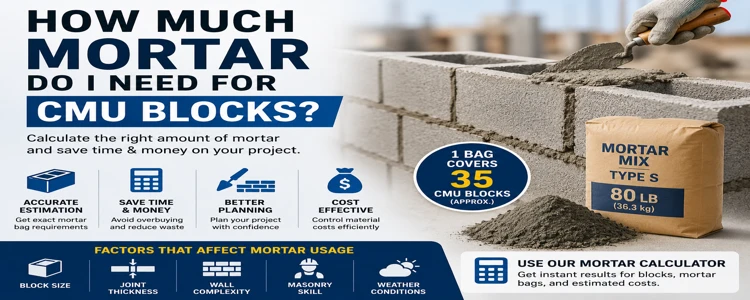
One 80 lb mortar bag covers approximately 35 CMU blocks
Basic Mortar Estimation Formula
The general formula is:
Total Blocks ÷ Coverage Per Mortar Bag
Example:
210 blocks ÷ 35 = 6 bagsEstimated mortar needed:
6 mortar bags
Mortar Bags for Common Wall Sizes
| Wall Size | Approximate Blocks | Mortar Bags Needed |
|---|---|---|
| 100 sq ft | 113 blocks | 4 bags |
| 200 sq ft | 225 blocks | 7 bags |
| 300 sq ft | 338 blocks | 10 bags |
| 500 sq ft | 563 blocks | 17 bags |
These estimates may vary depending on mortar joint thickness and construction methods.
60 lb vs 80 lb Mortar Bags
Mortar bags are commonly sold in:
- 60 lb bags
- 80 lb bags
80 lb Mortar Bags
Most commonly used for CMU walls
Advantages:
- Better coverage
- Fewer bags required
- Preferred by contractors
Coverage:
Around 35 CMU blocks per bag
60 lb Mortar Bags
Smaller and lighter bags are easier to carry but provide less coverage.
Coverage:
Around 25–27 CMU blocks per bag
Mortar Joint Thickness
Standard mortar joints are usually:
3/8 inch thick
Thicker joints require:
- More mortar
- Higher material cost
Consistent mortar joints improve wall appearance and structural performance.
Factors That Affect Mortar Usage
Several factors can increase or decrease mortar requirements.
Block Size
Larger blocks may require more mortar depending on joint design.
Wall Complexity
Walls containing:
- Corners
- Openings
- Decorative patterns
- Reinforcement
usually require additional mortar.
Masonry Skill Level
Experienced masons typically waste less mortar during installation.
Weather Conditions
Hot weather may cause mortar to dry faster, increasing material usage.
Mortar Cost Estimate
Mortar bag prices vary by:
- Brand
- Region
- Bag size
- Material type
Typical prices:
- 60 lb bag → $8–$12
- 80 lb bag → $10–$18
Example Mortar Cost Calculation
Suppose:
- 7 mortar bags required
- Price per bag = $14
Calculation:
7 × $14 = $98Estimated mortar cost:
$98
How to Reduce Mortar Waste
You can reduce material waste by:
- Mixing proper mortar quantities
- Using consistent joints
- Storing bags properly
- Avoiding overmixing
- Hiring experienced masons
Accurate planning saves money and improves efficiency.
Mortar Types for CMU Construction
Common mortar types include:
- Type M
- Type S
- Type N
Type M Mortar
Used for:
- Foundations
- Heavy loads
- Retaining walls
Provides high compressive strength.
Type S Mortar
Very common for:
- Structural walls
- Exterior masonry
- CMU block walls
Offers strong bonding and durability.
Type N Mortar
Commonly used for:
- Interior walls
- Light-duty construction
- Non-load-bearing applications
Why Accurate Mortar Estimation Matters
Correct mortar estimation helps:
- Reduce project costs
- Prevent shortages
- Improve scheduling
- Minimize waste
- Increase construction efficiency
Professional contractors always estimate mortar carefully before starting masonry work.
Use a Mortar Calculator
Manual calculations can take time and may cause mistakes.
Our online Mortar Calculator helps you:
- Estimate mortar bags instantly
- Calculate block quantities
- Estimate masonry costs
- Support different block sizes
- Add waste percentage
Using a calculator improves accuracy and project planning.
Final Thoughts
Knowing how much mortar you need for CMU blocks is essential for successful masonry construction. Mortar requirements depend on wall size, block quantity, joint thickness, and bag size.
Using accurate calculations helps reduce waste, save money, and improve construction efficiency. For faster results, use our online CMU Block Calculator and Mortar Calculator to estimate blocks, mortar bags, and masonry costs instantly.