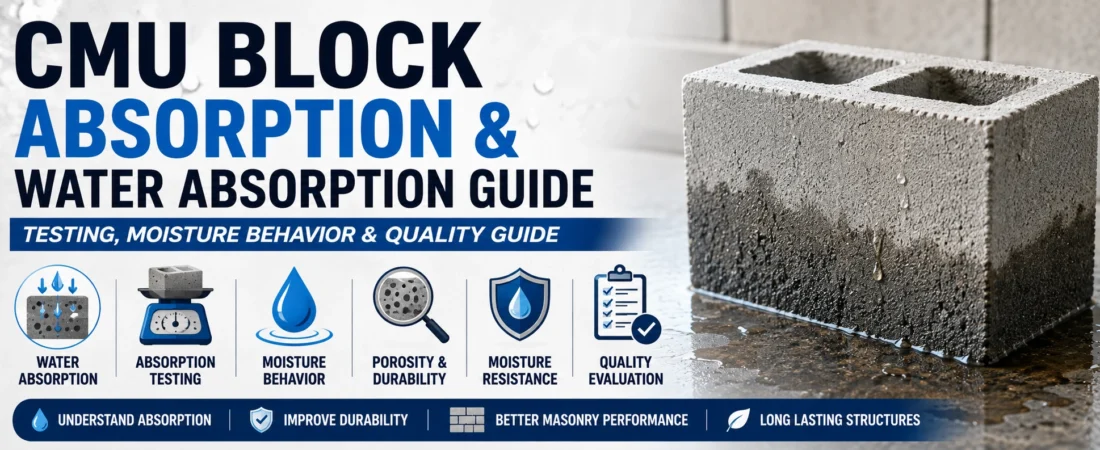
Concrete Masonry Units (CMUs) are porous concrete products, so they can absorb and transmit water to some degree. Understanding CMU block absorption and water absorption is important when evaluating masonry quality, durability, moisture resistance, and suitability for different building applications.
Water absorption is not simply a measure of whether a block is “good” or “bad.” It is one of several properties that should be considered along with density, compressive strength, durability, workmanship, and the overall wall design.
This guide explains what CMU absorption means, how it is measured, what affects absorption, and why water absorption matters in masonry construction.
What Is CMU Water Absorption?
CMU water absorption refers to the amount of water a concrete masonry unit can absorb when exposed to water under specified testing conditions.
Because concrete masonry contains pores and capillaries, water can enter the material when the block is exposed to moisture.
Absorption is commonly expressed as a percentage of the dry mass of the masonry unit.
A simplified calculation is:
Water Absorption (%) = [(Saturated Mass − Dry Mass) ÷ Dry Mass] × 100
Where:
- Dry Mass = weight of the dry CMU
- Saturated Mass = weight of the CMU after the specified saturation procedure
The actual laboratory test procedure and acceptance requirements depend on the applicable standard and type of masonry unit.
Why Is CMU Absorption Important?
Water absorption can affect several aspects of masonry performance.
Understanding absorption helps with:
- Evaluating masonry units
- Comparing different CMU products
- Assessing moisture behavior
- Understanding durability
- Selecting appropriate masonry systems
- Evaluating material quality
- Planning moisture control
- Understanding wall drying behavior
However, absorption should not be considered by itself.
A wall’s moisture performance also depends on:
- Block properties
- Mortar
- Grout
- Mortar joints
- Flashing
- Drainage
- Sealants
- Coatings
- Wall orientation
- Exposure conditions
- Workmanship
CMU Absorption vs Water Absorption
The terms CMU absorption, water absorption, and concrete block absorption are often used to describe the same general property.
In technical applications, however, the exact meaning depends on the test method being used.
For example, a laboratory test may specify:
- How the unit is dried
- How it is saturated
- Water temperature
- Saturation duration
- Mass measurement
- Calculation procedure
Therefore, absorption values should always be compared using the same test method and applicable standard.
How Is CMU Water Absorption Measured?
A basic absorption test involves comparing the mass of a dry masonry unit with its mass after it has absorbed water under specified conditions.
The general process is:
Step 1: Dry the CMU
The unit is dried under controlled conditions until the required dry condition is reached.
Step 2: Measure Dry Mass
The dry unit is weighed and its mass is recorded.
Step 3: Saturate the Unit
The CMU is exposed to water according to the applicable test procedure.
Step 4: Measure Saturated Mass
After the specified saturation process, the unit is weighed again.
Step 5: Calculate Absorption
The difference between saturated and dry mass represents the amount of water absorbed under the test conditions.
The result is normally reported as a percentage.
Example of CMU Absorption Calculation
Suppose a dry CMU weighs:
30 kg
After the specified saturation procedure, the unit weighs:
33 kg
The absorbed water is:
33 − 30 = 3 kg
The absorption percentage is:
3 ÷ 30 × 100 = 10%
Therefore, the calculated absorption is 10% under the assumed test conditions.
This example is only for understanding the calculation. Actual testing should follow the applicable masonry standard and laboratory procedure.
What Factors Affect CMU Water Absorption?
Several characteristics can influence how much water a CMU can absorb.
1. Concrete Density
Density has an important relationship with pore structure.
Higher-density units may have different absorption characteristics from lightweight or lower-density units.
2. Aggregate Type
The type of aggregate used in manufacturing can influence the physical properties of the finished CMU.
Different aggregates can produce different densities, pore structures, and absorption characteristics.
3. Mix Design
The proportions of cementitious material, aggregates, water, and other components influence the resulting concrete structure.
4. Compaction
Manufacturing compaction affects the internal structure of the block.
Poor or inconsistent compaction can create additional voids and affect absorption.
5. Curing
Curing affects the development of the cementitious matrix and therefore can influence the final properties of the masonry unit.
6. Manufacturing Process
Production equipment, vibration, mold filling, compaction, and material consistency can all influence the finished unit.
For more information about the manufacturing process, see our:
CMU manufacturing methods can influence density, pore structure, strength, and other block properties. Learn more about the production process in our CMU Block Production Guide.
Does Higher CMU Absorption Mean Lower Quality?
Not necessarily.
A higher absorption value does not automatically mean that a CMU is unsuitable for construction.
The appropriate absorption requirement depends on factors such as:
- Unit classification
- Density
- Intended application
- Applicable standard
- Project requirements
- Exposure conditions
A CMU should therefore be evaluated against the requirements that apply to that specific product and application.
CMU Absorption and Density
Absorption and density are related properties, but they are not the same thing.
Density describes the mass of a unit relative to its volume.
Absorption describes how much water the unit takes up under specified test conditions.
Both properties can provide useful information about a masonry unit.
For example, two CMUs can have different densities and different absorption characteristics while still meeting their respective requirements.
CMU Absorption and Moisture Resistance
Absorption is also different from the overall moisture resistance of a masonry wall.
A block may absorb some water without the completed wall experiencing unacceptable moisture penetration.
The overall wall system can include:
- CMU
- Mortar
- Grout
- Flashing
- Weep holes
- Sealants
- Drainage cavities
- Coatings
- Waterproofing systems
For a broader discussion of masonry moisture behavior, see our:
CMU absorption is only one part of overall moisture performance. Learn more about water resistance and moisture-related considerations in our CMU Moisture Resistance Guide.
Why Porosity Matters in CMU
Concrete masonry contains a network of pores.
When water comes into contact with the surface, some of it can enter these pores through absorption and capillary action.
The size, distribution, and connectivity of pores can influence:
- Water movement
- Drying
- Absorption
- Moisture storage
- Durability
This is why manufacturing consistency is important when producing concrete masonry units.
CMU Absorption and Efflorescence
Water movement through masonry can also be associated with efflorescence.
When moisture moves through a masonry unit, it can transport soluble salts toward the surface. When the water evaporates, salts may remain behind as visible deposits.
For more information about this specific problem, see our:
Moisture movement can contribute to white salt deposits appearing on masonry surfaces. Learn more about the causes, prevention, and cleaning of efflorescence in our CMU Block Efflorescence Guide.
Does CMU Absorb Rainwater?
Yes, CMU can absorb some rainwater because concrete masonry is generally porous.
However, the amount of water absorbed depends on:
- Type of CMU
- Surface condition
- Exposure
- Rain intensity
- Duration of exposure
- Pore structure
- Surface treatments
- Wall design
Proper masonry design uses drainage and moisture-management strategies to control water rather than relying solely on the block itself to prevent moisture entry.
CMU Water Absorption and Wall Drainage
A masonry wall exposed to rain needs a way to manage water.
Important components may include:
- Flashing
- Weep holes
- Drainage paths
- Properly tooled mortar joints
- Sealants
- Appropriate wall detailing
Keeping drainage paths clear is important because trapped water can create long-term moisture problems.
For more information, see our:
Proper drainage helps manage water that reaches a masonry wall. Learn more about flashing, weep holes, drainage paths, and moisture control in our CMU Wall Drainage Guide.
CMU Absorption Testing
Absorption testing provides a way to quantify how much water a CMU takes up under specified test conditions.
A proper test should be performed using the applicable testing procedure rather than simply soaking a block in water and comparing its weight.
The testing process generally involves:
- Preparing the specimen
- Determining its dry mass
- Exposing it to water under specified conditions
- Determining its saturated mass
- Calculating the difference
- Reporting the absorption result
The exact testing procedure should follow the applicable standard for the masonry unit being evaluated.
Dry Mass and Saturated Mass
Two important measurements in an absorption calculation are the dry mass and saturated mass.
Dry Mass
The dry mass is the weight of the CMU after it has been dried according to the applicable testing procedure.
Saturated Mass
The saturated mass is the weight of the CMU after it has absorbed water according to the specified saturation procedure.
The difference between these two measurements represents the amount of water absorbed during the test.
CMU Absorption Calculation
The basic absorption calculation can be expressed as:
Absorption (%) = [(Saturated Mass − Dry Mass) ÷ Dry Mass] × 100
For example, if a CMU has:
- Dry mass = 25 kg
- Saturated mass = 27 kg
Then:
- Absorbed water = 27 − 25 = 2 kg
- Absorption = 2 ÷ 25 × 100
- Absorption = 8%
The result represents the absorption under the particular test conditions used.
Absorption vs Permeability
Absorption and permeability are related to water behavior, but they are not the same property.
Absorption
Absorption describes how much water a material takes up under specified conditions.
Permeability
Permeability relates to how readily water can move through a material or system.
A CMU can absorb water without allowing water to freely pass completely through the wall.
This distinction is important when evaluating masonry moisture performance.
Absorption vs Water Penetration
A common misunderstanding is that if a CMU absorbs water, water must immediately pass through the entire block.
That is not necessarily the case.
Water can enter the pores near the surface and remain within the masonry.
Whether water eventually reaches the opposite side depends on factors such as:
- Moisture exposure
- Pore structure
- Wall thickness
- Pressure
- Cracks
- Mortar joints
- Wall design
- Drainage
- Surface treatments
Therefore, absorption alone should not be used to predict water leakage through an entire masonry wall.
Lightweight vs Normal-Weight CMU
CMUs can be manufactured using different aggregate types and densities.
The resulting units can have different physical characteristics, including:
- Density
- Weight
- Absorption
- Thermal properties
- Strength
- Texture
Because of these differences, absorption values should always be evaluated according to the specific type and classification of CMU.
A direct comparison between different types of masonry units may not be meaningful unless they are being evaluated under the same applicable requirements.
How Manufacturing Affects CMU Absorption
The manufacturing process can have a significant effect on the internal structure of a CMU.
Important factors include:
Mix Proportions
Changes in cementitious materials, aggregates, and water can affect the resulting concrete matrix.
Aggregate Characteristics
Aggregate type, grading, and moisture condition can influence the structure of the finished unit.
Compaction
Proper compaction helps produce consistent units.
Poor or inconsistent compaction can create unwanted voids or variations between blocks.
Vibration
Vibration helps distribute and consolidate the material during production.
Inconsistent vibration can contribute to variations in block density and internal structure.
Curing
Proper curing allows the cementitious materials to develop their intended properties.
For more information about curing, see our:
Proper curing plays an important role in the development of CMU properties. Learn more about curing methods, conditions, and the curing process in our CMU Block Curing Process Guide.
CMU Absorption and Block Quality
Absorption should be considered together with other important CMU properties.
Quality evaluation may include:
- Compressive strength
- Density
- Dimensions
- Absorption
- Surface condition
- Durability
- Appearance
- Manufacturing consistency
A single property does not provide a complete picture of masonry quality.
Can High Absorption Cause Problems?
High or uncontrolled moisture uptake can contribute to problems in certain situations.
Potential concerns include:
- Increased moisture storage
- Longer drying time
- Efflorescence
- Staining
- Freeze-thaw concerns in applicable climates
- Interior moisture problems when wall detailing is inadequate
However, the significance of absorption depends on the product, exposure, climate, wall construction, and applicable requirements.
CMU Absorption and Freeze-Thaw Conditions
In climates where freezing temperatures occur, moisture inside masonry can become particularly important.
Water that enters porous materials can freeze when temperatures fall below freezing.
Repeated freezing and thawing can place stress on materials.
For masonry exposed to severe environmental conditions, the appropriate CMU type and durability requirements should be considered during design and product selection.
Does Sealing CMU Stop Water Absorption?
A suitable masonry sealer can reduce water penetration at the surface, but it does not necessarily make a CMU completely impermeable.
The performance of a sealer depends on:
- Product type
- Surface preparation
- Application method
- Coverage
- Surface condition
- Product compatibility
- Exposure
A coating or sealer should therefore be selected for the intended masonry application rather than simply chosen because it claims to “waterproof” concrete.
CMU Absorption and Mortar
The moisture condition of CMU can also affect masonry construction.
Very dry masonry units can interact differently with mortar than units containing significant surface moisture.
Construction practices should account for:
- Weather
- Unit moisture condition
- Mortar consistency
- Mortar workability
- Masonry workmanship
The objective is to produce properly bonded masonry rather than simply minimizing the absorption of the block.
CMU Absorption During Storage
Storage conditions can affect the moisture condition of CMU before installation.
Blocks should be protected from unnecessary contamination and excessive exposure when appropriate.
During storage, consider:
- Ground contact
- Rain exposure
- Standing water
- Drainage
- Covering
- Air circulation
- Handling
Blocks that have become significantly wet may require appropriate consideration before installation depending on project conditions.
CMU Water Absorption Testing Checklist
When evaluating CMU absorption testing, record:
✓ CMU type
✓ Unit classification
✓ Sample identification
✓ Number of specimens
✓ Dry mass
✓ Saturated mass
✓ Test conditions
✓ Test method
✓ Absorption result
✓ Testing date
✓ Laboratory or testing personnel
✓ Applicable acceptance requirements
Keeping complete records makes it easier to compare results between production batches.
Common CMU Absorption Mistakes
Mistake 1: Treating Absorption as a Strength Test
Absorption and compressive strength are different properties.
One should not be used as a substitute for the other.
Mistake 2: Comparing Different Test Methods
Absorption results obtained using different procedures may not be directly comparable.
Mistake 3: Assuming All CMUs Have the Same Absorption
Different unit types, densities, materials, and manufacturing processes can produce different results.
Mistake 4: Assuming Absorption Means Leakage
A CMU can absorb water without water immediately passing through the entire wall.
Mistake 5: Ignoring Wall Drainage
Good masonry moisture management requires proper wall detailing in addition to suitable block properties.
Mistake 6: Focusing Only on the Block
Mortar joints, flashing, openings, sealants, and other wall components can all influence moisture performance.
How to Reduce Moisture Problems in CMU Walls
Good moisture management can include:
- Proper flashing
- Functional weep holes
- Clear drainage paths
- Properly constructed mortar joints
- Appropriate sealants
- Suitable coatings where required
- Proper detailing around openings
- Correct wall construction
- Regular inspection
For broader moisture-related guidance, see our:
Water management involves more than the absorption characteristics of individual blocks. Learn more about moisture control, water resistance, and masonry wall performance in our CMU Moisture Resistance Guide.
Final CMU Absorption Checklist
Before evaluating CMU absorption, make sure you know:
✓ What type of CMU is being tested
✓ Which standard applies
✓ Which test procedure is being used
✓ Dry mass
✓ Saturated mass
✓ Calculated absorption
✓ Density classification
✓ Strength requirements
✓ Exposure conditions
✓ Project requirements
✓ Wall moisture-control strategy
This provides a much more useful evaluation than looking at an absorption percentage alone.
Frequently Asked Questions
What does CMU absorption mean?
CMU absorption describes the amount of water a concrete masonry unit takes up under specified test conditions.
How is CMU absorption calculated?
It is generally calculated by comparing the saturated mass with the dry mass and expressing the absorbed water as a percentage of the dry mass.
Does higher absorption always mean a bad CMU?
No. The acceptable absorption depends on the type of unit, applicable requirements, intended use, and exposure conditions.
Is CMU absorption the same as permeability?
No. Absorption describes water uptake, while permeability relates to the movement of water through a material or system.
Can CMU absorb rainwater?
Yes. Concrete masonry is porous and can absorb some water when exposed to rain or other moisture.
Does sealing CMU eliminate absorption?
A suitable sealer can reduce water penetration, but it does not necessarily make the masonry completely impermeable.
Why is absorption important in masonry construction?
It helps characterize the moisture-related behavior of the masonry unit and can be considered alongside strength, density, durability, and overall wall design.